

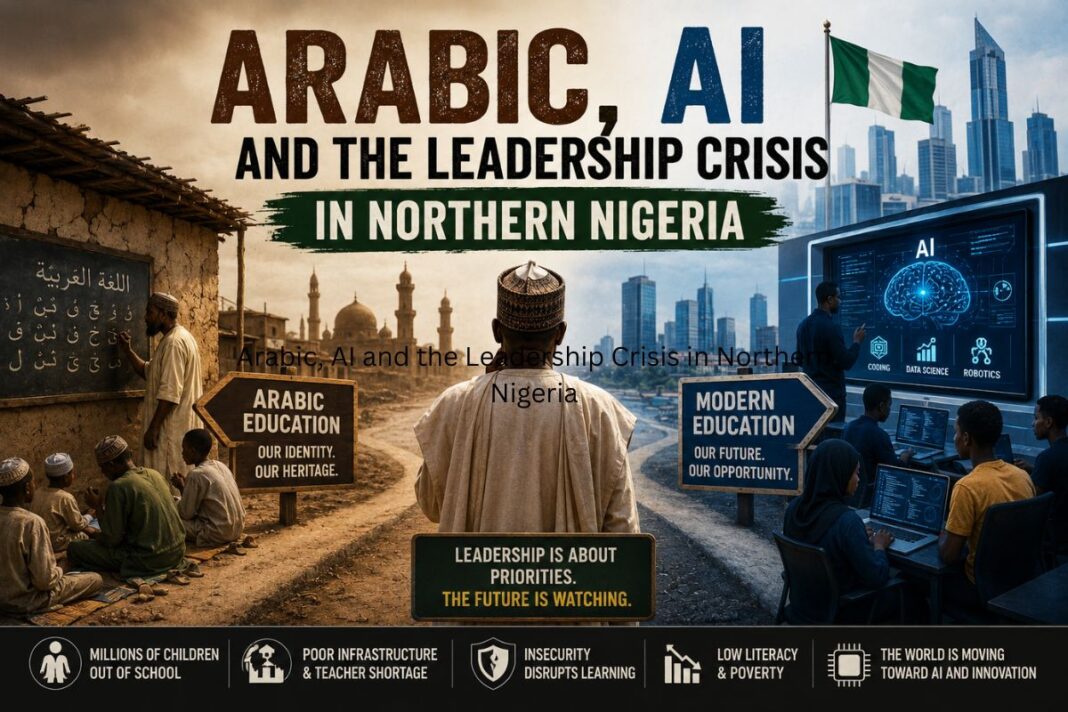

Governor Bala Mohammed’s recent advocacy for the inclusion of Arabic in Nigeria’s education curriculum has once again sparked a debate about priorities in a region already battling some of the worst educational indices in the country.
The controversy is not necessarily about Arabic itself. Arabic is a respected global language spoken by hundreds of millions of people and remains important for religious, cultural and diplomatic purposes. The real question is whether promoting Arabic should rank among the most urgent educational priorities for Northern Nigeria at a time when the region is struggling with mass illiteracy, millions of out-of-school children, poor school infrastructure, teacher shortages, insecurity, and a rapidly changing global economy driven by technology and artificial intelligence.
Before advocating a nationwide policy, many Nigerians would naturally ask a simple question: has Bauchi State, under Governor Bala Mohammed, successfully implemented such a programme within its own educational system since he assumed office? If the policy has been implemented, what measurable educational benefits has it produced? If it has not, why should it become a national priority?
You may also like;
- When the Mob Becomes Judge, Jury and Executioner
- Miva University Graduates 1,280 Students, Proving Online Degrees Work in Nigeria
- When Kings Choose Sides: The Dangerous Politicisation of Traditional Thrones
- The Collapse of the Naira and the Poverty of Nigerians
These are legitimate questions because leadership is often judged not by speeches but by results.
The modern world is undergoing a technological revolution. Countries are investing heavily in artificial intelligence, robotics, coding, data science, biotechnology and digital innovation. Nations that fail to prepare their young people for this future risk becoming consumers rather than creators of technology.
While countries in Asia and other parts of the world are equipping children with digital skills from an early age, many schools across Northern Nigeria still lack basic classrooms, functional laboratories, internet access and qualified teachers. In some communities, children sit under trees to receive lessons. In others, schools have been shut down because of insecurity.
Against this backdrop, it is difficult for many Nigerians to understand why a political leader would consider the introduction of Arabic into the curriculum a pressing national issue.
The statistics are troubling. Northern Nigeria accounts for the overwhelming majority of Nigeria’s out-of-school children. Female literacy rates in several northern states remain among the lowest in the country. Poverty levels are high, and educational attainment continues to lag behind national averages.
These problems did not emerge overnight. They are the product of decades of poor leadership, misplaced priorities and political calculations that often place sentiment above development.
This is perhaps the greatest tragedy of Northern Nigeria. The region is not lacking in human resources. It is blessed with vast land, a large population, abundant cultural heritage and immense economic potential. Yet it continues to trail behind in many indicators of human development.
The uncomfortable truth is that too many northern leaders have historically focused on preserving old political structures rather than transforming society through education and innovation.
The result is evident everywhere. A region that once produced some of Nigeria’s most respected intellectuals now struggles with alarming literacy rates. A region that should be leading agricultural and industrial development is battling poverty on a massive scale. A region that should be producing software developers, engineers, scientists and innovators is still debating issues that much of the world settled generations ago.
This is not an attack on culture, religion or language. Every society has a right to preserve its identity. Arabic has its place in religious education and scholarship. But governance requires prioritisation.
When a house is on fire, one does not begin by repainting the walls.
Northern Nigeria today faces an educational emergency. Millions of children remain outside the classroom. Thousands of schools lack basic facilities. Teachers are poorly trained and poorly motivated. Universities struggle with funding challenges. Technical and vocational education remains weak.
These are the issues demanding urgent attention.
Imagine the impact if northern governors collectively championed coding academies, science laboratories, digital literacy centres and AI training programmes. Imagine if every child in the region had access to quality primary education. Imagine if state governments competed to produce the highest number of engineers, doctors, software developers and researchers.
Such initiatives would not merely improve educational outcomes; they would transform the economic future of the region.
Unfortunately, discussions around education in Northern Nigeria often become entangled with politics, religion and identity. The consequence is that debates about progress are replaced by debates about symbolism.
This is one reason many critics argue that Northern Nigeria suffers from a shortage of visionary leadership.
A visionary leader looks beyond the next election cycle. A visionary leader studies global trends and prepares his people for the future. A visionary leader understands that the greatest resource of any society is not oil, land or minerals but human capital.
The countries dominating the twenty-first century are not doing so because they possess superior religious credentials. They are succeeding because they invested heavily in education, research, innovation and technology.
Northern Nigeria cannot afford to be left behind.
The region’s young population should be its greatest advantage. Instead, it risks becoming its greatest challenge if millions of young people remain uneducated and unemployable. Needless to say, most of the recruits into banditry and terrorism are the teeming young population across the land.
The question therefore is not whether Arabic should be taught. The question is whether it deserves to be prioritised above the urgent educational deficiencies already threatening the future of millions of northern children.
Leadership is ultimately about solving problems. The most pressing problem facing Northern Nigeria today is not a shortage of Arabic instruction. It is a shortage of quality education, economic opportunity and future-ready skills.
Until northern leaders confront these realities with courage and seriousness, the region may continue to lag behind while the rest of the world races toward an AI-driven future.
And that, more than anything else, is the real tragedy.