

Traditional rulers and religious leaders occupy a unique place in society. They are custodians of culture, symbols of unity, and moral voices whose influence often extends beyond political boundaries. Their words carry weight, their actions send powerful messages, and their endorsements can shape public perception. This is precisely why they must exercise extreme caution when dealing with partisan politics.
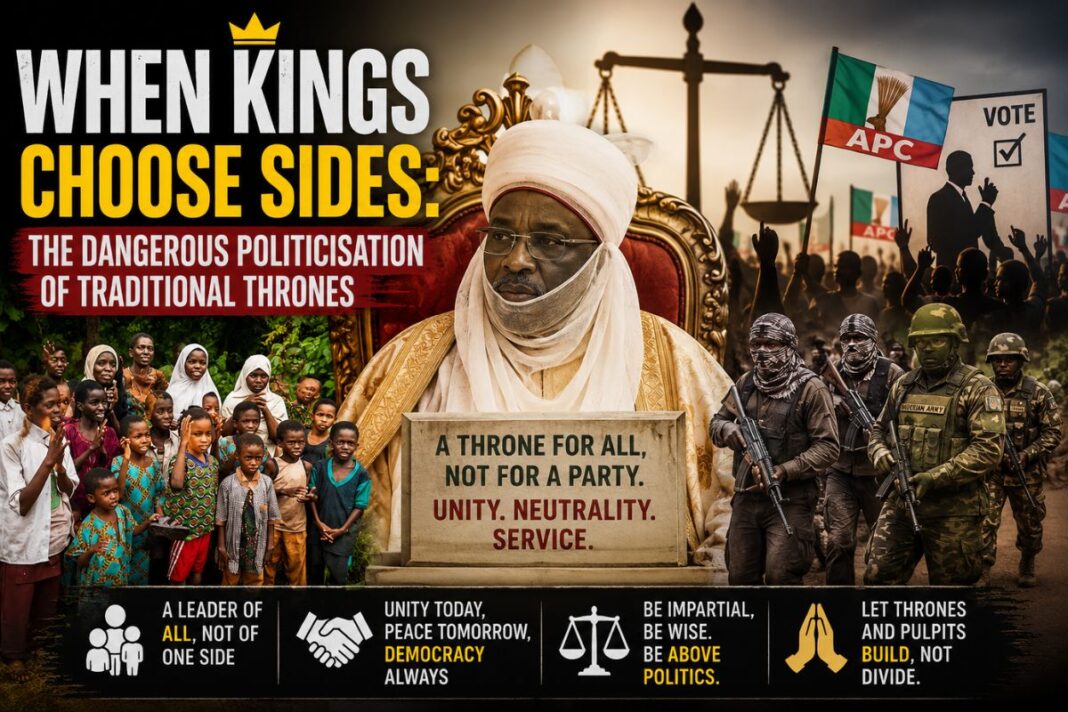
The reported endorsement of candidates of the All Progressives Congress (APC) by the Emir of Ilorin, Dr. Ibrahim Sulu-Gambari, has once again ignited an important conversation about the role of traditional institutions in Nigeria’s democracy. While the Emir reportedly based his support on the leadership and reputation of Governor AbdulRahman AbdulRazaq, the implications of such a public blessing cannot be ignored.
The Emir of Ilorin is not alone in this. It is becoming a disturbing pattern among traditional rulers. Before the 2023 election, the Oba of Lagos was reported to have made some remarks against a candidate, suggesting his preference for another. This is unworthy to the throne and disturbing to society.
You may also read;
- When the Mob Becomes Judge, Jury and Executioner
- FAAC Windfall and the Missing Development Dividend: What Are Nigerian Governors Doing With the Money?
- When the Pepper Reaches the Pepper Seller’s Eye: The Lessons Nigeria Keeps Refusing to Learn
- Born Without Fingers, He Became the Teacher Nobody Could Forget
In a democracy, every citizen has the right to hold political opinions, including traditional rulers and clerics. However, the offices they occupy demand a higher level of restraint. A traditional ruler is not merely an individual; he is an institution. He is expected to be the father of all, regardless of political affiliation, ethnicity, religion, or social status.
The moment a monarch openly identifies with one political party or candidate, he risks alienating subjects who belong to rival political camps. Those who do not support the endorsed candidate may begin to feel excluded or unwelcome in an institution that ought to belong to everyone.
Nigeria’s political environment is already deeply divided along ethnic, religious, and partisan lines. Communities have been fractured by elections. Friendships have been destroyed by political disagreements. Families have become polarised over candidates. Traditional rulers should be among the forces healing these divisions, not deepening them.
The same principle applies to religious leaders. Whether in churches, mosques, or other places of worship, clerics are expected to guide consciences rather than direct votes. Their congregations often consist of people with different political beliefs. Openly campaigning for one candidate can create unnecessary tensions among worshippers and transform sacred spaces into political battlegrounds.
History has shown again and again that political endorsements from respected community leaders can sometimes produce unintended consequences. When an endorsed candidate loses, supporters may blame the traditional ruler or cleric. When the candidate wins but fails to perform, the credibility of those who endorsed him may also suffer.
Rather than becoming partisan actors, traditional rulers and religious leaders should focus on promoting standards. Their concern should not be who wins but who is worthy. They should use their influence to encourage integrity, competence, accountability, and service. They should openly challenge candidates with questionable records and commend those who demonstrate good character and a commitment to public service.
A traditional ruler can invite all candidates seeking office, pray for them equally, and urge them to conduct peaceful campaigns. A religious leader can encourage members to vote according to conscience, competence, and credibility rather than ethnic or religious sentiments. Such an approach preserves neutrality while still contributing positively to the democratic process.
This does not mean traditional institutions should remain silent in the face of bad leadership. On the contrary, they have a moral responsibility to speak against corruption, violence, abuse of power, and injustice. They should educate citizens on the qualities of good leadership and discourage support for candidates whose records clearly undermine public trust.
Their role should be that of referees, not players. Referees guide the game, enforce the rules, and maintain order. Once they begin playing for one side, their neutrality disappears and their authority is questioned.
Nigeria needs traditional rulers and religious leaders now more than ever. But it needs them as bridges, not barriers; as unifiers, not partisans. Their blessings should be available to every credible contestant willing to serve the public good. Their influence should be used to elevate standards, not political parties.
The throne and the pulpit command respect because they are seen as belonging to everyone. The day they become extensions of political parties is the day they begin to lose the moral authority that makes them valuable to society.
In a nation struggling with division, traditional rulers and religious leaders must remain above the political battlefield. Their greatest service to democracy is not choosing winners but helping citizens choose wisely.