

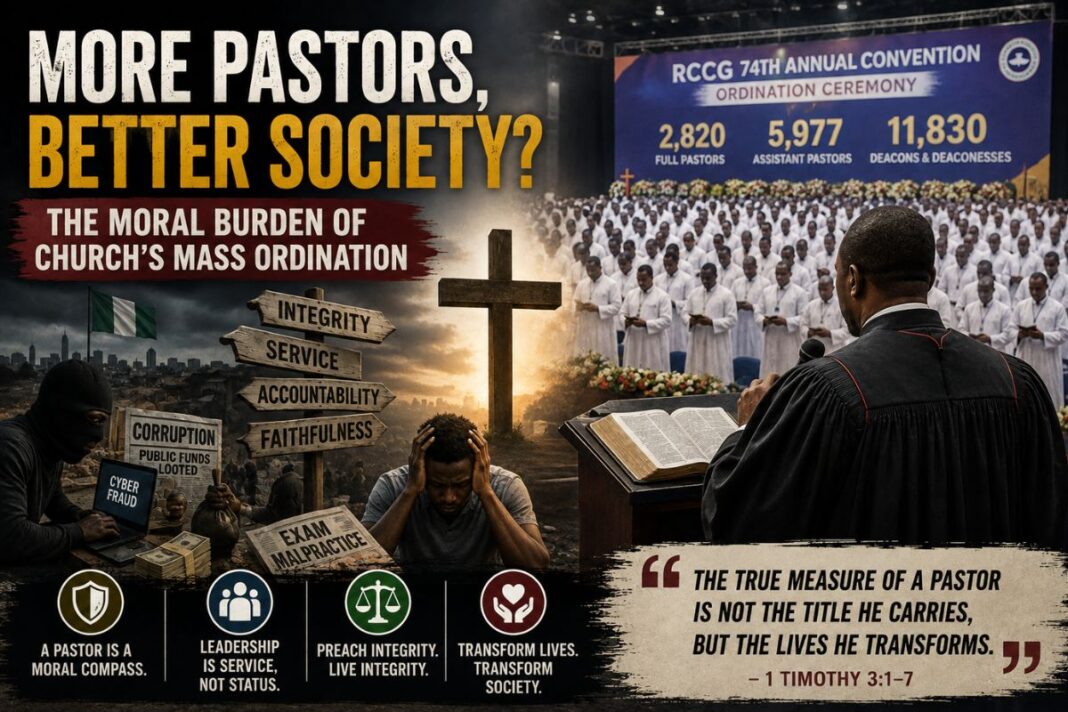

The Redeemed Christian Church of God (RCCG) concluded its 74th Annual Convention recently with the ordination of 2,820 full pastors, 5,977 assistant pastors, and 11,830 deacons and deaconesses. The development represents one of the largest single expansions of church leadership in Nigeria and reinforces the RCCG’s position as one of the most influential Pentecostal movements in the world.
For members of the church, the ordination ceremony was a moment of celebration, spiritual renewal, and institutional growth. More ministers mean more hands to shepherd congregations, plant churches, counsel troubled families, mentor young people, and advance evangelism. In a country struggling with insecurity, corruption, drug abuse, cybercrime, family breakdown, and moral uncertainty, one would naturally expect that an increase in the number of pastors would translate into a more righteous society.
Yet that expectation raises an uncomfortable question: Why does Nigeria continue to experience rising levels of social decay despite having one of the highest concentrations of churches, pastors, bishops, apostles, prophets, and evangelists in the world?
You may also read:
- When the Mob Becomes Judge, Jury and Executioner
- Faith Without Risk Is Not Faith: Why Many Young Christians Struggle With Consistency
- The Man Who Never Cried — A Story About Men, Mental Health, and the Silence That Kills
- FAAC Windfall and the Missing Development Dividend: What Are Nigerian Governors Doing With the Money?
This is not a criticism directed at RCCG alone. It is a question for the entire Christian community.
The biblical role of a pastor goes beyond preaching eloquent sermons on Sunday mornings. A pastor is expected to be a moral compass, a custodian of integrity, and an example to believers. In the Scriptures, the Apostle Paul instructed church leaders to be above reproach, self-controlled, respectable, hospitable, and of good character. The pulpit was never intended to be a platform for fame, wealth, or influence. It was meant to be a place of service.
Ordination, therefore, is not merely a promotion. It is a public declaration that the individual possesses the spiritual maturity and moral character required to guide others.
The real test begins after the ceremony.
If the thousands of newly ordained ministers embody the values they preach, their impact should be visible beyond church walls. Communities should become safer. Families should become stronger. Young people should become more disciplined. Public officials who sit under their teachings should become more accountable. Business owners should become more honest. Corruption should diminish.
Unfortunately, reality often tells a different story. Nigeria remains deeply religious but simultaneously struggles with some of the world’s most troubling social indicators. Public funds are looted with astonishing boldness. Examination malpractice persists. Internet fraud has become a lucrative enterprise for many youths. Electoral corruption remains widespread. Domestic violence continues. Ritual killings frequently make headlines.
Many perpetrators of these crimes are not strangers to religion. Some attend church regularly. Some occupy leadership positions in religious organisations. Some quote scriptures with ease. This contradiction suggests that religious activity alone does not necessarily produce moral transformation.
Part of the problem lies in the growing gap between preaching and practice.
Over the years, numerous reports involving church leaders have damaged public confidence in the clergy. In Nigeria alone, several pastors have recently faced allegations ranging from sexual abuse to exploitation of vulnerable followers.
In Abuja, Pastor Amos Isah of Prophetic Victory Voice of Fire Ministry was remanded and later re-arraigned over allegations involving the rape and exploitation of a minor. He has denied the allegations, and the matter remains before the courts.
In Anambra State, authorities arrested Pastor Harrison Charles over allegations that included sexual misconduct and underage marriage. The pastor disputed aspects of the allegations, but the case attracted widespread public attention.
Another Anambra-based cleric, Evangelist Dozie Ezani, was arrested over allegations involving the sexual abuse of a teenage girl. Authorities reported that investigations were ongoing.
Similarly, in Nasarawa State, police arrested Pastor Asonye Isaiah following allegations that he exploited a teenager under the guise of conducting spiritual cleansing.
The problem is not confined to Nigeria. In the United States, federal authorities have pursued serious charges against Houston-based church leader David E. Taylor, alleging sexual exploitation, coercion, forced labour, and financial misconduct. Taylor has denied wrongdoing, but the allegations have further intensified global concerns about abuse of spiritual authority.
In the Philippines, the influential religious leader Apollo Quiboloy has faced accusations including sex trafficking and abuse. He has consistently denied the allegations, but the case has become one of the most prominent religious scandals in Asia.
These examples do not represent all pastors. Indeed, countless pastors quietly serve their communities with integrity, sacrifice, and genuine compassion. Many provide scholarships, care for widows, rehabilitate drug addicts, support struggling families, and give hope to people facing despair.
However, every scandal involving a church leader inflicts damage far beyond the individual involved. When a pastor is accused of sexual abuse, people begin to distrust spiritual authority. When a preacher lives extravagantly while members suffer, people question the sincerity of the gospel. When ministers preach holiness but practice immorality, young people become cynical about faith itself.
The greatest threat to Christianity today may not be persecution from outside the church but hypocrisy within it. This is why the ordination of thousands of new ministers should not merely be celebrated; it should also inspire reflection.
Churches must place greater emphasis on character than charisma. A powerful preacher who lacks integrity is a danger to the church. A gifted speaker who cannot control greed, lust, pride, or anger can cause immense harm. The ability to attract crowds should never be mistaken for spiritual maturity.
The selection process for church leadership should include rigorous accountability mechanisms. Background checks, mentorship, ethical training, financial transparency, and disciplinary procedures should be strengthened. Ministers should be held to higher standards, not lower ones.
Equally important is the need for pastors to speak courageously against corruption and injustice.
Too often, some religious leaders condemn individual sins while remaining silent about systemic wrongdoing. They preach against fornication but avoid confronting corruption. They denounce drunkenness but ignore the theft of public resources. They pray for national transformation while refusing to challenge the behaviours that undermine it.
A pastor’s responsibility extends beyond the altar. If thousands of newly ordained ministers consistently teach honesty, reject corruption, defend the vulnerable, and model integrity in their personal lives, the impact on society could be enormous. Their influence would extend into homes, schools, markets, government offices, and boardrooms.
Nigeria does not merely need more pastors. It is in dire need of more pastors whose private lives match their public sermons.
The RCCG’s latest ordination exercise is a significant milestone. But history will not judge its success by the number of certificates issued, titles conferred, or photographs taken during the ceremony. The true measure of success will be found in the lives transformed, the communities improved, and the moral example set by those who now carry the title of pastor.
In the end, society is not changed by the number of preachers it has. Society is changed when those who preach become living examples of the values they proclaim.