

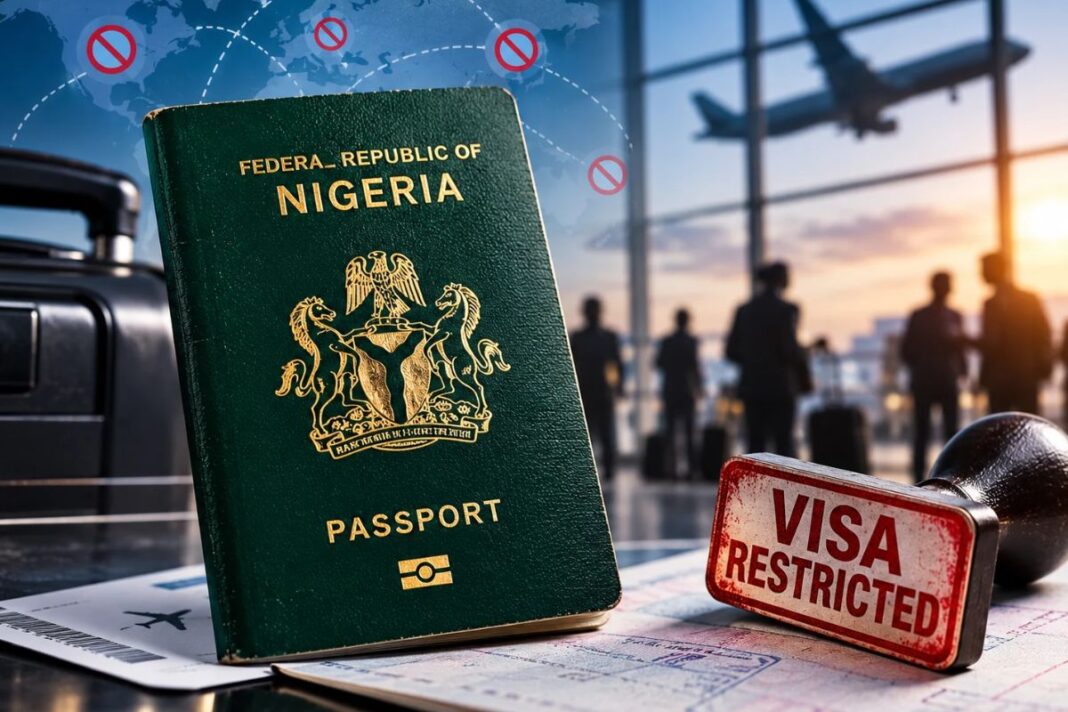

There was a time when travelling abroad was largely a matter of making plans, booking a flight, packing a suitcase and heading to the airport. Today, for many Nigerians, international travel begins with a more complicated question: Will the embassy grant me a visa?
Unfortunately, the latest report on Nigeria’s passport ranking suggests that the situation may be getting worse.
According to a report published by The PUNCH on October 20, 2026, the Nigerian passport has fallen to 181st position out of 196 countries in the latest IziVisa Passport Ranking Index. The report states that Nigerian passport holders can travel to 24 countries without a visa, obtain visas on arrival in 16 countries and access 43 destinations through electronic visas.
The development is troubling, not merely because of the numbers but also because of what they represent for Nigeria’s international reputation, economic prospects and citizens’ freedom to move around the world.
However, one important distinction must be made. The IziVisa ranking differs considerably from the Henley Passport Index, which placed Nigeria 90th in July 2026, with access to 44 destinations without a prior visa. The two indices use different methodologies and destination coverage, so their rankings cannot be compared directly as though they measure precisely the same thing. Nevertheless, one thing is clear: Nigeria’s limited international travel privileges deserve serious attention.
A passport is more than a travel document. It represents a country’s identity and provides its citizens with access to opportunities beyond their national borders.
Unfortunately, possessing a Nigerian passport can mean facing additional questions, documentation requirements, financial demands and lengthy waiting periods before travelling to certain countries.
For Nigerians planning holidays, attending conferences, visiting relatives or pursuing business opportunities, visa restrictions can turn an otherwise straightforward journey into an expensive and uncertain exercise.
Consider a Nigerian professional invited to an international conference. While a colleague holding a more powerful passport may travel with minimal paperwork, the Nigerian participant may need to secure an appointment, provide bank statements, obtain an invitation letter, demonstrate strong ties to Nigeria and pay non-refundable application fees.
Even after meeting these requirements, approval is not guaranteed. The consequences are obvious: opportunities can disappear while applicants wait for visa decisions.
One of the most significant implications of a weak passport is its potential impact on business and investment. In an increasingly interconnected world, businesses depend on international relationships, trade exhibitions, investment forums, professional networks and face-to-face negotiations.
You may also read;
- AI Is Writing the Code Now: Why the Creator of Ruby on Rails Has Put His Pencil Down
- Inside Mentor To Marry: Pastor Kingsley Okonkwo’s ₦700k Christian Matchmaking Platform
- Uber Nigeria Shutdown: What Happens to Your Account?
- Dangote Refinery IPO Opens at ₦525: See How to Buy Shares
When Nigerian entrepreneurs encounter visa barriers, they may miss opportunities to meet prospective investors, negotiate contracts, explore new markets or establish partnerships.
A technology entrepreneur invited to pitch a business idea to international investors may find the opportunity slipping away because a visa was not issued on time. A small business owner hoping to attend an international trade fair may abandon the trip because the cost of securing travel documents has become prohibitive.
These challenges can place Nigerian businesses at a disadvantage against competitors from countries whose citizens enjoy greater freedom of movement.
International mobility does not automatically produce economic growth, but restrictions can make it harder for Nigerians to participate fully in the global economy. Nigeria cannot reasonably aspire to become a major economic force while ignoring the barriers its citizens face in accessing international markets.
Every year, Nigerian students seek admission into universities and other institutions abroad. Many others pursue scholarships, research opportunities, academic exchanges and professional development programmes.
Although visa requirements are not determined solely by passport rankings, a weak passport can increase the administrative burden associated with international travel. Students may need to provide extensive documentation, prove their financial capacity (proof of funds) and wait for visa decisions before commencing their studies. The situation can become particularly frustrating when an opportunity comes with a strict deadline.
Beyond formal education, young Nigerians attending international competitions, technology boot camps, innovation programmes and professional conferences may encounter similar difficulties.
At a time when the world is increasingly driven by knowledge, innovation and international collaboration, Nigeria should be making it easier for its young people to access opportunities that can contribute to national development. Instead, avoidable travel barriers risk limiting their exposure and competitiveness.
A passport’s strength also reflects the relationships a country maintains with other nations, although rankings alone cannot explain the full range of diplomatic considerations behind visa policies.
Countries generally consider several factors when determining entry requirements, including security, migration patterns, diplomatic relations and the reliability of travel documentation.
Consequently, a weak passport can affect how citizens experience international travel, even when individual travellers have no history of wrongdoing.
Nigerians who travel legitimately for tourism, business or family visits may face additional scrutiny because of concerns associated with irregular migration, visa overstays or document fraud. Imagine immigration officials separating you from all others for extra search just because of your passport.
This creates an unfortunate situation in which people who have committed no offence must nevertheless contend with obstacles associated with broader perceptions of their nationality. The Nigerian government must therefore treat the country’s international image as a matter of national importance.
It must also resist the temptation to dismiss every travel restriction as discrimination. Where unfair treatment occurs, diplomatic engagement is necessary. Where restrictions reflect legitimate concerns about immigration compliance, security or documentation, the appropriate response is to address those concerns.
The implications are not limited to businesspeople and students. Millions of Nigerians maintain family, cultural, religious and professional connections across national borders. For families separated by migration, international travel can be essential to maintaining relationships.
A Nigerian hoping to attend a wedding, visit an elderly relative, attend a funeral or reunite with family members abroad may have to navigate expensive applications and uncertain processing times.
For people with urgent reasons to travel, such delays can be emotionally devastating. Visa restrictions can also affect Nigerians living abroad who wish to maintain closer contact with relatives at home or travel between countries for personal and professional reasons.
International mobility is therefore not simply a luxury for wealthy Nigerians. It can be an important part of family life, professional advancement and personal development.
A passport’s global standing cannot be improved by government declarations alone. It depends partly on the relationships a country builds and the confidence other governments have in its institutions and citizens’ travel compliance.
Nigeria must therefore approach this challenge through deliberate diplomacy. The Ministry of Foreign Affairs, Nigerian missions abroad and the Nigeria Immigration Service should work together to strengthen international confidence in Nigerian travel documents.
The federal government should pursue reciprocal visa arrangements with countries where such agreements are feasible and mutually beneficial. It should also engage governments that have introduced or tightened restrictions affecting Nigerian travellers.
However, reciprocity must be approached carefully. Making travel more difficult for foreign visitors simply because Nigerians face restrictions elsewhere could discourage investment, tourism and international cooperation without necessarily improving access for Nigerian citizens. The objective should be to negotiate practical arrangements that expand legitimate travel opportunities while protecting Nigeria’s national interests.
Equally important is the need to strengthen passport integrity, prevent document fraud and improve the efficiency of immigration services. A credible passport system, supported by reliable identity verification and effective border management, can contribute to international confidence.
While the government bears substantial responsibility for diplomacy and passport administration, citizens also have a role to play. Nigerians travelling abroad must respect the immigration laws of their destination countries, provide accurate information in visa applications and comply with the conditions attached to their visas.
Those who obtain tourist visas should not misuse them for purposes that violate their conditions. Employers, educational institutions and travel agents should equally discourage document fraud and other practices that undermine legitimate applications.
It is unfair to judge every Nigerian by the misconduct of a few. Nevertheless, responsible travel practices are essential to building confidence and protecting the opportunities available to future travellers.
Ultimately, the debate about Nigeria’s passport ranking is a debate about opportunity, reputation and national development. A country with a large population, considerable natural resources, a vibrant entrepreneurial class and a globally influential diaspora should be working towards greater international mobility for its citizens.
The government must first establish the precise scale of the reported decline, examine the methodology behind the IziVisa ranking and determine whether specific countries have recently changed their entry requirements for Nigerians.
It should then develop a measurable strategy for expanding visa-free access, improving diplomatic relations, strengthening passport credibility and supporting legitimate international travel. The success of such efforts should be measured not merely by Nigeria’s position on a league table but also by the number of meaningful travel opportunities secured for its citizens.
For Nigeria, the message is clear: a passport should open doors, not become another reminder of the country’s challenges.
The Nigerian passport must become a stronger instrument of opportunity for students, entrepreneurs, professionals, tourists and families.
Until that happens, many Nigerians will continue to encounter a frustrating reality: being citizens of a country rich in human potential while facing considerable obstacles when attempting to explore the world. That is a challenge the Tinubu-administration cannot afford to ignore.