

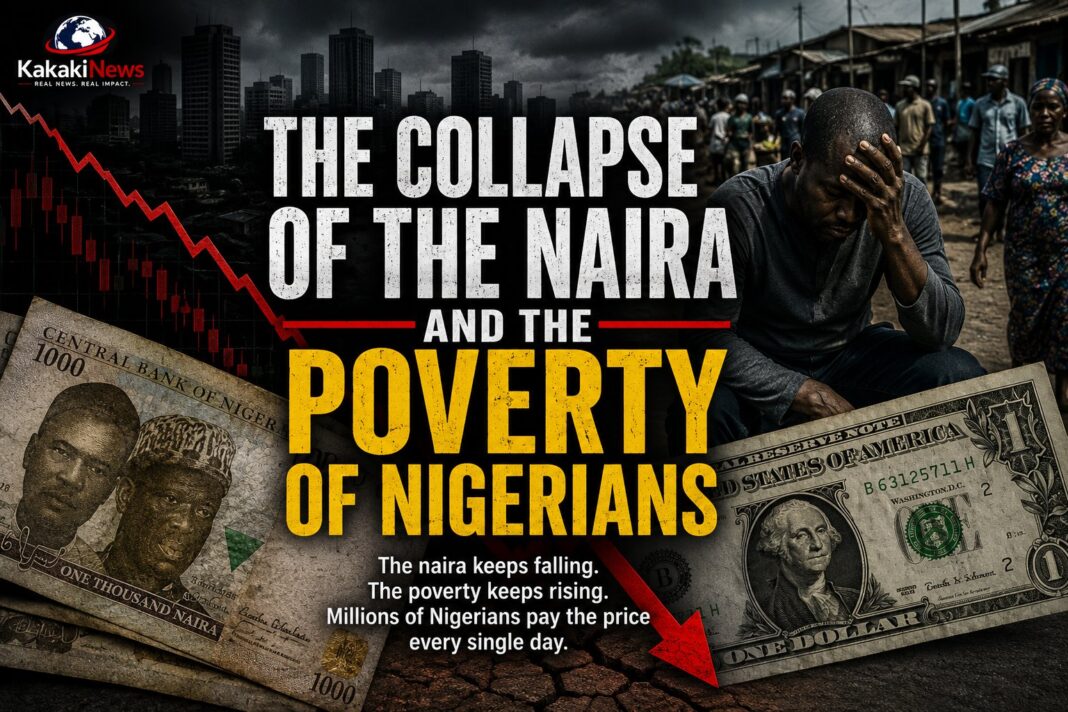

“The difference between one dollar and one naira is so big that even if you earn one naira every day, you won’t make one dollar in two years.”
That statement sounds exaggerated at first glance, but it is the whole truth. It captures the painful reality of Nigeria’s economic crisis and the collapse of the value of the naira against the United States dollar. It reflects not just a weak currency, but a deeper national tragedy: the steady impoverishment of millions of Nigerians whose incomes have remained in naira while the value of their labour, savings, and purchasing power continues to evaporate.
For decades, the Nigerian naira was one of Africa’s strongest currencies. There was a time when the naira exchanged almost equally with the dollar. In the 1980s, one naira could buy more than one dollar. Two naira use to be equivalent to the British pounds. But all that is now history. The situation has become almost unbelievable. Today, one dollar now exchanges for well over one thousand naira in the parallel market, making the naira one of the weakest currencies in the world.
This dramatic decline did not happen overnight, but the economic policies introduced under President Bola Ahmed Tinubu accelerated the suffering in ways that ordinary Nigerians continue to feel every day.
When the Tinubu administration came into office on May 29 2023, it immediately implemented two major economic policies: the removal of fuel subsidy and the floating or devaluation of the naira through exchange-rate unification. The government defended these decisions as necessary reforms meant to rescue the economy, attract foreign investors, eliminate corruption in the subsidy regime, and strengthen public finances. Officials repeatedly claimed that the reforms would eventually lead to stability and appreciation of the naira.
Indeed, government representatives have often pointed to periods when the naira slightly recovered in the foreign exchange market as proof that the reforms are working. They cite rising foreign reserves, increased investor confidence, and improved fiscal revenue as evidence that Nigeria is on the path to economic recovery.
But for ordinary Nigerians, these claims sound disconnected from reality. They are mere propaganda meant to boost the image of a sinking government desperate to remain in power.
A currency’s strength is not measured only by what central bank officials say or what economic charts display. Its real value is measured by what people can afford with it. On that basis, the naira has become painfully worthless to millions of citizens.
The average Nigerian worker now earns salaries that can barely survive inflation. Transport fares have multiplied because fuel prices skyrocketed after subsidy removal. Food prices have surged to frightening levels. Basic necessities such as rice, bread, cooking gas, electricity, and medicine have become luxuries for many families.
The removal of subsidies on petroleum products was especially devastating because fuel is the foundation of economic activity in Nigeria. Since electricity supply remains unreliable, businesses and households depend heavily on petrol and diesel for power generation. Once fuel prices increased, every other sector immediately became more expensive. Traders increased prices to cover transportation costs. Farmers paid more to move goods. Manufacturers spent more on production. The result was nationwide inflation that crushed the purchasing power of citizens.
Similarly, the devaluation of the naira worsened the crisis. Nigeria is heavily dependent on imports — from fuel to machinery, pharmaceuticals, food items, and industrial materials. As the naira weakened against the dollar, import costs rose sharply, and businesses transferred those costs directly to consumers.
The irony is cruel. While the government celebrates higher revenue generated from exchange-rate reforms, Nigerians who earn in naira have effectively become poorer overnight. Someone earning ₦100,000 monthly today cannot buy what the same amount could purchase just two years ago. Savings accumulated over decades have lost much of their value. Entire families have slipped from middle-class stability into economic uncertainty.
What makes the situation more frustrating is the visible disconnect between the political elite and the suffering population. Citizens are repeatedly told to be patient and endure temporary pain for future prosperity, yet many politicians continue to live extravagantly with convoys, luxury travel, and inflated government spending. The burden of sacrifice appears to fall almost entirely on ordinary Nigerians.
Those in government and their cronies argue that subsidy removal and naira devaluation were unavoidable because the old system was unsustainable and corrupt. There is some truth to this argument. The fuel subsidy regime was riddled with fraud, and multiple exchange rates encouraged corruption and speculation. However, even necessary reforms can become destructive when implemented without adequate protection for the population.
The Tinubu administration introduced these reforms in a country already struggling with unemployment, weak infrastructure, insecurity, low industrial productivity, and widespread poverty. Removing subsidy and devaluing the currency simultaneously created a severe economic shock without sufficient social safety nets to cushion the effects.
As a result, poverty has deepened. Hunger has increased. Small businesses are collapsing under rising operating costs. Young Nigerians are increasingly desperate to leave the country in search of better opportunities abroad. The “japa” phenomenon has intensified because many citizens no longer believe the economy offers hope for survival or prosperity.
Meanwhile, government officials continue to speak about macroeconomic gains and future growth. Yet economic growth means little to citizens whose daily reality is hardship. A stronger reserve figure does not feed hungry families. A marginal appreciation of the naira on paper does not reduce the cost of food in the market. Economic reforms lose moral legitimacy when they improve statistics while worsening human suffering.
The naira’s collapse is therefore more than a financial issue. It is a social and psychological crisis. It represents the shrinking dignity of work in Nigeria. People labour harder yet earn less in real value. Professionals who once lived comfortably now struggle to survive. Graduates see little reward for education. Pensioners watch their life savings become meaningless.
The statement comparing one naira to one dollar is therefore not merely about exchange rates. It is about the widening gap between the lives Nigerians once hoped for and the harsh economic reality they now endure.
Until the government’s reforms translate into genuine improvements in living conditions — affordable food, stable electricity, lower inflation, job creation, stronger local production, and real purchasing power — many Nigerians will continue to see official claims about the appreciation of the naira as disconnected from the suffering on the streets.
For the ordinary citizen, the naira today is not simply weak. It has become a painful symbol of economic decline, broken promises, and a nation where survival itself is becoming increasingly expensive