

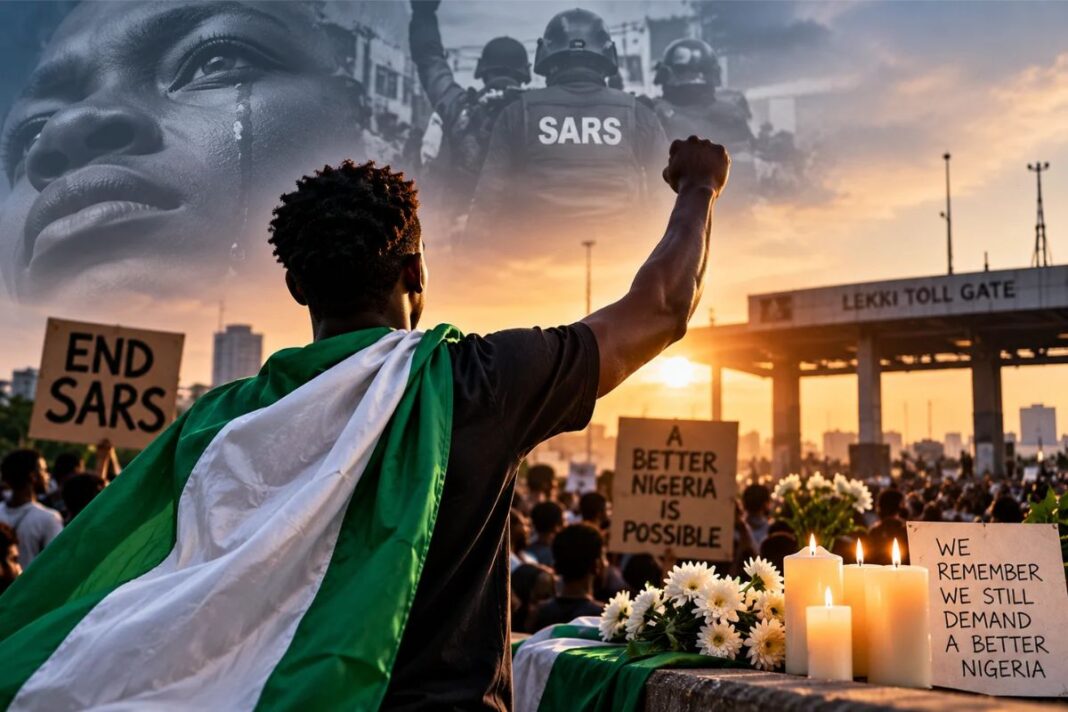

Six years ago, thousands of Nigerian youths took to the streets to demand an end to police brutality, particularly the abuses associated with the now-defunct Special Anti-Robbery Squad (SARS). What began as a protest against harassment, extortion, torture, unlawful detention and extrajudicial killings soon evolved into a broader expression of frustration with bad governance, unemployment, poverty and the apparent indifference of political leaders to the suffering of ordinary Nigerians.
The #EndSARS movement became one of the most remarkable demonstrations of youth solidarity in Nigeria’s history. For once, young people rose above ethnic, religious and political differences to demand a country that respected their lives, rights and aspirations.
What started as a peaceful movement ended on a very sad note across the country. The protests were followed by violence, deaths, injuries, arrests and the destruction of public and private property. The shootings at the Lekki Toll Gate in Lagos on October 20, 2020, became a defining moment in the nation’s recent history, deepening public distrust of the government and its security agencies.
Now, six years later, an uncomfortable question demands an honest answer: Was EndSARS worth the sacrifice?
The first major achievement of EndSARS was the disbandment of SARS on October 11, 2020. For years, Nigerians had complained about the activities of its operatives, who were accused of profiling young people, demanding money, torturing suspects and committing other human rights abuses.
The government had previously announced measures to reform the unit, but abuses and public complaints continued. EndSARS demonstrated that citizens could no longer be ignored when they collectively demanded accountability.
However, disbanding SARS was only the beginning. The real objective was to reform policing in Nigeria and ensure that no security operative could abuse citizens without consequences. Unfortunately, six years later, the scorecard remains disappointing.
A report by Premium Times on October 20, 2026 quoted the Rule of Law and Accountability Advocacy Centre as warning that allegations of police brutality, extortion, unlawful detention, torture and extrajudicial killings persisted. The organisation argued that the gap between announced reforms and actual police conduct remained dangerously wide.
You may also like;
- Arrested, Detained, Then Discharged: How Nigeria’s Justice System Steals Years from Citizens
- Nigeria 2027 Election: Major Candidates, Political Battles and Issues to Watch
- Is Your Business Website a Waste of Money? Maybe You’re Not Using It Properly
- Madonna University, Don’t Destroy These Nursing Students Over One Costly Mistake!
This raises a fundamental question: What was the point of abolishing SARS if some of the practices that made the unit notorious continue to be reported against other police formations?
Changing the name of a police unit is not the same as changing the culture of policing. Redeploying officers accused of abuses without transparent investigations and appropriate disciplinary action does not constitute justice.
The problem is not simply the existence of a particular police unit. It is a system in which some officers appear to believe they can violate citizens’ rights and escape accountability.
EndSARS will remain indelible on our minds because people lost their lives. Others suffered permanent injuries, psychological trauma, financial losses and the destruction of their livelihoods. Families were left to mourn loved ones whose deaths raised questions that remain unresolved.
For these victims, anniversaries and commemorative statements cannot replace justice. The judicial panels established after the protests provided an opportunity for victims to narrate their experiences and seek redress. Some officers were indicted, and compensation was recommended for victims and affected families.
Yet implementation has been inconsistent and inconclusive. This underscores that the distance between acknowledging wrongdoing and correcting it. Compensation cannot bring back the dead, but it can help survivors rebuild their lives and demonstrate that the state recognises its responsibility. Equally important is the prosecution of officers found to have committed criminal offences.
Without accountability, compensation risks becoming a financial transaction that allows institutions to move on while victims continue to suffer.
The Lekki Toll Gate shootings remain particularly significant. Whatever terminology different parties use to describe the events of that night, the use of force against unharmed protesters, the reported deaths and injuries, and the questions surrounding accountability cannot simply be wished away.
A country that fails to establish accountability for violations committed during peaceful protests sends a dangerous message. And that is, that the price of demanding one’s rights may be death, with little consequence for those responsible.
Perhaps, one of the movement’s most important achievements is that EndSARS awakened a generation that had been largely dismissed as politically indifferent. Young Nigerians demonstrated an ability to organise, raise funds, provide medical assistance, communicate internationally and sustain a national campaign without relying on traditional political structures.
The movement also exposed the limitations of Nigeria’s political leadership. Many young people became more conscious of the relationship between governance, security, economic opportunity and personal freedom.
EndSARS helped reinforce the understanding that bad governance is not an abstract political problem. It affects whether a young person can travel safely, find employment, start a business, obtain quality education or interact with a police officer without fear.
Nevertheless, political consciousness must translate into political participation and institutional change. Street protests alone cannot build a functioning democracy. As 2027 approach, citizens must also register to vote, scrutinise candidates, participate in political parties, demand transparency from elected representatives and hold public officials accountable between elections.
The 2023 general elections provided an opportunity for many young Nigerians to express their political preferences. However, the broader challenge remains: how can the energy, solidarity and determination displayed during EndSARS be converted into a sustained movement for responsible leadership? The answer lies in organisation, strategic engagement and continuous civic participation.
Was It Worth It?
This is perhaps the most difficult question because it concerns human lives.
Can a movement that contributed to the deaths of young Nigerians be described as worthwhile when many of its demands remain unmet?
There is no satisfactory way to measure the value of a human life against political reforms, however desirable those reforms may be.
The young Nigerians who died were not disposable instruments of social change. They were sons, daughters, siblings, friends and citizens whose lives mattered. Their families deserve truth, justice and meaningful support. It would therefore be insensitive to declare that their deaths were worth it simply because EndSARS became a defining moment in Nigerian history.
Yet it would also be wrong to conclude that the movement achieved nothing. If nothing, it forced police brutality in Nigeria into the national and international spotlight. It demonstrated the power of collective action and challenged the assumption that young Nigerians would indefinitely tolerate abuses without resistance. It created a lasting reference point for discussions about human rights, public accountability and responsible governance.
The more appropriate conclusion is that EndSARS was justified, but the sacrifice must not be allowed to become meaningless. The responsibility now rests with the government, the police, the judiciary, civil society and Nigerian citizens to ensure that the movement produces lasting change.
First, the government in Lagos and other states of the federation, must fully implement the recommendations of the judicial panels. Victims and families awarded compensation should receive their entitlements, while allegations of criminal conduct should be investigated and prosecuted in accordance with the law.
Second, police reform must move beyond legislation, policy announcements and changes in leadership. The Police Act 2020 and the Nigeria Police Regulations introduced in 2026 provide frameworks for more accountable policing. Their effectiveness, however, must be measured by what happens when officers encounter ordinary citizens, not by official speeches.
Police officers accused of misconduct must face transparent investigations. Independent complaint mechanisms should be strengthened, and citizens must be able to report abuses without fear of intimidation or retaliation.
Third, police welfare must improve. Officers need adequate training, modern equipment, decent working conditions and appropriate psychological support. But poor welfare must never become an excuse for extortion, torture or extrajudicial killings.
Fourth, young Nigerians must sustain their civic engagement. Social media campaigns and annual memorials are useful, but they should complement sustained advocacy, community organising, legal action, voter education and participation in democratic institutions.
Lastly, the government must address the broader governance failures that helped fuel the protests. Youth unemployment, economic hardship, unequal opportunities and the perception that public officials operate above the law will continue to undermine public trust. A government that wants to prevent future unrest must listen to legitimate grievances before frustration explodes into confrontation.
Six years after EndSARS, Nigeria must decide whether it wants to remember the movement merely as a tragic chapter in its history or treat it as a continuing demand for a better country.
The most fitting tribute to those who died is not another hashtag, candlelight procession or commemorative speech. It is a Nigeria where young people are not profiled because of their appearance, citizens are not tortured for suspected offences, and security operatives understand that their uniforms confer responsibility rather than unlimited power.
It is also a Nigeria where citizens can peacefully demand accountability without fearing that the state will respond with violence.
Was EndSARS worth it? The lives lost were priceless, and no subsequent achievement can compensate for their deaths. But the struggle for justice, dignity and responsible governance was necessary.
The tragedy would become even greater if six years passed without meaningful reform, if victims continued to wait for justice, and if the same abuses that drove young Nigerians into the streets returned under different names.
We must not allow EndSARS to end in history books. Its unfinished demands must become the foundation for a more accountable police force, a more responsible government and a society in which the lives of young Nigerians truly matter.