

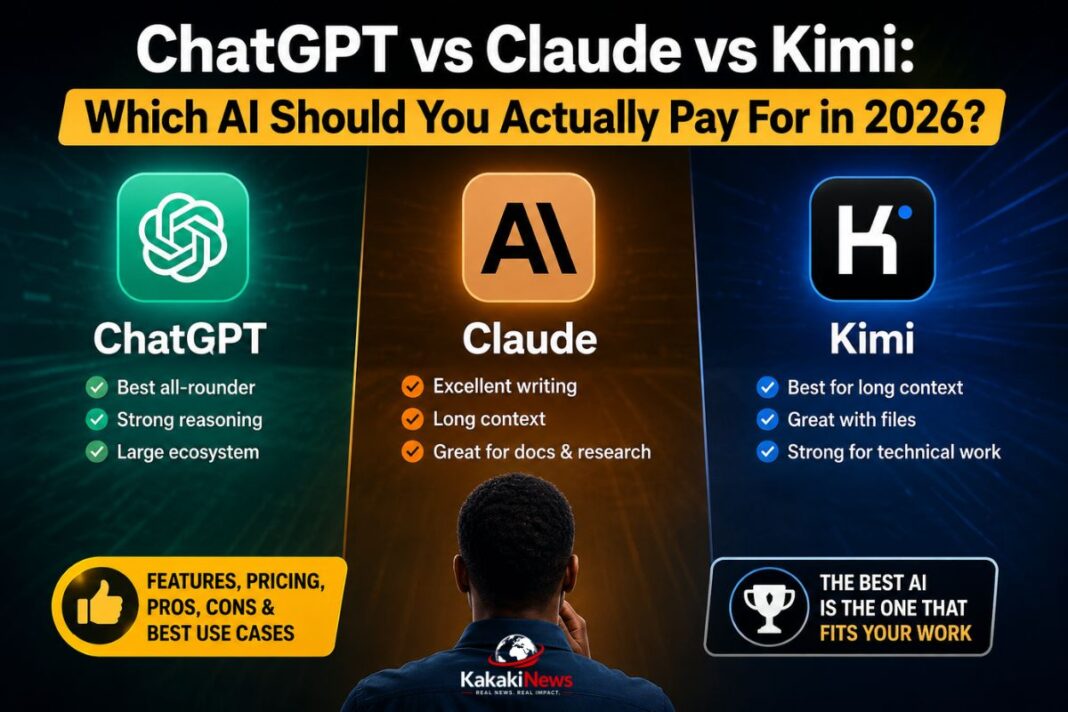

If you’ve been on Twitter or in any tech WhatsApp group this month, you’ve probably seen people arguing about which AI is the best. Somebody swears by ChatGPT because it does everything. Somebody else says Claude writes cleaner and thinks harder. And now there’s a new name in the conversation: Kimi, a Chinese AI model that just walked in and started beating the big boys on coding tests.
I get asked this question almost every week by clients and readers: which one should I actually pay for? So let’s break it down properly, no sugarcoating, with real numbers.
The Short Answer
If you want one tool that does almost everything, from writing to images to video, go with ChatGPT. If your work depends on careful thinking, long documents, or clean code you can trust without checking twice, go with Claude. If you’re technical and want serious power at a lower cost, Kimi deserves a real look.
Now let’s get into why.
You may also like;
- How to Make Real Money With AI in Nigeria: The Truth Nobody Is Telling You (Part 1)
- How to Make Money With AI in Nigeria (Part 2)
- How to Make Money With AI in Nigeria (Part 3)
- How AI Is Changing Jobs and Businesses in Nigeria
Where Each One Stands Right Now
ChatGPT runs on GPT-5.6, which reached general release on July 9, 2026. It comes in three versions: Sol (the flagship), Terra (a cheaper mid-tier), and Luna (fast and budget-friendly). OpenAI still has the biggest ecosystem of any AI company, with tools for images, video generation through Sora, a coding agent called Codex, and an Operator agent that can complete tasks on the web for you.
Claude, built by Anthropic, currently runs on Claude Sonnet 5 as the everyday model, with Claude Opus 4.8 as the more powerful option for heavier tasks, and Claude Fable 5 as the most capable tier. Claude built its name on giving careful, well-reasoned answers, and it’s become the model many developers trust most for coding work that needs to run the first time correctly.
Kimi, made by Chinese company Moonshot AI, just released its newest model, Kimi K3, on July 16, 2026. It’s a massive 2.8 trillion parameter model, and within hours of release, it topped a major coding leaderboard, ranking ahead of both Claude and ChatGPT’s newest models on front-end coding tests. It trails behind on general intelligence tests, but for coding and long documents, it’s now a serious contender.
Pricing Compared
Here’s where the differences really start to show.
| Plan Level | ChatGPT | Claude | Kimi |
|---|---|---|---|
| 🟢 Free | Yes, limited | Yes, limited | Yes, generous limits |
| 💰 Entry | Go – $8 | Pro – $20 | From $19 |
| ⭐ Mid | Plus – $20 | Max – $100 | Up to $199 |
| 🚀 Top | Pro – $100–200 | Max – $200 | API Pay-as-you-go |
| 👥 Business | Business – $25–30/seat | Team – $20–25/seat | Not published |
If you’re building software or automating tasks and prefer paying per use instead of a flat subscription, here’s how the API pricing compares per one million tokens (a rough measure of how much text goes in and comes out):
| Model | Input Cost | Output Cost |
|---|---|---|
| GPT-5.6 Sol (ChatGPT flagship) | $5.00 | $30.00 |
| GPT-5.6 Terra | $2.50 | $15.00 |
| GPT-5.6 Luna | $1.00 | $6.00 |
| Kimi K3 | $3.00 | $15.00 |
For everyday chat use, most people should just compare monthly subscription cost against how much value they’ll get from it, not the API pricing, which is built for developers running the model inside their own apps.
Context Window: How Much Each One Can “Remember” at Once
Context window simply means how much text an AI can read and hold in mind during one conversation. If you’re feeding it a long contract, a full book manuscript, or hundreds of pages of research, this number matters a lot.
| Model | Context Window |
|---|---|
| ChatGPT (GPT-5.6 family) | Varies by tier, generally large but not publicly fixed across all plans |
| Claude | Up to 200,000 tokens on standard plans, higher on enterprise setups |
| Kimi K3 | Over 1,000,000 tokens |
Kimi’s context window is the standout number here. If your work involves dumping an entire book, a huge codebase, or hundreds of pages of documents into one conversation, Kimi currently handles more than the other two without breaking a sweat.
Coding Strength
This is where Kimi made its loudest entrance. On Arena’s front-end coding leaderboard, Kimi K3 ranked first, ahead of Claude’s newest model and ChatGPT’s newest model, though it fell slightly behind on broader intelligence tests that measure reasoning outside of code.
Claude has held a strong reputation for a while now among developers who say it gives cleaner, more structured code with fewer formatting mistakes, which matters if you’re shipping that code straight into production. ChatGPT remains a strong all-rounder for coding too, especially paired with Codex for handling multi-step programming tasks.
If coding is your main use case and cost matters to you, Kimi is worth testing. If you need dependable, production-ready code with minimal cleanup, Claude still holds its ground.
Writing, Reasoning, and Everyday Use
For everyday writing tasks like emails, articles, business proposals, or social captions, all three models perform well. The real difference shows up in how they handle nuance.
Claude tends to give more careful, considered answers, especially on tasks that involve analysis, comparing options, or reviewing long documents. ChatGPT is faster to produce content in bulk and has a broader range of built-in tools, from image generation to voice mode to web browsing. Kimi is newer to this space and still catching up on polish and everyday conversational feel, even though its raw technical power is impressive.
A Word on Privacy
Before you jump on the “it’s free” excitement around Kimi, know what you’re trading for that price. Moonshot AI’s privacy policy states that user content gets used for training and improving its models, and unlike ChatGPT and Claude, it doesn’t clearly document an in-app way to opt out of that. If you’re feeding it sensitive client data, business documents, or anything confidential, that’s worth thinking about twice before you paste it in.
The Scorecard
| Category | ChatGPT | Claude | Kimi |
|---|---|---|---|
| Coding | B+ | A- | A |
| Writing and reasoning | A- | A | B+ |
| Context window (long documents) | B | B+ | A |
| Pricing and value | B+ | B | A- |
| Ecosystem (tools, plugins, extras) | A | B | C+ |
| Everyday ease of use | A- | A- | B |
| Data privacy | B+ | A- | C+ |
| Overall business fit | A- | A- | B+ |
| Best for beginners | A | B+ | C+ |
Final Verdict
There’s no single winner here, and anyone who tells you otherwise is trying to sell you something. What you should pay for depends entirely on what you’re doing.
If you run a business and need one AI to help with everything from customer replies to content to basic automation, ChatGPT gives you the widest toolkit for your money. If your work leans on trust, careful thinking, and clean output, especially for coding or reviewing long documents, Claude remains the steadier choice. If you’re technical, budget-conscious, and comfortable handling your own data carefully, Kimi K3 is the one to watch closely this year. It’s cheap, it’s powerful, and it’s improving fast.
My honest advice for Nigerian business owners and freelancers reading this: start with the free tier of whichever one fits your work best, actually use it for a full week on real tasks, then decide if it’s worth paying for. Don’t pay for hype. Pay for what actually saves you time.