


Nigeria may not be there, but Nigerian Blood Is! Meet the 15 Stars of Nigerian Heritage at World Cup 2026.
Fifteen players of Nigerian descent will represent eight different countries at the 2026 FIFA World Cup, and as a Nigerian, I have mixed feelings every time I see that number.
There is pride in knowing that Nigerian blood continues to produce world-class talent recognised and valued by some of the most competitive football nations on earth. But there is also a genuine sense of frustration when you sit down and imagine what the Super Eagles could have achieved if even a handful of these players had chosen to wear the green and white instead.
The truth is that many Nigerians will be watching the 2026 World Cup with a bittersweet feeling. While Nigeria will not be at the tournament, several players with Nigerian roots will be there, representing nations across Europe and North America. Their success is a reminder of Nigeria’s immense football potential, but also of the opportunities, systems, and decisions that have led some of our brightest talents to build their international careers elsewhere.
You may also like;
- Top 10 Players to Watch at the 2026 World Cup
- World Cup 2026 Host Cities: USA, Canada and Mexico — What You Need to Know
- Arsenal Win the Premier League After 22 Years — Now Can They Complete the Double in Budapest?
Here is the full story of every one of them, country by country.
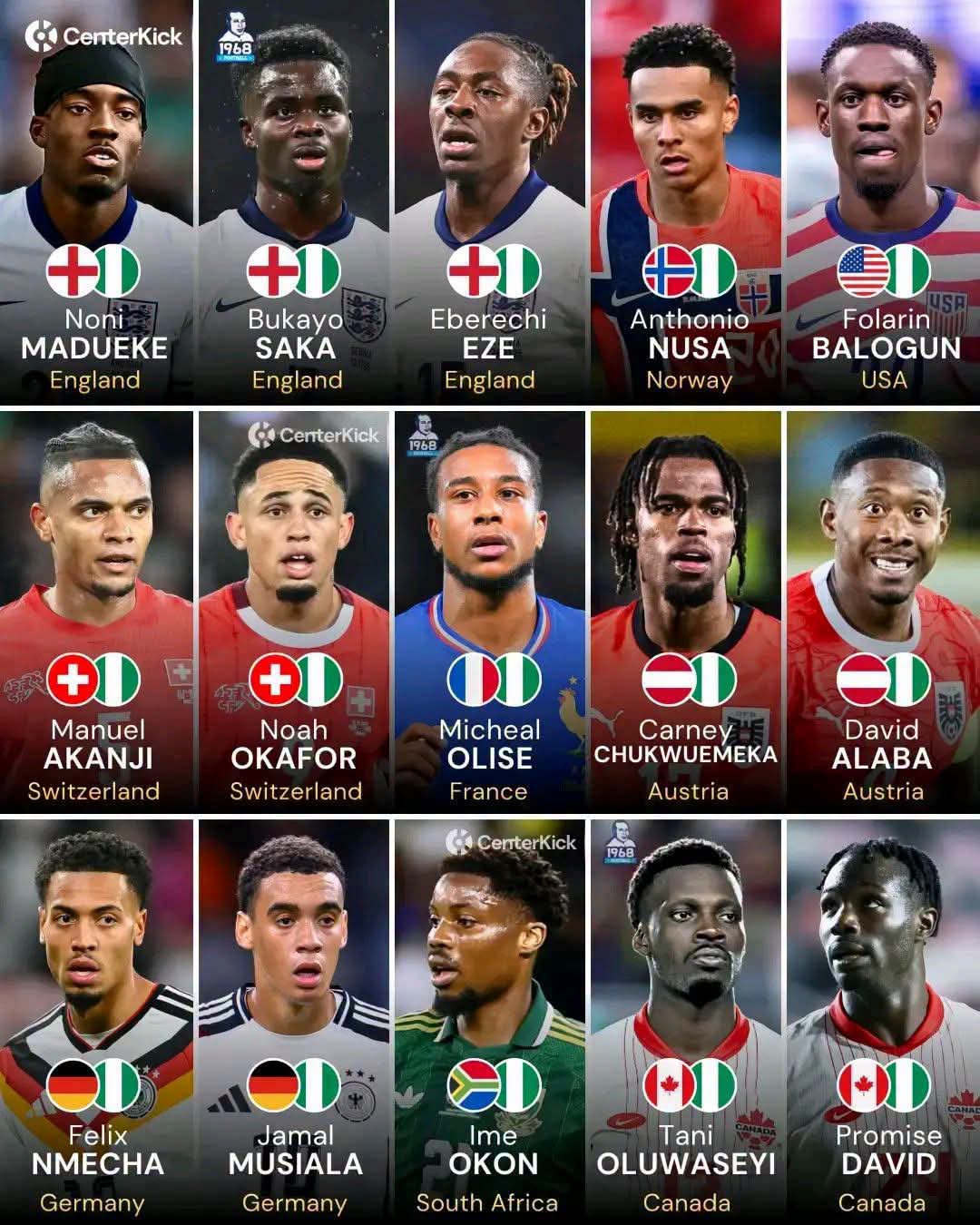
ENGLAND — Three Sons of Nigeria in the Three Lions
England have three players of Nigerian heritage in their 2026 World Cup squad, more than any other nation at this tournament. All three were on the Nigeria Football Federation’s radar at various points. All three said no to the green and white. And all three will now be among the most watched players in North America when the tournament kicks off on June 11.
1Bukayo Saka — English Player
Heritage: Yoruba Nigerian parents, both from Nigeria
Club: Arsenal
His full name tells the story before any analysis is needed. Bukayo Moses Ayoyinka Temidayo Saka. Every name in that sequence is Yoruba. Every syllable carries his parents’ homeland. And yet Saka has become one of the most important attacking players in English football over the past four years.
Born in London to Yoruba Nigerian parents, Saka visited Nigeria in 2023 and shared a video on Instagram with the caption “Ẹ kúulé o — thank you for the warm welcome.” He has said publicly that he is proud of his Nigerian heritage, that he watches Super Eagles games, and that he wishes Nigeria well. That honesty makes him easier to cheer for, even in the wrong colours.
Saka is England’s most reliable wide attacker. In a tournament where England have genuine aspirations under Thomas Tuchel, he will be central to everything they do going forward.
2Eberechi Eze — English Player
Heritage: Igbo Nigerian parents
Club: Arsenal
Eberechi Eze was born to Igbo Nigerian parents in London. Before committing to England, he attended a Nigerian youth team training camp. The NFF had a real chance. The chance passed.
Eze moved to Arsenal in January 2026 and won the Premier League with the club. Nigerian fans who watched him miss his penalty in the Champions League final against PSG recently will be familiar with his tournament heartbreak. He enters the World Cup with something to prove and the ability to prove it.
His dribbling, vision, and capacity to produce moments of individual brilliance in tight situations are qualities that Nigerian football culture has always recognised and celebrated. Watching them deployed in an England shirt is the specific bittersweet feeling this article is built around.
3Noni Madueke — English Player
Heritage: Igbo Nigerian heritage
Club: Arsenal
Noni Madueke is of Igbo Nigerian heritage and adds depth and directness to England’s attacking options. Quick, direct, and difficult to contain when he is in form, Madueke represents the sheer depth of Nigerian heritage talent available to England’s forward line — a position so rich with players of Nigerian descent that it borders on the extraordinary when you consider what all of them together could have meant for Nigeria.
GERMANY — Two Stars, Two Roads Not Taken
4Jamal Musiala — German Player
Heritage: Nigerian father, German mother
Club: Bayern Munich
Musiala’s father, Daniel Richard, was a footballer in Nigeria whose love of the game he passed directly to his son. Musiala even played for England through to Under-21 level before ultimately choosing Germany.
He has spoken honestly about the decision. “I could have played for Nigeria because it crossed my mind. I had good talks with Nigeria and Germany. So it really just came down to me and where I would feel most comfortable. So I decided to go with Germany.”
He is currently one of the two or three most naturally gifted players at this entire tournament. His ability to glide through midfields, his technical mastery, and his football intelligence are qualities that Germany did not develop alone. Nigerian roots helped build this. The international allegiance belongs to Germany. But the bloodline is Nigerian.
5Felix Nmecha — German Player
Heritage: Nigerian heritage
Club: Borussia Dortmund
Germany have named Felix Nmecha in their World Cup squad. A powerful, dynamic presence in central midfield, Nmecha brings physicality, pressing intensity, and forward runs that complement Germany’s creative players. His Nigerian heritage runs through his name and his athleticism, both of which are impossible to miss.
FRANCE — The One Who Had Four Options
6Michael Olise — French Player
Heritage: Nigerian father, French-Algerian mother
Club: Bayern Munich
The countries Michael Olise was eligible to represent at international level: England through birth, Algeria and France via his mother, and Nigeria through his father. Four nations. One player. The NFF included him as a standby for the 2021 Africa Cup of Nations qualifiers. France got there first and held on.
Olise is one of the most aesthetically pleasing players in world football right now. His movement, his finishing, and his ability to produce decisive moments in big matches make him one of the most watchable players at this tournament. Nigerian fans will cheer for him at Bayern Munich and at this World Cup while doing the unavoidable mental arithmetic of what he could have meant in green and white.
SWITZERLAND — Two Reliable Presences
7Manuel Akanji — Swiss Player
Heritage: Nigerian father, Swiss mother
Club: Inter Milan
Born to a Nigerian father, Akanji is one of the most technically accomplished defenders in world football. His ability to carry the ball out from defensive positions, his reading of the game, and his composure under elite pressure make him a foundation stone for Switzerland’s setup. The physical presence and defensive intelligence he brings to the Swiss backline carry qualities that Nigerian football fans recognise immediately.
8Noah Okafor — Swiss Player
Heritage: Nigerian heritage
Club: Leeds United
Noah Okafor has been named in Switzerland’s squad by head coach Murat Yakin. A forward with pace, directness, and the ability to impact games from wide positions or through the centre, Okafor’s Nigerian heritage sits in his name and in his athletic profile. Switzerland will be grateful for both in North America.
AUSTRIA — The Captain and the Convert
9David Alaba — Austrian Player
Heritage: Nigerian father, Filipino mother
Club: Real Madrid
Austria’s captain. One of the most decorated players of Nigerian heritage in football history. David Alaba’s father, George Alaba, moved to Austria from Nigeria. His son became a multiple Champions League winner, a Real Madrid starter, and the leader of the Austrian national team.
Alaba brings the most international experience to this list. At a World Cup where Austria are competitive without being expected to challenge the very top, his leadership will be the foundation of everything they attempt to build.
10Carney Chukwuemeka — Austrian Player
Heritage: Nigerian heritage
Club: Borussia Dortmund
Background: Previously eligible for England before switching allegiance to Austria
Carney Chukwuemeka recently switched his international allegiance to Austria and was selected in Ralf Rangnick’s squad alongside captain Alaba. A player who came through the English academy system, was eligible for Nigeria, and ultimately chose Austria, his creative midfield presence gives Rangnick’s side genuine technical quality in the centre of the park.
NORWAY — Playing Alongside Haaland
11Anthonio Nusa — Norwegian Player
Heritage: Nigerian heritage
Club: RB Leipzig
Nusa is one of Norway’s most exciting young attacking players and at this World Cup he will line up alongside Erling Haaland, the most lethal striker in the tournament. His pace, directness, and ability to run at defenders make him a genuine wide threat. For Nigerian fans watching Norway, Nusa gives them a direct bloodline reason to cheer Haaland’s supporting cast as loudly as the main man himself.
USA — The Triple-Eligible Forward
12Folarin Balogun — American Player
Heritage: Nigerian heritage, born in the United States, raised in England
Club: Monaco
Balogun’s eligibility story is one of the most layered on this entire list. Born in the USA to Nigerian parents, raised in England, developed through Arsenal’s academy, represented England at youth level, then switched allegiance to the United States senior team.
Three countries. One player. Nigeria never truly entered the conversation at the decisive moment. Now he carries American colours into a World Cup played on home soil, which means his matches will be played in front of partisan crowds who consider him entirely their own.
SOUTH AFRICA — The Bafana Bafana Connection
13Ime Okon — South African Player
Heritage: Nigerian heritage
Club: Hannover 96
Background: Born to Nigerian parents, represents Bafana Bafana
Ime Okon’s inclusion in Hugo Broos’ squad for Bafana Bafana is the most direct illustration of the Nigerian diaspora’s reach across African football specifically. Playing for a fellow African nation rather than a European one, his story carries a different character from the others on this list. Nigerian heritage contributing to African football rather than being absorbed into European international structures.
CANADA — Two Names That Carry Nigeria to North America
14Tani Oluwaseyi — Canadian Player
Heritage: Nigerian heritage
Club: Villarreal CF
Background: Chose Canada over Nigeria
Oluwaseyi’s Nigerian surname tells the heritage story before a single career statistic is mentioned. One of Canada’s most promising forwards, he is part of a generation of Canadian players with African roots who are transforming how the country competes in international football. Canada play on home soil at this World Cup and Oluwaseyi will be part of that moment.
15Promise David — Canadian Player
Heritage: Nigerian heritage
Club: Canadian setup
Promise David. His name alone carries the full weight of Nigerian Christian naming tradition into a Canadian football shirt. His presence in Canada’s squad alongside Oluwaseyi means that Nigerian heritage is doubly represented in a team playing in front of home crowds. Two Nigerian names. One Canadian badge. The complicated story of the diaspora captured in a squad list.
The Question That Will Not Go Away
Former Super Eagles striker Peter Odemwingie asked it publicly and directly: “How will Nigeria win the World Cup when our good players play for England?”
It is the right question and the honest answer is uncomfortable. These players did not abandon Nigeria. In many cases, Nigeria’s structures did not fight hard enough or move quickly enough to keep them. By the time the NFF expressed serious interest in several of these players, England, Germany, and France had already built years of relationship with them through academy systems, youth competitions, and consistent selection.
The pathway to wearing a Super Eagles shirt must be made more attractive, more certain, and more professionally managed if the next generation of Nigerian heritage players born abroad is going to choose green and white over what is being offered elsewhere.
As I said at the beginning, the feeling watching all of this is genuinely mixed. Pride in the talent. Frustration at the system. And the quiet, persistent belief that Nigeria’s football potential, if ever properly organised and sustained, is capable of producing something the world has not yet fully seen.
The Super Eagles are not at the 2026 World Cup. But fifteen players who carry Nigerian blood in their veins will be. Watch them. Be proud of what Nigeria produces. And then demand better from the people responsible for ensuring that production stays at home.
Which of these 15 Nigerian heritage players are you most excited to watch at the 2026 World Cup? And which one do you most wish had chosen the Super Eagles? Drop your answer in the comments below.