
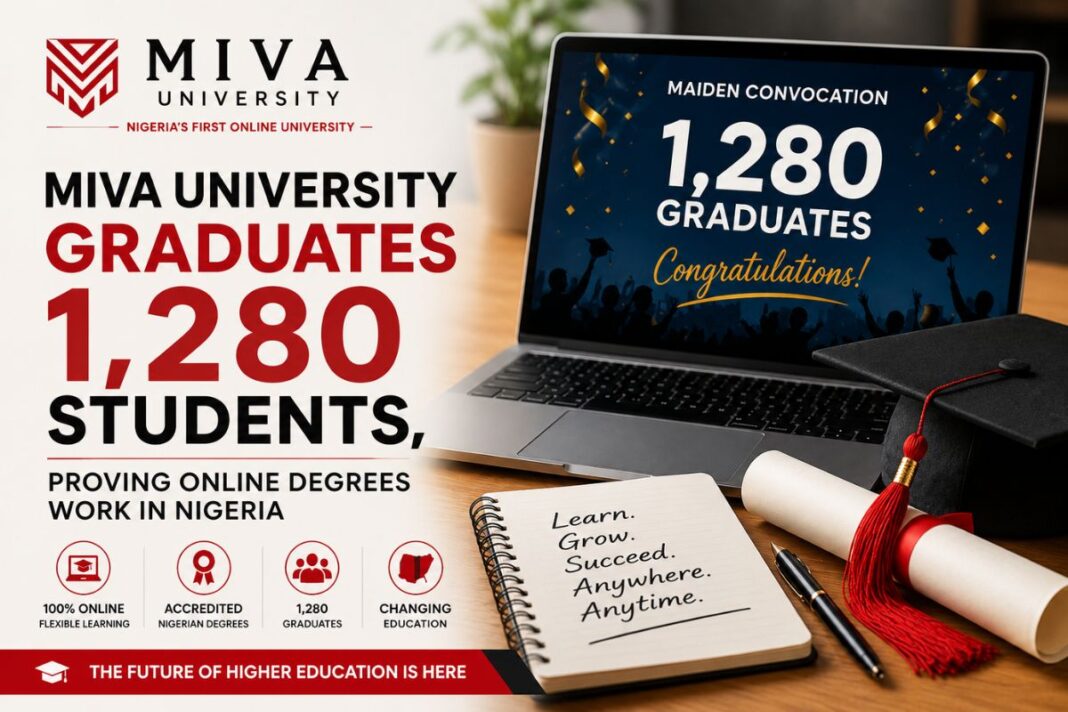

When I came across the news that Miva Open University had graduated 1,280 students at its maiden convocation, I wasn’t surprised. Not even slightly.
That isn’t arrogance. It’s the perspective of someone whose career has been shaped largely by online learning.
Over the past 10 to 15 years, about 90 percent of the professional skills I use today have come from the internet. Web development, digital transformation, SEO, artificial intelligence, content creation, WordPress, business strategy, and Learning Management Systems (LMS). I learned through blogs, YouTube, online courses, webinars, membership communities, documentation, and countless hours of self-directed study. The remaining 10 percent came from physical workshops, seminars, and short training programmes.
That experience has made me a long-time advocate of online learning.
Not because I reject the traditional classroom. I don’t. Brick-and-mortar universities continue to play an important role in education, research, and personal development.
But I have always believed that people should have the freedom to learn in the way that works best for them.
Freedom to learn at their own pace.
Freedom to build new skills regardless of where they live.
Freedom to study while working, raising a family, or running a business.
Freedom to earn a quality education without geography, financial limitations, or rigid schedules becoming barriers to opportunity.
That is why Miva’s achievement matters.
When Nigeria’s first fully online private university graduated 1,280 students, I didn’t see just another convocation ceremony. I saw proof that online learning is no longer an alternative. It is becoming an accepted and credible pathway to higher education.
For me, the moment wasn’t surprising.
It was validating.
You may also like;
- Top Scholarships Nigerians Can Apply for in 2026 — Fully Funded Opportunities Across the World
- What Is Social Learning? Features, Benefits and Best WordPress Platforms in 2026
- JAMB 2026 Policy Meeting: Full Summary of Key Updates Every Candidate Must Know
- Best Free Online Courses for Career Growth
What Actually Happened at the Miva Convocation
Nigeria’s first licensed online private university held its first-ever graduation ceremony, and the numbers tell the story clearly.
Of the 1,280 graduates, 241 were undergraduate students and 1,039 were postgraduate students. That postgraduate majority is significant. It tells you exactly who used this platform in its first cycle. Working adults. Professionals who already had jobs, businesses, and family responsibilities and still chose to open a laptop at ten o’clock at night to earn a higher qualification.
The university’s founder and chancellor, Sim Shagaya, acknowledged this directly at the ceremony. He described the graduating class as people who balanced full day jobs with late night studying, mothers and fathers who wondered whether a degree earned online at a young Nigerian university would be respected. He told them plainly that they did not quit.
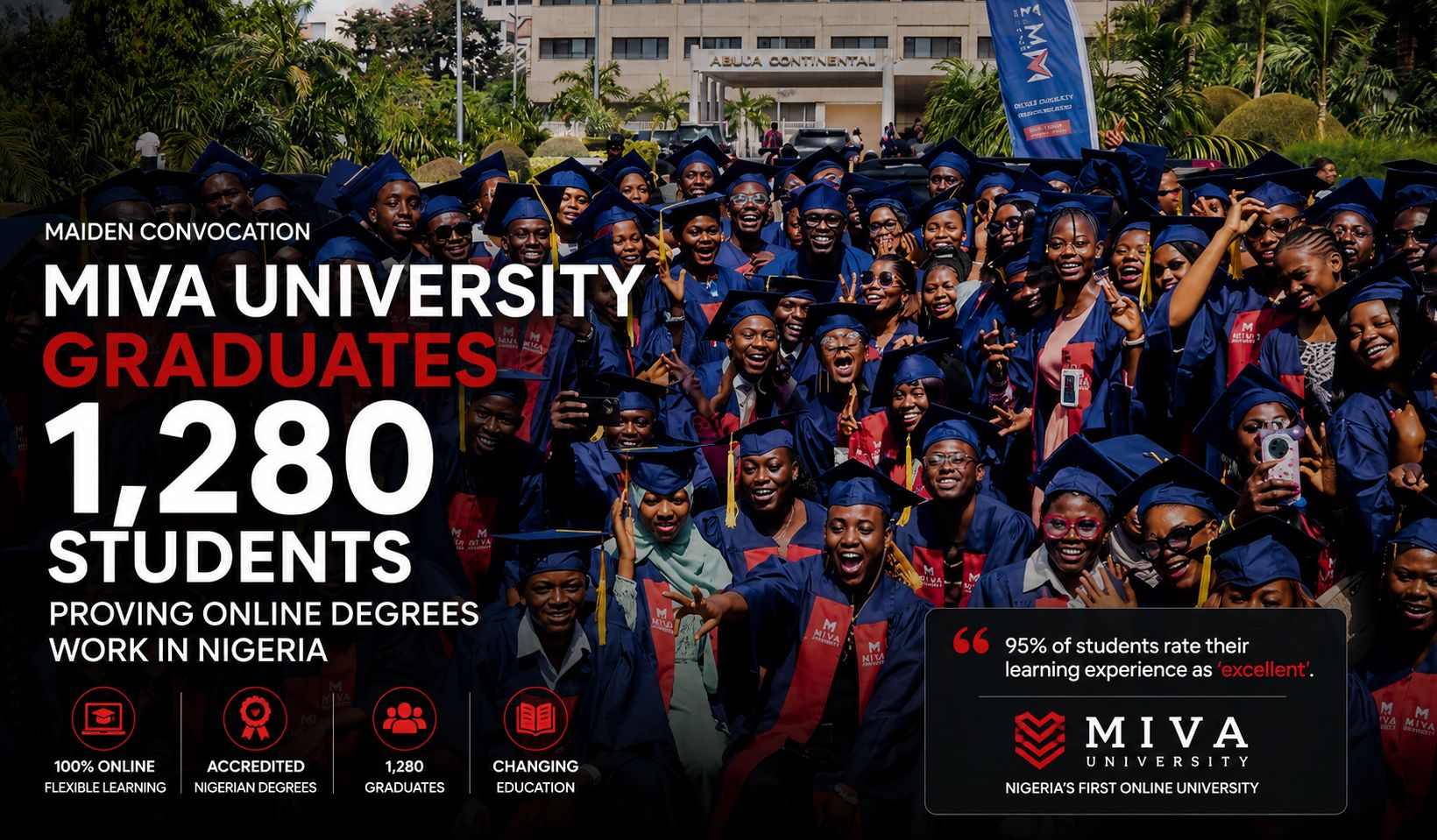
That is not a small thing. That is a story about determination meeting opportunity and what happens when both arrive at the same time.
The university’s vice-chancellor, Tayo Arulogun, described Miva’s founding conviction clearly. They refused to accept that high-quality tertiary education should be a scarce commodity limited by geography, infrastructure, or circumstance. That sentence could have served as the mission statement of every serious eLearning platform ever built. It is the foundational argument for why online education exists.
The best graduating student, Michael Ibie, achieved a perfect 5.0 CGPA. He said the flexibility of Miva’s model allowed him to pursue academic excellence while managing other responsibilities. His point was simple and important. Online learning did not lower the standard. It removed the barriers to reaching it.
My Greatest Classroom Was the Internet
That statement may sound unusual to some people. But it is the truth.
Over the years, I have attended a few physical training programmes, workshops, seminars, and short courses. Some lasted a day. Others lasted a few days. They were useful and I learned valuable things from each of them.
But if I were to honestly estimate where the professional skills I use today actually came from, I would say perhaps 10 percent came from those physical training environments.
The remaining 90 percent came from the internet.
I learned through blogs. I learned through YouTube. I learned through online courses. I learned through membership communities. I learned through forums and webinars. I learned by following experts, reading articles, testing ideas, making mistakes, and continually improving.
Most of what I know today about web development, digital transformation, SEO, content creation, WordPress, artificial intelligence, online business, and learning management systems came through self-directed online learning. I have spent years building eLearning platforms and setting up Learning Management Systems using WordPress, and every technique, every tool, and every approach I used was something I discovered and taught myself through the internet.
Nobody handed me a curriculum. Nobody monitored my attendance. Nobody forced me to study. The motivation came from curiosity and the desire to grow.
That experience has convinced me of something that I believe deeply. Learning is not defined by a location. It is defined by access, commitment, and consistency.
A classroom can accelerate learning. A great teacher can inspire it. But ultimately, the responsibility to learn rests with the learner. Technology simply makes that journey more accessible than it has ever been before.
So when Miva’s 1,280 graduates walked across that stage, I understood something about each of them that their certificates cannot fully capture. They chose to learn. They made that choice repeatedly, night after night, in the face of doubt and fatigue and the very real question of whether it would all count for something. And they saw it through.
That is not an easy thing. Most people never do it.
Why This Moment Matters for Nigerian Education
Nigeria has a university access problem that has been documented for years. Millions of qualified candidates apply for university places annually, and millions do not get in. JAMB processes over one and a half million candidates every year. The physical universities cannot absorb them all. Infrastructure cannot be built fast enough. Lecturers cannot be trained fast enough. The gap between demand and supply has been widening for decades.
Online education is not a complete solution to that problem. But it is a serious, scalable, and immediate partial answer.
The Minister of Education, Tunji Alausa, was present at the Miva convocation, and his words were direct. He said the world is changing rapidly, that artificial intelligence is redefining industries, and that in such a world, universities must also evolve. He described Miva’s model as the democratisation of knowledge, educational access at scale, and flexibility without compromising quality.
The Emir of Kano, Muhammadu Sanusi, who delivered the keynote address, described Nigeria as a nation of extraordinary human capital sitting on decades of unrealised potential. His point was that this graduating class, educated, digitally comfortable, and adaptable, represents exactly what Nigeria needs right now. A generation that is not waiting for the old systems to catch up.
He is right. And the same observation applies to every Nigerian who has been learning online, building skills through digital platforms, and developing themselves outside traditional institutional structures. That population is far larger than most people realise. Miva’s graduating class is the visible, accredited proof of it.
The Concerns That Deserve Honest Acknowledgement
Online education in Nigeria still faces real challenges, and it would be dishonest to celebrate this milestone without naming them.
Employer perception is not yet uniform. Some Nigerian organisations and industries still treat online degrees with residual scepticism, even when the institution is accredited and the curriculum is rigorous. That perception will change, but slowly. It requires consistent demonstration of quality by graduates who prove their competence in the workplace, not just on paper.
Infrastructure remains uneven. Reliable internet access and consistent electricity are still not guaranteed across large parts of Nigeria. Online learning at its best requires both. Students in areas with poor connectivity face genuine barriers that motivation alone cannot overcome. This is a structural challenge that extends well beyond education policy.
Quality control across the broader online education sector is also inconsistent. Miva has gone through formal accreditation and operates under regulatory oversight. Not every organisation offering online learning in Nigeria can say the same. Growth in this sector must be accompanied by stronger standards that protect learners from platforms that promise credentials without delivering genuine learning.
These are real concerns. They do not diminish what Miva has achieved. They define the work that still needs to be done.
What Miva Open University Is Building Toward
The ambition Miva has stated publicly is significant. The vice-chancellor announced scholarship commitments worth three billion naira and confirmed that the university is investing in robotics, drone technology, cybersecurity, and artificial intelligence-driven learning systems. The stated goal is to empower one million Africans through education by 2030.
One million learners by 2030 is a serious number. It would represent a scale of educational access that no physical university in Nigeria has achieved in that timeframe. If even a fraction of that ambition is delivered with the quality that produced a 5.0 CGPA graduate in the first cohort, it will represent a genuinely transformative contribution to Nigerian human capital.
The Lagos State Governor, Babajide Sanwo-Olu, represented at the ceremony, described the convocation as a historic milestone and committed Lagos State’s support for institutions that expand access to education for the digital economy. That kind of institutional backing matters for the long-term credibility and sustainability of online education in Nigeria.
A Word to Every Nigerian Who Has Been Learning Online
If you are someone who has been building your skills through YouTube, blogs, online courses, and digital platforms and wondering whether it counts, whether it will be recognised, whether the learning is legitimate — Miva’s graduating class is evidence that the answer is moving firmly toward yes.
The 1,280 people who graduated include people who studied at ten o’clock at night after putting their children to bed. People who completed coursework on a commute. People who chose education over convenience and growth over the easier option of staying exactly where they were.
They did not quit.
And here is what I want every self-directed online learner in Nigeria to understand. The knowledge you have built through blogs, YouTube, courses, and communities is real. The skills are real. The gap between informal online learning and formally recognised online education is narrowing. Miva represents one end of that narrowing. You represent the other.
The classroom is wherever you decide it is. It always has been. Nigeria just officially confirmed it.
*Are you considering an online degree or have you already completed one? What has your experience been with online learning in Nigeria? Drop your thoughts in the comments. This is a conversation worth having.*


