

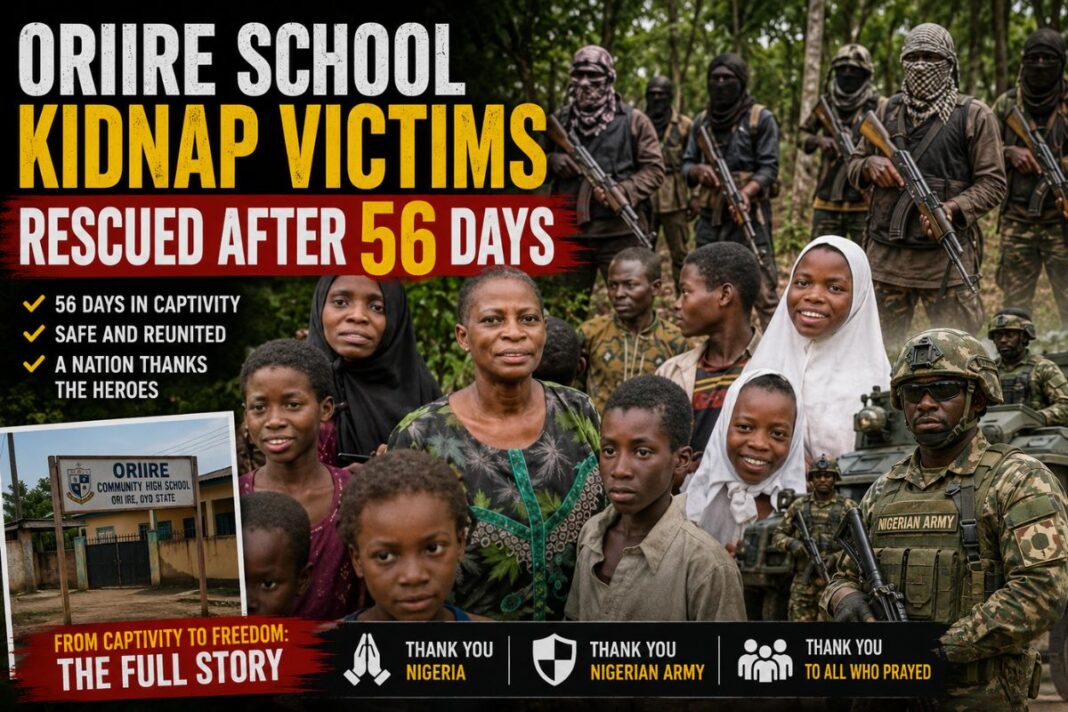

Oriire School Kidnap Victims Rescued After 56 Days: Full Story of Nigeria’s Most Heartbreaking Abduction
On the morning of May 15, 2026, children were sitting in their classrooms in Oriire Local Government Area of Oyo State. Some were as young as two years old. Others were teenagers preparing for examinations. Their teachers were at the front of the room. It was an ordinary Thursday morning.
Then the gunmen came.
Heavily armed men riding motorcycles arrived simultaneously at three schools in the Yawota and Ahoro-Esinele communities. They fired shots. They seized the children. They took the teachers. They grabbed a school principal. Within minutes, they had disappeared into the surrounding forest with 46 people, including a toddler, leaving behind terrified communities, grieving families, and a nation that would spend the next 56 days holding its breath.
On Friday, July 10, 2026, the Presidency of the Federal Republic of Nigeria confirmed that every one of those victims had been rescued. Eight of their captors were in the custody of the Department of State Services. Others had been killed during the rescue operation.
The 56-day ordeal of the Oriire school kidnapping was over. But the story of what happened between May 15 and July 10, and the questions it raises about the safety of Nigerian children in their own schools, deserves to be told in full.
You may also read;
- When the Mob Becomes Judge, Jury and Executioner
- FAAC Windfall and the Missing Development Dividend: What Are Nigerian Governors Doing With the Money?
- When the Pepper Reaches the Pepper Seller’s Eye: The Lessons Nigeria Keeps Refusing to Learn
- What Nigerians want from the next President
THE ATTACK: WHAT HAPPENED ON MAY 15
The morning of May 15 began like any other school day in the Oriire communities of Yawota and Ahoro-Esinele. Children had been dropped off by parents. Teachers had arrived and begun lessons. The day was already underway.
The attackers moved with coordination and speed that suggested advance planning and knowledge of the schools’ layouts. They struck three institutions simultaneously, which prevented any early warning from one school reaching the others in time to mount any defence or allow escape.
Baptist Nursery and Primary School in Yawota was the first target. Community High School in Ahoro-Esinele and L.A. Primary School in Ahoro-Esinele were hit at the same moment. Gunshots were fired to subdue resistance and create panic. Children were pulled from classrooms. Teachers who tried to intervene were overpowered.
When the attack ended, 39 pupils and 7 teachers had been taken. The victims ranged in age from two years old to 16. One teacher was killed during the assault itself. The remaining 46 were marched into the forest.
One teacher, Michael Oyedokun, would later be killed in captivity. His death was confirmed by security sources during the weeks of the ordeal and was formally acknowledged by President Tinubu during the rescue announcement. Oyedokun’s family were promised justice and accountability by the President.
The communities left behind were shattered. Parents gathered at the school gates unable to comprehend what had happened to their children. Local officials scrambled to alert state and federal authorities. And the news began to spread across Nigeria with the kind of speed that only horror generates.
THE KIDNAPPERS’ DEMANDS
Within days of the abduction, the identity of the group responsible and the nature of their demands began to emerge through communications with state government officials and security agencies.
The kidnappers were identified as suspected bandits with links to Boko Haram and Ansaru, the terrorist organisations that have operated across Nigeria’s North-West and North-Central zones and whose reach had now extended into Oyo State’s forest regions.
Their demands were stark. They wanted the release of two detained commanders. Mahmud Usman, known by the alias Abu Bara’a, and his deputy Abubakar Abba. Both were described as Boko Haram and Ansaru commanders who had been arrested by Nigerian security agencies and were being held for terrorism-related offences.
The Nigerian government refused.
This refusal was significant and deliberate. Releasing detained terrorist commanders in exchange for kidnap victims would have set a precedent with consequences far beyond a single rescue operation. It would have confirmed to every criminal and terrorist network in the country that attacking schools and taking children was an effective strategy for securing the release of their imprisoned colleagues.
The government held its position through 56 days of intense public pressure, media scrutiny, family anguish, and what one source described as multiple waves of misinformation that falsely claimed the victims had already been released.
THE 56 DAYS: A TIMELINE OF ANGUISH
May 15, 2026: Attack on three schools in Oriire LGA. 39 pupils and 7 teachers abducted. One teacher killed during the assault.
May 16 to 20: News spreads nationally. Parents hold vigils at school gates. Governor Seyi Makinde visits affected communities and pledges the full resources of Oyo State to secure the victims’ release. Federal security agencies deploy to Oyo State.
Late May: The Nigeria Union of Teachers describes the attack as barbaric and inhuman and warns that continued assaults on schools could force teachers nationwide to withdraw their services. Protests by teachers in Ogbomoso draw national attention.
June 1: The Nigeria Union of Teachers declares an indefinite strike across Oyo State public primary and secondary schools. Teachers withdraw services, demanding the government secure the victims’ release before schools reopen. Solidarity rallies follow across state capitals on June 2.
Early to mid June: At least three separate waves of misinformation falsely claim the victims have been released. Families of the victims describe the false reports as cruel additional trauma inflicted on people already living with unbearable uncertainty.
Mid June: President Tinubu approves the recruitment of 1,000 forest guards for Oyo State and directs a specialised rescue unit to intensify operations in the forest regions where the victims are believed to be held. Security sources report that troops are making progress but the terrain is difficult and the kidnappers are moving the victims frequently to avoid detection.
Late June: Reports emerge that the kidnappers had opened communication channels with the state government, repeating their demands for the release of the two Boko Haram commanders. The government rejects the demand again. Security operations continue.
July 5: The Chief of Army Staff, Waidi Shaibu, tells the public that troops are making tremendous progress towards freeing the schoolchildren and teachers. Families allow themselves cautious hope.
July 10: The Presidency confirms all victims have been rescued. Eight kidnappers are in DSS custody. Several others were killed during the operation.
HOW THE RESCUE HAPPENED
The full operational details of the rescue are still being compiled by security agencies who have promised a comprehensive account. But sources with direct knowledge of the operation have provided an early picture of what happened.
The rescue was not a single moment. It was the culmination of 56 days of coordinated intelligence gathering, military operations, and strategic pressure applied by multiple agencies simultaneously. The operation involved the Nigerian Army, the Nigeria Police Force, the Department of State Services, and the Office of the National Security Adviser, all working together under a coordinated command structure.
One particularly significant tactic was the sabotage of food supply chains to the forest reserve where the terrorists were camping. Military personnel disrupted the routes through which the kidnappers received provisions from outside their camp. As supplies dwindled, the group’s ability to sustain their position weakened.
Associates of the kidnappers who lived outside the forest camp were identified and picked up by security forces. This removed people who had been providing logistical support and intelligence to the kidnappers and further weakened the group’s operational capacity.
The combination of military pressure, supply disruption, and the removal of outside support eventually brought the kidnappers to a point where their position was no longer tenable. The rescue operation was executed at that moment of maximum vulnerability.
Eight of the kidnappers were arrested alive and are now in DSS custody for interrogation and prosecution. Several others were killed during the operation. The one demand the kidnappers had made throughout- the release of the terrorist kingpin whose freedom they sought- was never granted. He remains in custody and is being prosecuted for his crimes.
THE MOMENT OF FREEDOM
When the rescued victims emerged, the images that were shared by the Presidency showed children eating biscuits and a teacher, identified as the vice principal of Community Grammar School, Alamu Folawe, speaking directly to President Tinubu.
“Hello sir, our father, we are grateful,” she said. “Mr President, sir, we are grateful. We understand your commitment to our safety and we appreciate all you did for us.”
Folawe had previously appeared in propaganda footage released by the kidnappers during the captivity, where she had been filmed pleading with the government to meet the abductors’ demands. The contrast between that footage, a woman under duress in a forest, and the footage of her standing free, speaking with dignity and gratitude, captured the full weight of what the 56 days had meant and what the rescue represented.
The children were seen joining the teacher in expressing thanks, their voices small but present. They were alive. They were out. The long nightmare was over.
PRESIDENT TINUBU’S RESPONSE
President Bola Ahmed Tinubu expressed what he described as profound joy at the successful rescue, praising the military, the DSS, and the Nigeria Police Force for what he called their tireless efforts over 56 days.
In a statement issued through his Special Adviser on Information and Strategy, Bayo Onanuga, the President said: “I am profoundly happy that our security forces successfully rescued the abducted pupils and teachers from Orire, Ogbomoso in Oyo State today after a military, police and intelligence-driven operation that neutralised some of the terrorists that perpetrated the evil act and the arrest of eight of them.”
Tinubu also sympathised directly with the rescued victims and their families for the trauma of the prolonged captivity. He directed relevant emergency response agencies to work with the Oyo State Government to provide the victims with medical care, psychosocial support, and other necessary assistance.
He commended the Oyo State Government under Governor Seyi Makinde for its cooperation throughout the operation and urged the state to strengthen security around schools to prevent similar attacks.
The President also pledged justice for the family of Michael Oyedokun, the teacher who was murdered in captivity.
THE QUESTIONS THAT REMAIN
The rescue is cause for genuine relief, and the security agencies that executed this operation deserve acknowledgement for their persistence and professionalism over 56 days of extremely difficult operational conditions.
But the rescue of victims is not the same as the resolution of the problem that produced the kidnapping.
Three schools in a state capital region of southwest Nigeria were simultaneously attacked in broad daylight by heavily armed men who were able to seize 46 people and disappear into a nearby forest. They then held those victims for 56 days despite the deployment of federal and state security resources to recover them. This timeline raises fundamental questions about the security of Nigeria’s schools and communities that cannot be answered by a rescue alone.
How did the attackers have sufficient intelligence about three schools to strike them simultaneously without prior detection by local security? Who in the community was providing logistical support to the kidnappers, and how deep does that support network extend beyond the individuals arrested? What has changed structurally in Oyo State’s security arrangements around schools since May 15 that would prevent an identical attack tomorrow?
The NUT strike, which was suspended in early July as the rescue operation intensified, had exposed something important about the state of security around Nigerian educators. Teachers had reached the point where they were unwilling to enter classrooms because they genuinely did not know if they would leave them. That fear does not disappear with one rescue, no matter how successful.
The 1,000 forest guards whose recruitment President Tinubu approved during the crisis are a meaningful step. But forest guards are a response to the symptom. The deeper question is what combination of poverty, radicalisation, and institutional failure is producing the young men who are willing to ride motorcycles into a primary school and drag two-year-old children into a forest.
Those questions require honest, sustained engagement from every level of Nigerian government and society. A rescue ends a crisis. It does not address a condition.
A WORD FOR THE VICTIMS
Thirty-nine children went to school on May 15 and did not come home that evening. Seven teachers left for work that morning and were taken before they could complete the day. One teacher was killed in that attack. Another died in captivity, his name now forever connected to this story.
The children who survived 56 days in a forest captivity are not the same children who sat in those classrooms that Thursday morning. Trauma of this depth and duration does not resolve itself. It requires time, professional support, community love, and the kind of patient, consistent care that sees beyond the immediate relief of rescue to the longer journey of recovery.
Nigeria celebrated their return today. The next responsibility is to see that celebration turn into sustained support for children and adults who experienced something no human being, and certainly no child, should ever have to endure.
They are home. The work of healing begins now.
WHAT HAPPENED: KEY FACTS AT A GLANCE
| Detail | Information |
|---|---|
| Date of abduction | Thursday, May 15, 2026 |
| Location | Oriire Local Government Area, Oyo State, Nigeria |
| Schools attacked | Baptist Nursery and Primary School (Yawota), Community High School (Ahoro-Esinele), L.A. Primary School (Ahoro-Esinele) |
| Total victims abducted | 46 (39 pupils and 7 teachers including a toddler as young as 2 years old) |
| Teacher killed during attack | 1 teacher killed during the initial assault |
| Teacher killed in captivity | Michael Oyedokun (murdered by abductors during captivity) |
| Days in captivity | 56 days |
| Date of rescue | Friday, July 10, 2026 |
| Kidnappers arrested | 8 in DSS custody |
| Kidnappers killed | Several neutralised during rescue operation |
| Ransom paid | No. No concession made to kidnappers |
| Kidnappers’ demand | Release of Boko Haram/Ansaru commanders Mahmud Usman and Abubakar Abba. Demand was refused. |
| Agencies involved in rescue | Nigerian Army, Nigeria Police Force, DSS, Office of the National Security Adviser (ONSA) |
| Presidential confirmation | President Bola Tinubu via Bayo Onanuga, Special Adviser on Information and Strategy, July 10, 2026 |
Nigeria is relieved tonight. But the children of Oriire deserve more than relief. They deserve a country that protects them before the gunmen arrive, not only after.
Rest, recover, and heal. Nigeria is thinking of you.
Do you have thoughts on how Nigeria can better protect its schools from attacks like this? Drop your comments below. This conversation matters.