

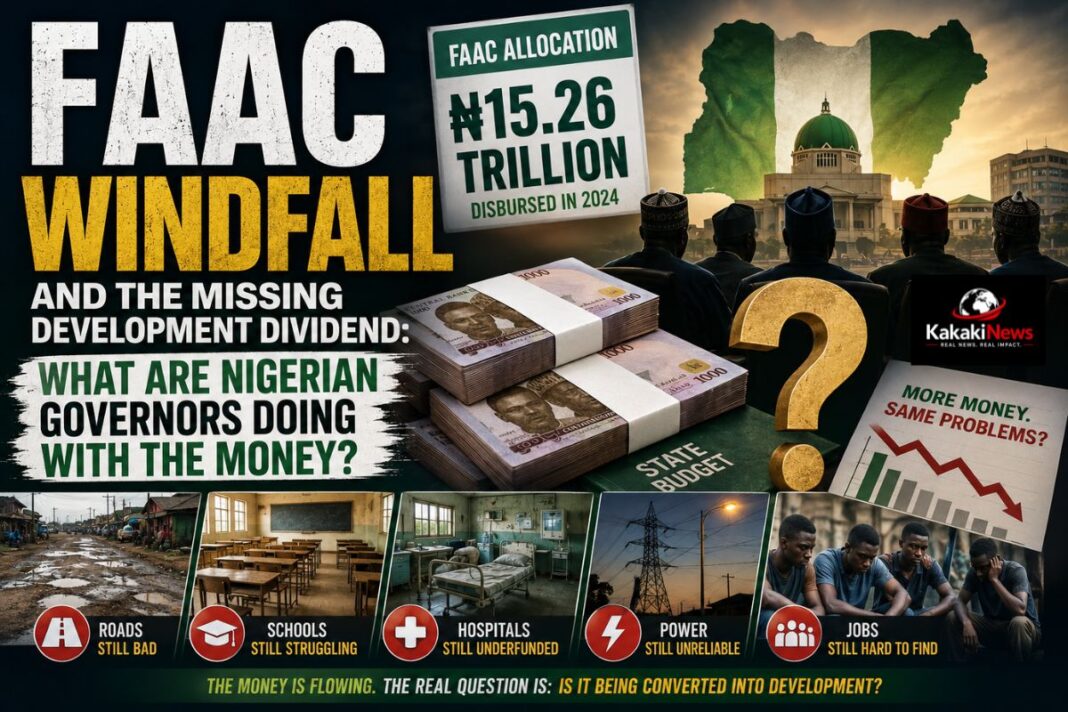

Upon the inauguration of the Bola Ahmed Tinubu administration on May 29, 2023, one of the major justifications for the removal of fuel subsidy was that it would free up resources for development at all levels of government. It’s been three years later and there is no dispute that government revenues have increased dramatically. The more difficult question is whether citizens can point to a corresponding improvement in the quality of their life.
Across Nigeria, many states are receiving far more money from the Federation Account Allocation Committee (FAAC) than they did before subsidy removal. Yet poverty remains widespread, unemployment is high, public schools and hospitals are struggling, and basic infrastructure deficits persist. This has led many Nigerians to ask a simple question: if states now have more money than ever before, where is the development?
You may also like
When the Pepper Reaches the Pepper Seller’s Eye: The Lessons Nigeria Keeps Refusing to Learn
The Revenue Explosion
According to the Nigeria Extractive Industries Transparency Initiative (NEITI), FAAC disbursed a record ₦15.26 trillion to the federal, state and local governments in 2024. This represented a 43% increase compared to previous years and was largely attributed to fuel subsidy removal and exchange-rate reforms.
The increase was not marginal. It was transformative.
Several states that previously complained of insufficient federal allocations suddenly found themselves with unprecedented revenues. NEITI reported that Lagos, Rivers, Bayelsa, Akwa Ibom, Delta and Kano each received over ₦200 billion in allocations during the period reviewed. Together, these states accounted for about one-third of all allocations to states.
In addition to FAAC receipts, every state generates Internally Generated Revenue (IGR). Lagos earns hundreds of billions annually from taxes and levies. Rivers, Delta, Ogun, Kano and several others also generate substantial revenues independently. This means governors today command far more resources than many of their predecessors.
The Puzzle of Limited Impact
If revenues have increased so dramatically, why do many citizens feel little has changed?
The answer is not that no state is performing. The answer is that the scale of visible development in many states does not appear proportional to the scale of available resources.
In numerous states, roads remain impassable, healthcare facilities lack equipment, schools remain underfunded, and youth unemployment remains alarming. Citizens often hear announcements of projects but struggle to identify transformational outcomes that match the size of government revenues.
The disconnect between public spending and public welfare has become one of the defining governance questions of the post-subsidy era.
The Abia Example
Let us look at Abia State, an interesting case study.
Abia is not among the highest recipients of FAAC allocations. States such as Lagos, Rivers, Bayelsa and Delta receive substantially more federal allocations due to population, derivation revenues and other factors. Yet Abia has attracted national attention because of visible governance initiatives under Governor Alex Otti.
One of the most significant developments is the operation of the 141MW Aba Integrated Power Project, developed by Geometric Power. The project was commissioned in 2024 and is designed to provide electricity to Aba and surrounding areas within a ring-fenced distribution zone.
While it would be inaccurate to claim that the entire state enjoys uninterrupted 24-hour electricity, many businesses and residents in the Aba ring-fenced area have reported significantly improved power supply compared to what existed previously. The project has become a symbol of what focused economic planning can achieve.
Importantly, the Geometric Power project was largely a private-sector initiative developed over many years before the current administration. Nevertheless, the state’s support and coordination have helped make the project operational. The lesson is not about who deserves credit. The lesson is that citizens can see a clear development outcome.
This raises uncomfortable questions for states receiving far larger allocations.
If Abia can point to visible improvements despite receiving less money than several oil-producing states, what explains the comparatively limited outcomes in many states that receive significantly more?
The Lagos Example: High Revenue, Visible Output
Lagos receives among the highest federal allocations in Nigeria.
However, Lagos also generates more internal revenue than all but a handful of states combined.
Critics may disagree with aspects of governance in Lagos, but few dispute that significant investments are visible in transportation, road infrastructure, urban renewal, technology, health facilities and economic development.
The lesson from Lagos is simple:
Revenue alone does not create development. Governance capacity matters.
The Oil-Producing States Question
The most difficult questions arise in relation to some oil-producing states.
States such as Rivers, Delta and Bayelsa benefit not only from regular FAAC allocations but also from the constitutional 13% derivation principle tied to oil production. Consequently, they often rank among the highest-funded states in the federation.
Yet decades after becoming some of Nigeria’s richest subnational governments, many communities in these states still struggle with poor roads, inadequate healthcare, youth unemployment and environmental degradation.
This does not mean nothing has been achieved. There have been investments in roads, schools and other infrastructure. However, relative to the enormous revenues received over many years, many analysts argue that outcomes have fallen far below expectations.
A visitor to some parts of Bayelsa or Delta may reasonably ask why states with such large revenues do not exhibit development levels closer to what similar resource-rich regions have achieved elsewhere in the world.
The Governance Deficit
The fundamental problem may not be lack of money. It may be lack of vision.
Too many state governments appear trapped in a governance model focused on recurrent expenditure, political patronage and short-term projects rather than long-term economic transformation.
Few governors have articulated credible 20-year economic plans.
Few states have clear industrialisation strategies.
Few states have developed comprehensive agricultural value chains.
Few states have created competitive technology ecosystems.
Few states have substantially improved learning outcomes despite increased funding.
In many cases, governance remains dominated by politics rather than development.
The result is predictable: more money enters government accounts, but citizens experience little change in their daily lives.
What Should Governors Be Doing?
The post-subsidy revenue windfall presented a historic opportunity.
Governors should be investing aggressively in:
Power Infrastructure: Reliable electricity remains the foundation of industrial development. The Aba model demonstrates the transformative potential of stable power.
Agricultural Industrialization: Rather than merely supporting farming, states should build processing zones that create jobs and add value to agricultural products.
Education Reform: The goal should not simply be building classrooms but producing a workforce capable of competing in a modern economy.
Healthcare Systems: Every state should have functioning primary healthcare centres, modern hospitals and emergency response systems.
Urban Development: Cities should be designed to attract investment, tourism and innovation.
Job Creation: Success should be measured by private-sector jobs created, not by the number of political appointments made.
In summary, the evidence is clear: subsidy removal significantly increased revenues available to Nigerian states. FAAC distributions reached historic levels, and most states now command financial resources unimaginable just a few years ago.
The challenge facing Nigeria today is therefore less about revenue and more about governance.
Citizens are increasingly justified in asking governors tough questions. How much money has your state received? How much has been generated internally? What measurable improvements have occurred in education, healthcare, infrastructure, power supply, job creation and poverty reduction?
The era when governors could blame Abuja for every problem is becoming less convincing. The money is flowing.
The real question is whether it is being converted into development.
History may ultimately judge many governors not by how much money entered their states, but by how little they achieved with it.