

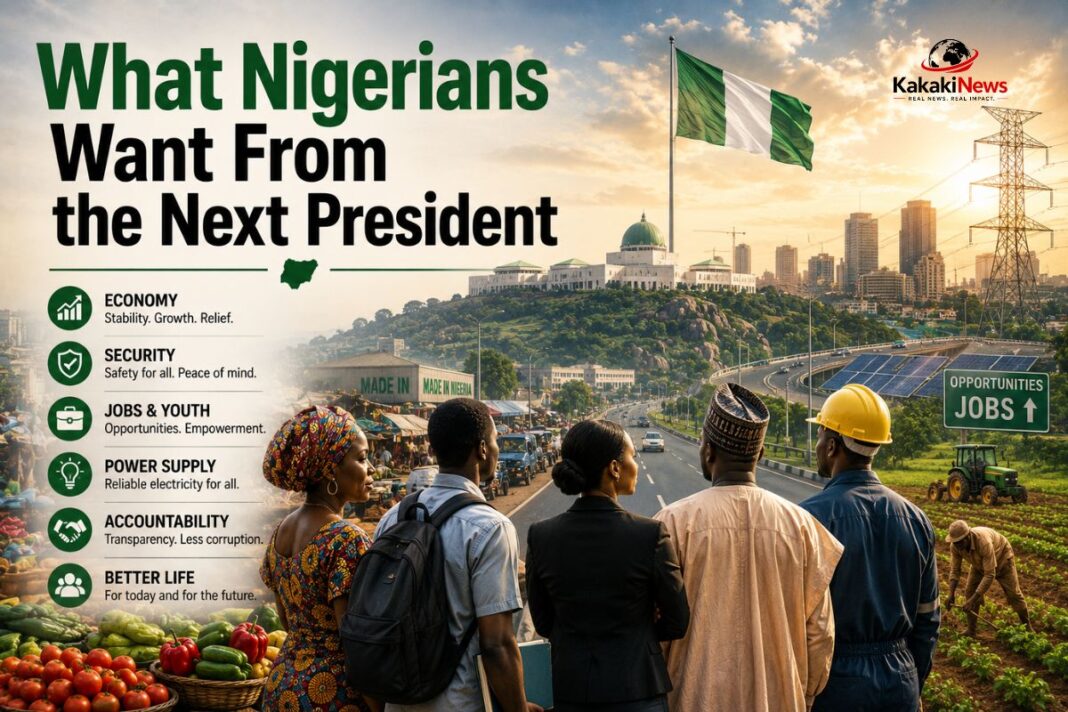

With the major political parties gradually settling on their presidential candidates ahead of the 2027 general election, Nigerians are already shifting attention from political slogans to something more important: expectations.
After years of economic hardship, insecurity, unemployment, inflation, and growing frustration with governance, many citizens are no longer interested in fancy campaign speeches. What Nigerians increasingly want is simple – competence, stability, and leadership that actually improves everyday life.
So far, the major political parties and emerging coalitions expected to shape the 2027 race include the ruling All Progressives Congress (APC), which has endorsed President Bola Ahmed Tinubu for re-election, African Democratic Congress (ADC) has produced former vice president, Alhaji Atiku Abubakar, and former Anambra State governor, Peter Obi is the candidate of the Nigeria Democratic Congress (NDC). Omoyele Sowore, Goodluck Jonathan are candidates that may likely be on the ballot.
It’s one year away from the next inauguration of the next President of the Federal Republic of Nigeria. Regardless of who eventually wins in January 2027 and gets inaugurated on May 29, 2027, Nigerians already have a long list of expectations.
The biggest expectation is economic relief.
At the moment, to say that millions of Nigerians are fraustrated is to put it mildly. Nigerian are really exhausted. Since the removal of fuel subsidy and the devaluation of the naira under the Tinubu administration, the cost of living has skyrocketed. Food prices are unbearable, transport costs are crushing families, and salaries can barely survive inflation. Nigerians want the next president to stabilise the economy in a way that ordinary people can actually feel and relate with, not only in economic reports or government press conferences as it is at the moment.
People want a president who can make the purchasing power of the naira stronger, reduce inflation, create jobs, and restore purchasing power. Nigerians are tired of “macroeconomic improvements” that do not improve life in the market, on the streets, or at home.
The second expectation is security.
From terrorism to banditry, kidnapping, communal violence, and cult-related killings, insecurity has damaged national confidence. Parents fear for children in schools. Farmers fear going to farms. Travellers fear highways. Businesses fear investing.
Nigerians expect the next president to move beyond repeated condemnations after attacks and actually build a proactive security system that prevents violence before it happens.
Another major expectation is electricity.
At this point, stable electricity supply almost feels like a national dream. Nigerians are tired of running homes and businesses on generators while paying high electricity tariffs for unreliable supply. Young entrepreneurs, tech startups, manufacturers, and small businesses all need stable electricity to survive.
Despite privatising power supply some years ago, the effect is yet to be felt by Nigerians like they experienced in the telecommunications sector. Thus, many now see constant power failure as a symbol of government failure itself.
There is also growing demand for honest governance and accountability.
The internet and social media have increased knowledge and awareness about governance. With this knowledge, citizens are becoming more frustrated by the perception that politicians continue to live comfortably while ordinary people suffer. Nigerians expect the next president to reduce wasteful government spending, fight corruption seriously, and show more empathy toward citizens.
People want leadership that looks less disconnected from reality.
Youth inclusion is another major expectation. Nigeria is a very young country, yet many young people feel politically excluded except during campaigns. The next president will face enormous pressure to create opportunities for youths through employment, education, technology, and entrepreneurship support.
The “japa” wave — where young Nigerians leave the country massively — reflects growing hopelessness. Nigerians want a country where young people can imagine a future without needing to escape abroad.
Electoral credibility will also matter. After controversies surrounding previous elections, many Nigerians want reforms that strengthen trust in democracy. Citizens increasingly want leaders produced through transparent and credible processes, not endless court battles and political manipulation.
At the same time, Nigerians are becoming more emotionally detached from politicians themselves. Personality worship is reducing. Many citizens no longer care about tribal speeches, party loyalty, or political propaganda as much as they care about survival.
In simple terms, Nigerians want results.
By May 29, 2027, whoever takes the oath of office will inherit a country full of frustration, economic pressure, and rising public anger; but also a country filled with talented, resilient, and hopeful people desperate for competent leadership.
The next president may discover very quickly that Nigerians are no longer asking for magic or miracles. They are simply asking for a government that works.


