

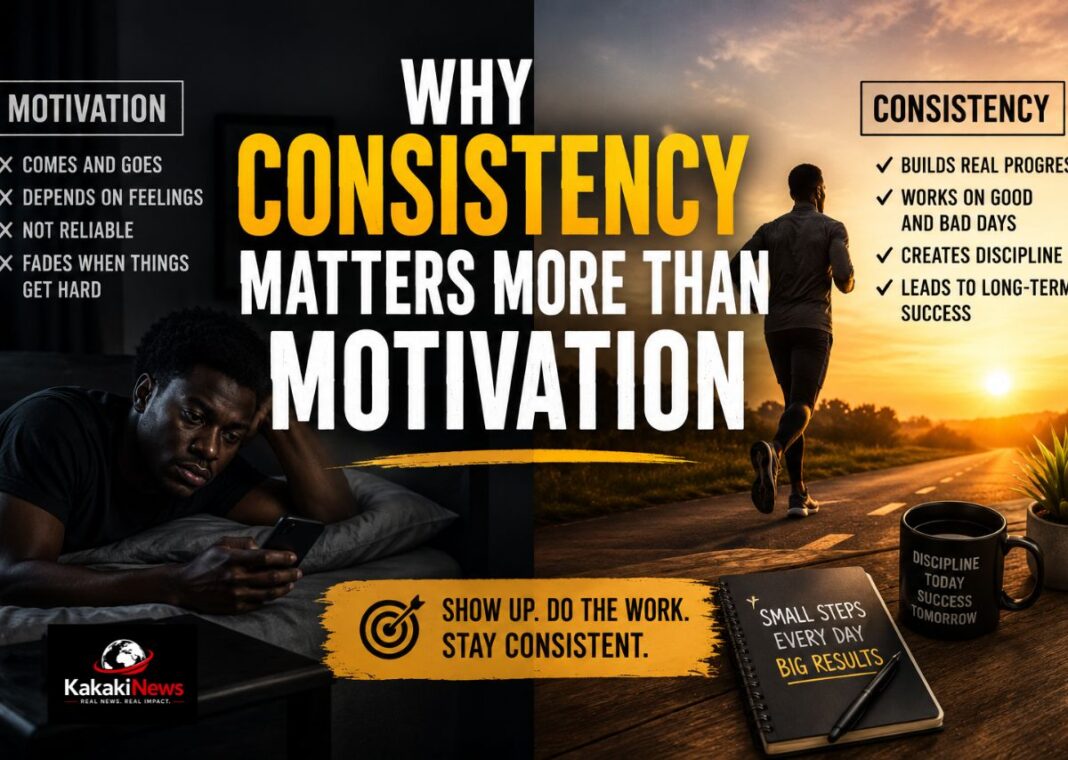

For a long time, I genuinely believed that reading and listening to motivational books and audio could spur a person to greater achievements without requiring much else. That if you just found the right speaker, the right book, the right sermon, something would permanently shift inside you and the results would follow.
Growing up, I read a lot of motivational books. Every single one got me supercharged. My adrenaline would spike. My mind would race with possibilities. I would make lists, set goals, and, in that moment, feel like the version of myself I had always wanted to become was finally within reach.
Then after a while, the flame would die. And I would be back to square one.
During my teenage years, I attended all kinds of seminars, workshops, and events featuring notable speakers across Nigeria. Those rooms were electric. The energy was real. By the time a skilled motivational speaker was in full flow, the atmosphere was nothing short of extraordinary. People were scribbling notes furiously, nodding, standing, clapping, and mentally drafting action plans on the spot. I was right there with them, feeling what I can only describe as pure ecstasy, convinced that this time something had permanently changed.
I would go home happy, full of fire, certain that my life was about to be different.
About one week later, the fire in my bones had gone out completely.
It took me some time to name what I had discovered. But eventually I understood it clearly. Motivation is an emotion. It rises and falls like all emotions do. What actually moves a life forward is not how inspired you feel. It is what you do on the days when you feel nothing at all.
The Problem With Chasing Motivation
Motivation is not worthless. That needs to be said clearly. A powerful book or a well-delivered speech can genuinely open your mind to possibilities you had not considered. It can interrupt a pattern of thinking that has been holding you in place. It can provide the initial energy you need to start something.
But starting is not the same as finishing. And inspiration is not the same as execution.
The problem is that most people treat motivation as the engine rather than the spark plug. A spark plug ignites the engine. It does not run the car. Once the engine is running, the spark plug’s job is done. The fuel, the gears, the road, and the driver’s hands are what actually take you somewhere.
Motivation is the spark plug. Consistency is everything else.
The Nigerian seminars of the 1990s and early 2000s produced rooms full of people who felt deeply, genuinely inspired for a week. Then life returned. The boss was still difficult. The rent was still due. The business still had no customers. The exam was still coming. And the feeling from the seminar had no practical mechanism for surviving contact with those realities.
No motivational speech, however brilliant, comes with a daily delivery system. That system has to be built by you. And the building of it has nothing to do with how motivated you feel.
What Consistency Actually Is
Consistency is the decision to show up for something repeatedly, regardless of your emotional state on any given day.
It is not about being perfect. A person who writes 300 words every morning, even badly, even reluctantly, even on the days when nothing flows, will have written over 100,000 words in a year. That is a full book. No single burst of motivation produces a book. A daily practice does.
It is not about doing large amounts. Many people underestimate small actions taken repeatedly because they look insignificant in isolation. Saving ₦2,000 every day feels like nothing. Over a year it is ₦730,000. Over two years it is ₦1.46 million. The number is not magic. The repetition is.
It is not about always feeling ready. In fact, the most important consistency is the kind that happens when you do not feel ready. When you are tired, discouraged, or convinced that nothing is working. That is the consistency that builds character alongside results.
The Science Behind Why Habits Beat Inspiration
Neuroscience offers a clear explanation for why this works. Every time you repeat a behaviour, the neural pathway associated with that behaviour becomes slightly stronger. The brain is literally rewiring itself around your repeated actions.
After enough repetitions, the behaviour requires less conscious effort to execute. It begins to feel automatic. You stop needing to decide whether to do it. It becomes part of who you are rather than something you have to talk yourself into.
This is why experienced athletes do not rely on motivation to train. They trained so consistently for so long that showing up became their default state. The motivation is almost irrelevant because the habit is load-bearing.
The same principle applies to writing, reading, saving money, praying, exercising, practising a skill, or running a business. In the early weeks, it requires will and conscious effort. In the later months, it becomes simply what you do.
Motivation can get you to week one. Only consistency gets you to month six.
The Trap of the Seminar High
There is a specific version of this problem that many Nigerians who have attended personal development events will recognise. The seminar high.
You pay to attend an event. The production is impressive. The speaker is charismatic. The testimonials are real and moving. The content is genuinely valuable. And you leave in a state of elevated certainty, convinced that your life is about to change dramatically.
Then Monday comes.
What happened in that room was real. The insight was real. The emotion was real. But emotions are designed by nature to be temporary. They rise in response to stimuli and they fall when the stimuli are removed. The speaker leaves the stage. The music stops. The crowd disperses. And the emotional state that felt so transformative in the room has no mechanism for surviving the ordinary demands of Tuesday.
This is not the fault of the speaker. It is not even a failure of the attendee. It is simply what emotions do. They do not last.
The people who get genuine long-term value from seminars and motivational content are not the ones who felt the most in the room. They are the ones who left the room and immediately built a small, specific daily action into their routine connected to what they learned. Not a grand transformation. One small, repeatable action. That action, sustained over weeks and months, is where the actual value of the seminar lives.
What Daily Habits Actually Look Like
The gap between where most people are and where they want to be is not usually talent. It is not opportunity, though opportunity matters. The gap is most often explained by what a person does between waking up and going to sleep on an ordinary Tuesday with no special circumstances and no emotional surge pushing them forward.
Paying attention is a daily habit. Not to everything, but to what you are trying to build. The person learning a new skill who pays careful attention during practice improves faster than the one who goes through the motions. Attention is trainable. It gets stronger the more deliberately you apply it.
Learning a small amount every day compounds. Fifteen minutes of reading in a specific area of knowledge every morning adds up to roughly 90 hours of learning per year. Ninety hours spent deliberately in any field produces a meaningful level of understanding. Most people never accumulate ninety hours in anything because they wait for motivation to study rather than simply opening the book for fifteen minutes.
Doing the next small thing when the big picture feels overwhelming is a consistency strategy. You do not have to solve the whole problem today. You have to do the next small, specific, right action. Then tomorrow, the next one after that. The accumulation of small right actions is what large achievements are made of, looked at from a distance.
Showing up for your relationships consistently matters as much as showing up for your work. Calling your parents regularly, checking in on friends, being present with your children on ordinary evenings rather than only on special occasions. These are consistency practices with compounding returns that most people only appreciate after they stop.
The Question Worth Sitting With
Think about the thing you most want to build or become in the next two years. Not the most ambitious version. Just the honest version. The career you want, the business you want to grow, the skill you want to develop, the body you want to take care of, the person you want to become.
Now ask yourself: what is the smallest daily action that is connected to that goal?
Not the most impressive action. The smallest one you would actually do tomorrow morning regardless of how you feel. The one that, if repeated every day for twelve months, would produce a result you cannot currently see from where you stand.
That action is worth more than the next seminar you attend. It is worth more than the next motivational book you buy. It is worth more than the best speech any speaker in Nigeria has ever delivered to a room full of excited people.
Because that action, repeated daily for a year, is not motivation. It is your life, being built one ordinary day at a time.
Motivation is a visitor, a ginger. It comes, it energises you, and it leaves. Consistency is a resident. It stays. And over time, it builds things that no visitor, however inspiring, could ever build on its own.
Show up tomorrow. Not because you feel like it. Because you decided to.
That decision, made on an ordinary morning with no adrenaline and no seminar energy, is the one that changes everything.