

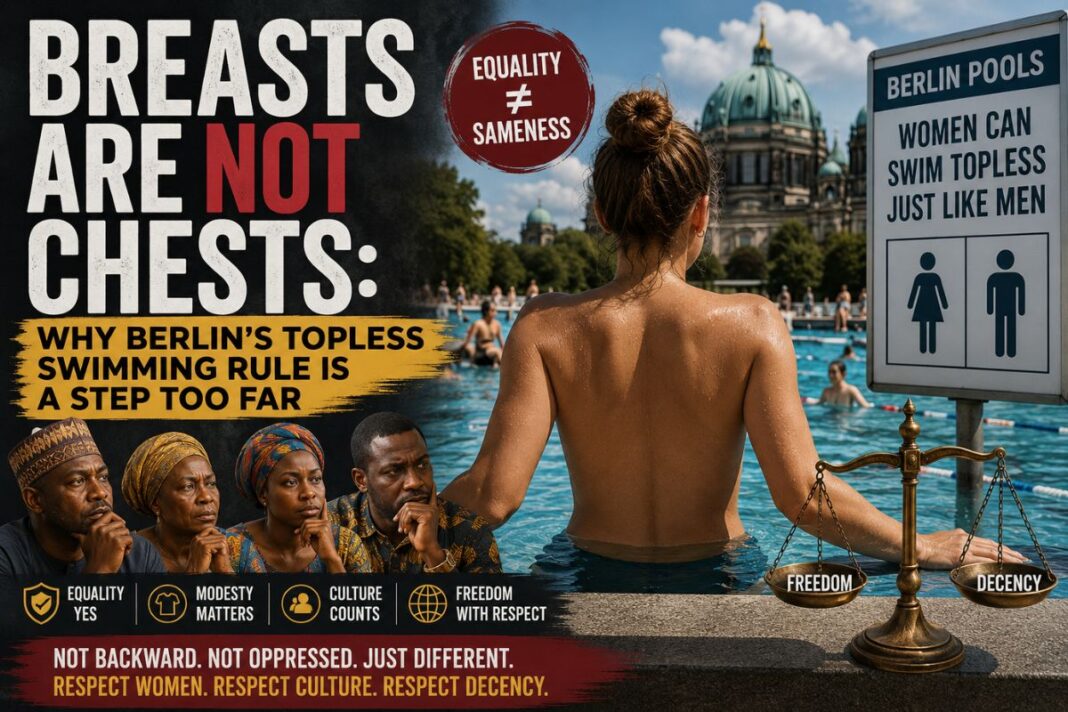

When Berlin authorities announced that women could now swim topless in public pools just like men, supporters hailed the decision as a victory for gender equality and body freedom. The ruling followed a discrimination complaint by a woman who was asked to leave a public swimming pool after going topless. Authorities eventually concluded that female breasts should not be treated differently from male chests under bathing regulations.
To many in Europe’s liberal circles, the decision is being celebrated as a progressive step forward. To many Africans, however, it is likely to be viewed as a step in the wrong direction.
The issue is not whether women deserve equal rights. They do. The issue is whether equality requires society to ignore obvious biological, cultural and moral distinctions between men and women.
You may also like;
- When the Pepper Reaches the Pepper Seller’s Eye: The Lessons Nigeria Keeps Refusing to Learn
- The Age of Queens: Why Europe’s Female Monarchs Hold Important Lessons for Nigeria
- Why Nigerians Naturally Turn to Prayer During Crisis and Why Action Still Matters
- When Citizens Become Saboteurs
That is where Berlin appears to have erred. One of the greatest mistakes of modern social activism is the tendency to equate equality with sameness. Equality means men and women should enjoy equal dignity, equal protection under the law and equal opportunities. Sameness suggests that every distinction between men and women is unfair and must therefore be erased.
The two concepts are not the same.
The fact that society treats certain parts of the male and female body differently does not automatically amount to discrimination. Across centuries and civilizations, the female breast has been regarded as an intimate and private part of the body. This understanding did not emerge from oppression alone; it evolved from cultural norms, social expectations and collective ideas of modesty.
Berlin’s ruling effectively asks society to pretend that a woman’s breasts are no different from a man’s chest. While that may satisfy a legal argument, it ignores social reality.
Breasts are not chests. It is ridiculous and tactless to conclude that breasts and chests are same.
No amount of political correctness can erase that distinction.
Even in countries considered socially liberal, the female breast continues to carry a different social meaning from the male torso. Advertising regulations, media content guidelines and public decency laws across much of the world still recognize this reality. If society genuinely believes there is no difference, why do such distinctions continue to exist in countless other areas?
The answer is simple: because people instinctively understand that there is a difference.
What makes the Berlin decision particularly interesting is that it reflects a growing trend in some Western societies where long-established norms are increasingly challenged in the name of individual freedom. Any boundary is viewed as restrictive. Any distinction is viewed as discriminatory. Any tradition is viewed as something to be dismantled.
Yet not every tradition is oppressive.
Not every social norm is unjust.
And not every cultural value deserves to be discarded simply because it is old.
This is where the African value system offers an important perspective.
Across much of Africa, modesty remains an important social virtue. While customs vary between countries, ethnic groups and religious communities, there is generally a strong belief that certain aspects of personal conduct should reflect respect for oneself and for the wider community.
African societies have traditionally emphasized communal responsibility over radical individualism. The question is often not simply, “What am I free to do?” but also, “How will my actions affect the people around me?”
Public spaces are shared spaces.
Swimming pools are used by families, children, teenagers and people from diverse cultural and religious backgrounds. In many African communities, the idea of women swimming topless in public would not be viewed as an expression of freedom but as a violation of social expectations regarding decency and modesty.
That does not necessarily make Africans backward, just as Berlin’s residents are not necessarily immoral for holding different views.
It simply demonstrates that cultures often arrive at different conclusions about what constitutes acceptable public behavior.
The problem arises when one cultural viewpoint is presented as the universal standard of progress.
Too often, Western institutions assume that moving away from traditional norms automatically represents advancement. Yet many Africans would argue that a society’s progress should be measured by the strength of its families, the quality of its education, the safety of its streets and the opportunities available to its citizens—not by how much clothing people are permitted to remove in public.
Supporters of Berlin’s decision argue that nobody is being forced to swim topless. Technically, they are correct.
But laws and policies do more than permit behavior. They also shape social norms.
When authorities officially endorse a practice, they send a message about what society considers acceptable and desirable. In this case, the message is that female breasts should no longer be regarded as private in public recreational settings.
Many people are uncomfortable with that conclusion.
There is also a contradiction that deserves attention.
Modern societies increasingly emphasize privacy, consent and personal boundaries. At the same time, they continue to push for fewer restrictions regarding public exposure and public conduct. The result is a confusing social environment where some boundaries are reinforced while others are deliberately dismantled.
One cannot help but wonder where the line will eventually be drawn.
History teaches us that societies thrive when freedom is balanced with responsibility. Individual rights are important, but so are shared values. A community cannot function solely based on personal preference.
The question therefore is not whether women should be free to make choices about their own bodies. Of course they should.
The real question is whether every traditional standard of modesty should be abandoned in the pursuit of a particular interpretation of equality.
Many Africans would answer that question with a firm no.
For them, respecting women does not require denying the uniqueness of the female body. Promoting equality does not require erasing every distinction between men and women. And advancing human rights does not require abandoning cultural values that have guided societies for generations.
Berlin’s authorities may see their decision as a landmark achievement for equality.
Others will see it as a curious example of a society so determined to eliminate differences that it has begun to ignore common sense.
The female breast remains, for many people around the world, a private part of the body deserving a degree of modesty and respect. Recognizing that reality does not diminish women. It does not threaten equality. And it certainly does not make one opposed to freedom.
Rather, it reflects a belief that progress should not be measured by how many traditions a society abandons, but by whether it can preserve dignity, respect and social harmony while protecting the rights of all.
That is a lesson many African cultures still understand. Berlin may have overlooked that.