

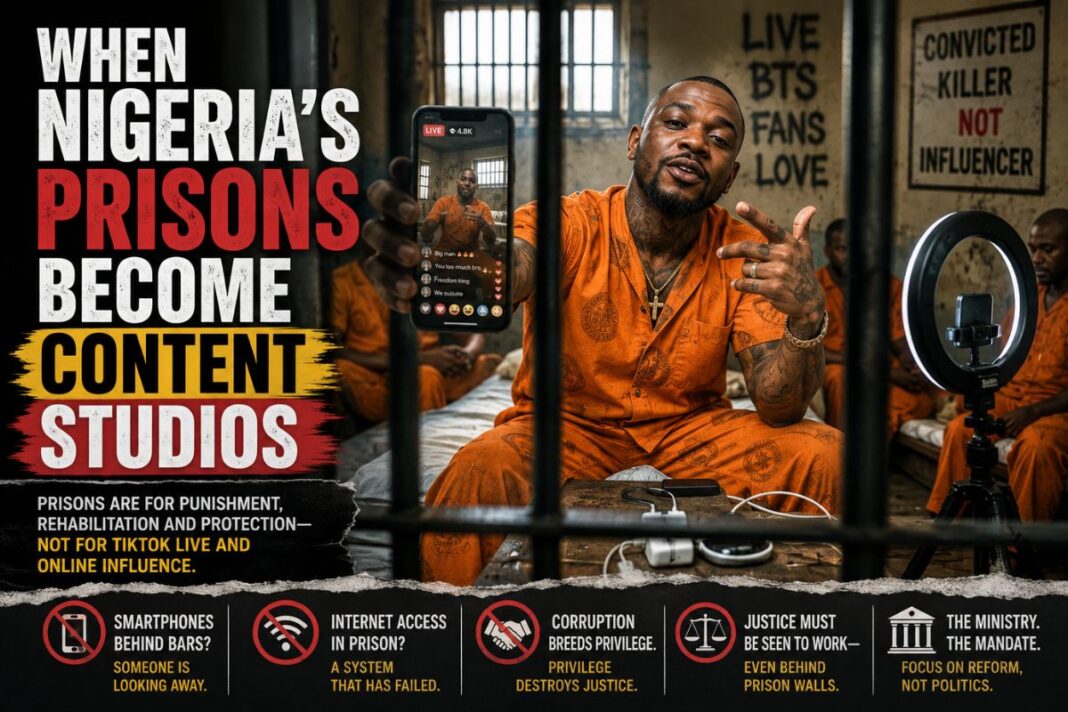

The recent revelation that a convicted killer allegedly conducted TikTok Live sessions from a Nigerian correctional facility should alarm every citizen who believes in the rule of law. It is not merely a story about a prisoner with access to a smartphone. It is a disturbing illustration of a correctional system that appears increasingly unable—or unwilling—to enforce the very purpose for which it exists.
A prison is not designed to be a social media studio. It is not meant to be a place where convicts build online audiences, entertain followers, and project influence to the outside world. The primary objectives of imprisonment are punishment, deterrence, rehabilitation, and the protection of society. When a convicted criminal can comfortably interact with thousands of viewers on TikTok from behind bars, the integrity of the correctional process is called into question.
The issue goes beyond one inmate. It exposes a culture of compromise within the Nigerian Correctional Service (NCoS), where regulations are often defeated by corruption, favoritism, negligence, or outright complicity.
For years, Nigerians have heard stories suggesting that prison conditions differ according to the status and financial strength of inmates. The poor often endure overcrowded cells, poor sanitation, inadequate healthcare, and harsh living conditions. The rich and influential, however, are frequently alleged to enjoy privileges unavailable to ordinary inmates.
Nothing symbolized this perception more than the controversy surrounding popular cross-dresser Bobrisky. Following his conviction, allegations emerged that he did not serve his sentence entirely within prison walls. A leaked audio recording that generated national outrage purportedly suggested that a prison term could be served in a rented apartment outside the correctional facility through the influence of corrupt officials.
You may also like;
- When the Mob Becomes Judge, Jury and Executioner
- FAAC Windfall and the Missing Development Dividend: What Are Nigerian Governors Doing With the Money?
- When the Pepper Reaches the Pepper Seller’s Eye: The Lessons Nigeria Keeps Refusing to Learn
- Breasts Are Not Chests: Why Berlin’s Topless Swimming Rule Is a Step Too Far
Whether every detail of those allegations was ultimately proven or not, the controversy damaged public confidence in the correctional system. The mere fact that millions of Nigerians found the claims believable speaks volumes about the credibility crisis facing the institution.
Citizens asked a simple question: If imprisonment can be negotiated, rented, outsourced, or customized according to one’s financial capacity, what then becomes of justice?
Now comes the report of a convicted killer allegedly running TikTok Live sessions from prison. Again, Nigerians are confronted with another troubling question: How does a prisoner gain access to a smartphone, internet connection, charging facilities, and sufficient privacy to conduct live broadcasts?
Such an act cannot happen in isolation. A smartphone does not magically appear inside a correctional facility. Someone must have smuggled it in. Someone must have looked away. Someone must have permitted repeated access to it. Someone must have failed to enforce regulations. The chain of responsibility inevitably leads back to officials entrusted with maintaining discipline and security.
This is why the incident should not be treated as the misconduct of a single inmate. It is a test of institutional accountability.
If investigations confirm the allegations, disciplinary actions should not stop with the prisoner. Every officer found to have aided, facilitated, ignored, or benefited from the violation must face appropriate sanctions. Anything less would amount to treating symptoms while ignoring the disease.
The concerns deepen further when viewed alongside previous controversies involving Nigerian correctional facilities.
Many Nigerians still remember the recent case involving actor Olanrewaju Omiyinka, popularly known as Baba Ijesha. Following his release from prison after serving a sentence for sexual assault-related offences involving a minor, reports emerged that he fathered a child who was approximately seven months old shortly after regaining freedom.
The development sparked widespread public debate. While there may be various explanations for the timeline, the episode fueled speculation about the level of supervision and control within correctional facilities. It added to a growing public perception that what happens inside Nigerian prisons often differs significantly from official narratives.
When such stories accumulate over time, they create an image of a correctional system where rules are flexible, privileges are negotiable, and enforcement depends largely on who an inmate is and what resources are available to them.
This perception is dangerous.
The justice system functions largely on public trust. Courts can sentence offenders. Legislatures can pass laws. Police can make arrests. But if correctional facilities fail to enforce sentences faithfully, the entire criminal justice architecture begins to lose legitimacy.
Consider the message sent to crime victims.
A family that loses a loved one to murder expects that a convicted killer will serve the punishment imposed by the courts. Victims of sexual offences expect accountability. Citizens who obey the law expect consequences for those who break it.
But when convicts appear to enjoy privileges that ordinary law-abiding citizens may not even possess, public faith in justice erodes. And the consequences extend beyond perception.
Correctional facilities are also expected to rehabilitate offenders. Rehabilitation requires structure, discipline, accountability, education, vocational training, counselling, and behavioral reform. It does not involve unrestricted access to social media platforms.
In fact, allowing inmates to maintain unregulated online influence may undermine rehabilitation efforts. It can encourage criminal celebrity culture, enable continued contact with criminal networks, facilitate intimidation of witnesses, or create opportunities for fraudulent activities.
Around the world, correctional authorities recognize the risks posed by unauthorised communication devices. This is why strict measures exist to prevent inmates from accessing smartphones and internet services without authorisation.
Nigeria cannot afford to be different. The Nigerian Correctional Service must therefore undertake a comprehensive review of security procedures across all custodial centres. Cell phone detection systems, surprise searches, surveillance mechanisms, staff vetting procedures, and disciplinary frameworks must be strengthened.
More importantly, the institution must confront the corruption that often undermines enforcement. If Nigeria does not destroy corruption, corruption will destroy Nigeria.
Technology alone cannot solve a problem rooted in human compromise. Even the most sophisticated security systems will fail if officials are willing to circumvent them for personal gain.
The Federal Government must also recognise that recurring controversies involving correctional facilities are not isolated public relations challenges. They are indicators of deeper institutional weaknesses requiring urgent reform.
This brings us to the role of the Minister of Interior, Olubunmi Tunji Ojo, whose ministry oversees the Nigerian Correctional Service.
At a time when disturbing questions are being raised about prison administration, security breaches, inmate privileges, and institutional accountability, Nigerians expect the minister’s full attention to be directed toward fixing the system under his supervision.
The country needs a correctional system that commands respect, enforces discipline, protects society, and rehabilitates offenders. It does not need prisons that become extensions of the entertainment industry or comfortable alternatives to lawful punishment.
Reports suggesting that the minister is preoccupied with political calculations and future governorship ambitions in Ondo State are therefore concerning. Politics has its place, but governance must come first.
The Ministry of Interior oversees critical institutions that affect national security and public confidence. The challenges confronting the Nigerian Correctional Service are serious enough to demand sustained attention, strategic leadership, and decisive reforms.
If convicted killers can allegedly host TikTok Live sessions from prison, if allegations continue to surface about preferential treatment for influential inmates, and if public confidence in correctional facilities continues to decline, then the ministry has more than enough work on its hands.
The minister should focus on restoring integrity to the institutions under his watch. The pursuit of higher political office can wait. The credibility of Nigeria’s correctional system cannot.
A nation where prison walls no longer confine, where punishment becomes negotiable, and where convicts enjoy privileges unavailable to ordinary citizens risks undermining the very foundation of justice. The latest controversy should therefore serve as a wake-up call—not only for correctional authorities but for everyone entrusted with safeguarding the rule of law.
Justice must not only be pronounced in courtrooms; it must be seen to be enforced behind prison walls.