

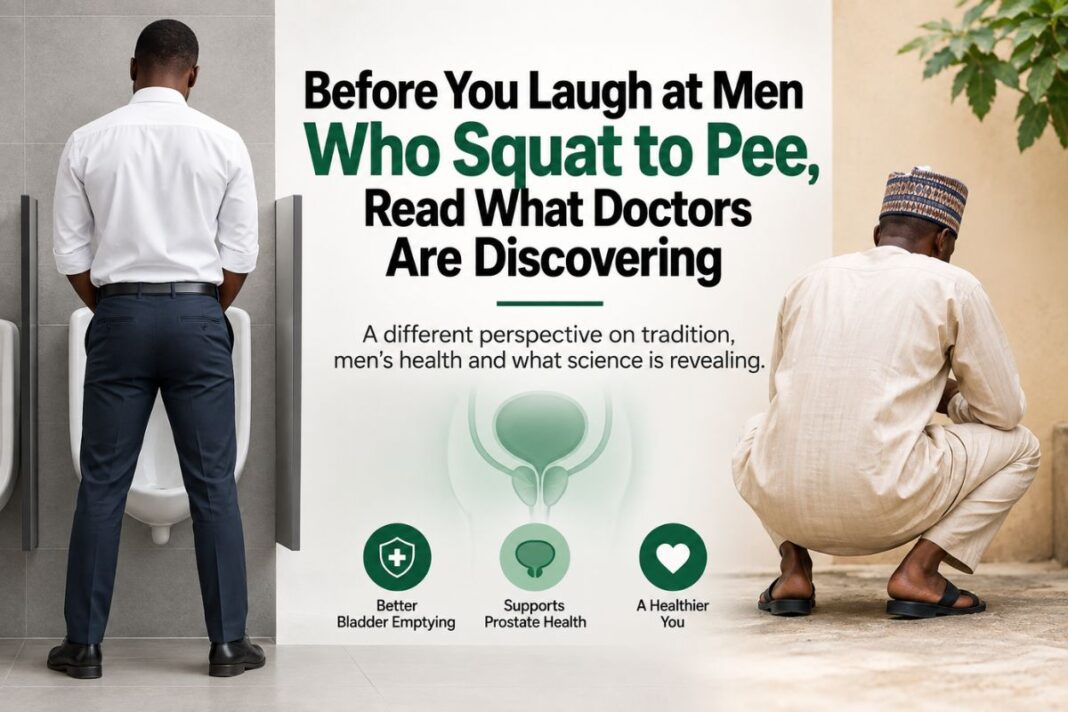

For many Southern Nigerians, it is a familiar joke. Mention a Northern Nigerian man, and someone will crack a joke about how he squats to urinate. The laughter usually follows. The mockery is often presented as harmless banter, one more cultural difference in a country blessed with hundreds of ethnic identities and traditions.
But perhaps it is time to ask a different question. What if there is something worth learning from that habit?
Not because it is fashionable. Not because it is superior. Certainly not because it is a magic shield against prostate cancer. Science does not support such a claim. Yet, in an age where men are increasingly battling urinary problems, enlarged prostates, and lifestyle-related illnesses, the simple act of squatting or sitting while urinating deserves a closer look.
Many men regard urination as a task that should be completed as quickly as possible. Stand, unzip, release, and move on. Efficiency is king. Comfort is secondary. Reflection is unnecessary. Yet human beings did not evolve around modern toilets.
For thousands of years, people squatted. They squatted to cook, to rest, to defecate, and in many cultures, to urinate. Even today, millions of people across Africa, Asia, and the Middle East continue to use squatting positions naturally.
The irony is that what some urban Africans now consider primitive may actually be closer to how the human body was originally designed to function.
Medical researchers who have examined urination postures found something interesting. Among men suffering from lower urinary tract symptoms, especially those with enlarged prostates, sitting while urinating often results in better bladder emptying and less urine remaining in the bladder afterward.
You may also like;
- When the Mob Becomes Judge, Jury and Executioner
- How to Make Money With AI in Nigeria (Part 2)
- 24 Legit Websites Where Nigerians Are Getting Paid in Dollars Working Remotely
- The Poison Hidden in Freshness: When Healthy Living Becomes a Health Risk
That may sound insignificant until one understands the implications. A bladder that does not empty properly can contribute to discomfort, frequent urination, interrupted sleep, urinary tract complications, and reduced quality of life. Anyone who has watched an elderly man make repeated trips to the bathroom throughout the night understands how distressing these symptoms can become.
The prostate gland naturally enlarges with age. For many men, this enlargement begins silently and gradually. What starts as a slight hesitation while urinating may eventually become straining, weak urine flow, or the sensation that the bladder is never empty.
In such circumstances, posture matters. Sitting or squatting relaxes certain muscles of the pelvis and may allow urine to flow more naturally. It is not a cure. It is not a replacement for medical treatment. But it can be a simple adjustment that supports better bladder function for some men.
This is where the cultural lesson becomes interesting. Northern Nigerian communities did not adopt squatting because of scientific journals or medical conferences. It emerged from tradition, environment, and social norms. Yet, whether intentionally or unintentionally, the practice aligns with what some researchers now recognize as beneficial for men experiencing urinary difficulties. Sometimes culture arrives at useful habits long before science explains them.
This should also remind us of a broader truth: not every traditional practice deserves ridicule. Modern society has developed a dangerous habit of assuming that whatever comes from urbanization is automatically superior. We celebrate imported lifestyles while dismissing indigenous wisdom. We laugh at customs before understanding their purpose. Yet history repeatedly teaches us humility.
Many traditional diets once mocked as “poor people’s food” are now praised by nutritionists. Indigenous herbs once dismissed as superstition have inspired modern medicines. Practices that appeared outdated have occasionally revealed unexpected health benefits.
The lesson is not that tradition is always right. The lesson is that tradition should not be mocked before it is understood.
Unfortunately, discussions about men’s health are often buried beneath ego and cultural stereotypes. Men joke about health conditions they should be discussing seriously. They postpone medical examinations. They ignore warning signs. They confuse masculinity with silence.
Prostate-related illnesses continue to affect millions of men worldwide. While there is no guaranteed way to prevent prostate cancer, health experts consistently emphasize healthy living, regular exercise, maintaining a healthy weight, and seeking medical attention when symptoms arise.
Notice what is absent from that list. No reputable medical authority says that standing to urinate causes prostate cancer. Neither do they say that squatting eliminates the risk. Cancer is far more complex than that. Age, genetics, family history, lifestyle factors, and other biological mechanisms all play roles. Some risk factors are within human control; others are not.
This is why men should avoid simplistic health myths. A man who squats to urinate but ignores regular medical check-ups is not necessarily safer than a man who stands. Likewise, a man who stands to urinate is not automatically increasing his cancer risk.
Health is rarely determined by a single habit. However, posture remains relevant because comfort, bladder emptying, and urinary efficiency matter, particularly as men grow older.
Imagine if more men approached their bodies with curiosity rather than pride. Imagine if they paid attention to how often they wake at night to urinate, whether their urine stream has weakened, whether they feel incomplete emptying, or whether discomfort accompanies urination.
Imagine if they sought medical advice early instead of waiting until symptoms become unbearable. Perhaps we would have fewer preventable complications. Perhaps we would have more honest conversations about men’s health. And perhaps we would stop laughing at cultural practices simply because they are different from our own.
The Northern Nigerian man who squats to urinate may not be consciously thinking about pelvic muscles, bladder emptying, or urodynamic studies. He is merely following a practice he inherited.
But his Southern counterpart who mocks him should pause before laughing. The real issue is not whether one man squats and another stands. The real issue is whether either man is paying attention to his health. If squatting helps a man empty his bladder more comfortably, there is no shame in it. If standing works well for him and he has no urinary symptoms, there is no reason for guilt either.
What matters is awareness. What matters is recognising that men’s health deserves more discussion than it currently receives. And what matters is understanding that wisdom sometimes hides in the most ordinary places, even in something as simple as the posture a man adopts when answering nature’s call.
The next time someone jokes about Northern Nigerian men squatting to urinate, perhaps the conversation should change direction. Instead of laughing, ask a better question: What else have we been mocking without first understanding?