

Every nation has the right to debate immigration. Every government has the responsibility to protect jobs, maintain security, and manage social pressures. But when public frustration is directed at the wrong targets, societies risk fighting shadows while the real problems persist and remain untouched.
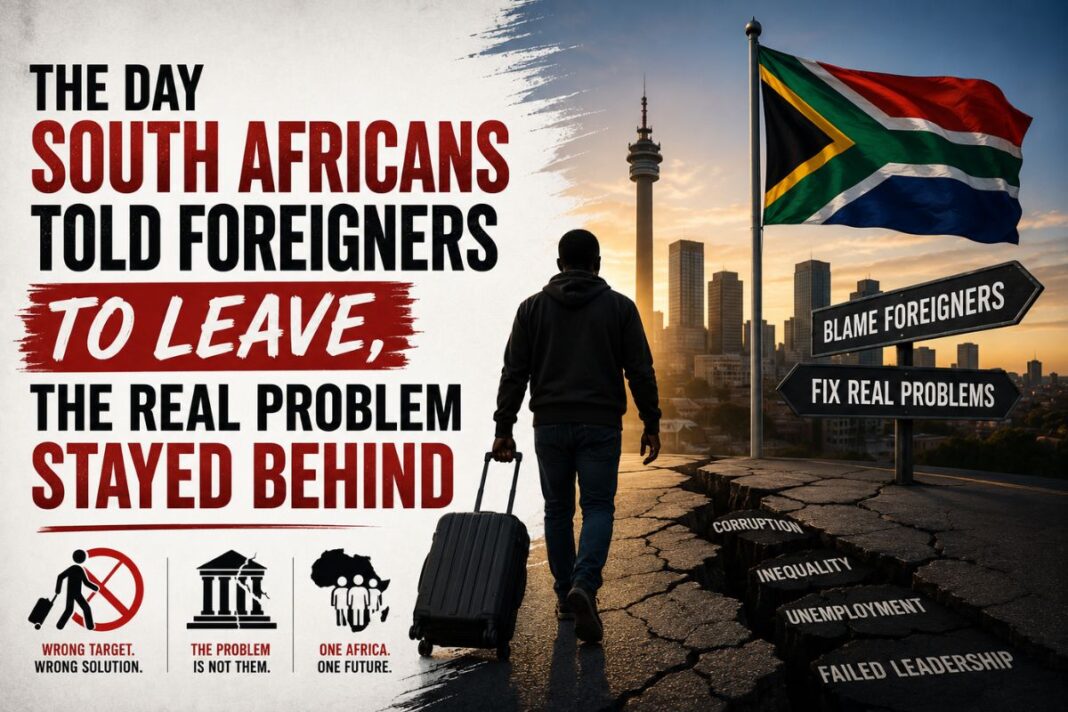
The recent anti-foreigner sentiments in South Africa have once again raised a troubling question: Why are fellow Africans repeatedly blamed for challenges that are fundamentally rooted in governance, economic inequality, and policy failures?
The irony became even more striking when, on the same day some groups were demanding that foreigners leave South Africa, President Cyril Ramaphosa was swearing in members of his administration. For many observers, it exposed a contradiction that has long existed within South African society. The anger directed at foreigners is rarely directed at all foreigners. It is often directed at black Africans.
You may also like:
- When the Mob Becomes Judge, Jury and Executioner
- Why Nigerians Naturally Turn to Prayer During Crisis and Why Action Still Matters
- FAAC Windfall and the Missing Development Dividend: What Are Nigerian Governors Doing With the Money?
- When the Pepper Reaches the Pepper Seller’s Eye: The Lessons Nigeria Keeps Refusing to Learn
The Zimbabwean cleaner, the Nigerian trader, the Malawian labourer, and the Ethiopian shop owner are frequently accused of taking opportunities from South Africans. Yet foreigners from Europe and other parts of the developed world who occupy influential positions in corporations, advisory roles, and economic institutions rarely become targets of public outrage. If the issue is truly foreign presence, then why is the hostility so selective?
The uncomfortable truth is that what often masquerades as anti-immigration sentiment can sometimes resemble prejudice against fellow Africans. A white foreign professional may be viewed as an investor or expert, while a black African migrant is viewed as a competitor or intruder. Such a contradiction undermines the argument that foreigners are the source of South Africa’s problems.
For years, immigrants from Nigeria, Zimbabwe, Mozambique, Malawi, Ghana, Ethiopia, Somalia, and other African countries have become convenient scapegoats whenever unemployment rises, crime increases, or public services deteriorate. The narrative is familiar: foreigners are taking jobs, occupying businesses, straining public resources, and worsening insecurity. Yet despite periodic crackdowns, protests, and calls for mass expulsions, the structural problems remain exactly where they were.
The reason is simple. African migrants are not the cause of South Africa’s deepest challenges.
South Africa remains one of the most unequal societies in the world. Millions of young people are unemployed. Crime remains stubbornly high. Economic growth has struggled for years. Public infrastructure is under pressure, while corruption scandals have repeatedly shaken public confidence in state institutions.
None of these problems originated in a Somali-owned shop, a Nigerian-owned business, or a Zimbabwean worker seeking a better life.
These are governance issues.
When citizens are frustrated, politicians and activists often find it easier to point fingers at vulnerable outsiders than to confront difficult questions about economic management, corruption, education, electricity supply, investment, and job creation. Blaming foreigners offers a simple explanation for a complex problem. Unfortunately, simple explanations are often wrong.
There is another irony that many Africans find difficult to ignore.
The struggle against apartheid was never a purely South African struggle. Across the continent, African nations provided support, refuge, training grounds, diplomatic backing, and financial assistance to anti-apartheid activists. Many countries sacrificed resources to isolate the apartheid regime. The fight for South African freedom became Africa’s fight.
From Nigeria to Zambia, Tanzania to Zimbabwe, numerous nations stood firmly behind the liberation movement when apartheid seemed invincible. Ordinary Africans contributed money. Governments offered sanctuary. Students marched. Diplomats campaigned.
The continent believed that an injury to South Africa was an injury to Africa.
That history makes today’s hostility toward fellow Africans particularly painful.
The Nigerian trader, the Zimbabwean labourer, the Ethiopian entrepreneur, and the Congolese student are not invaders. Most are simply pursuing the same dream that countless South Africans pursue abroad: safety, opportunity, education, and economic survival.
Indeed, South Africans themselves live and work across Europe, North America, Australia, and other African countries. They understandably expect to be treated with dignity and respect wherever they go. The same standard should apply to others who seek opportunities within South Africa.
This is not to suggest that immigration should be uncontrolled or that governments should ignore legitimate concerns about border management. Every sovereign nation has the right to regulate entry and residency according to its laws. However, there is a profound difference between enforcing immigration laws and cultivating hostility toward entire nationalities.
One is governance.
The other is prejudice.
History repeatedly shows that societies do not prosper by turning on vulnerable groups. Economic frustration can create anger, but anger alone does not create jobs. Violence against immigrants does not reduce corruption. Burning foreign-owned businesses does not improve electricity supply. Chasing African migrants from neighbourhoods does not reform public institutions.
At best, such actions provide a temporary emotional release. At worst, they deepen divisions, damage the economy, and tarnish the country’s international image.
South Africa possesses enormous potential. It has world-class universities, sophisticated financial institutions, abundant natural resources, and one of Africa’s most developed economies. The country does not need enemies from beyond its borders to explain its challenges.
The harder conversation is the one that must eventually take place: Why has economic opportunity remained out of reach for so many citizens decades after apartheid? Why does unemployment remain so high? Why do public frustrations continue to grow despite repeated promises of reform?
Those questions cannot be answered by blaming African migrants.
They require honest scrutiny of leadership, policy choices, and institutional performance.
In the end, the greatest threat to South Africa is not the foreigner selling goods at a street corner or running a small business in a township. It is the failure to address the conditions that create despair, inequality, and frustration in the first place.
A nation that fought one of history’s most notorious systems of discrimination should be especially careful not to embrace new forms of exclusion. The spirit that defeated apartheid was built on solidarity, justice, and human dignity. Those values should not stop at the border.
South Africa’s future will not be secured by driving out fellow Africans. It will be secured by confronting corruption, creating jobs, strengthening institutions, and delivering accountable governance.
The real battle is not against the African foreigner.
It is against the problems that government after government has failed to solve.