

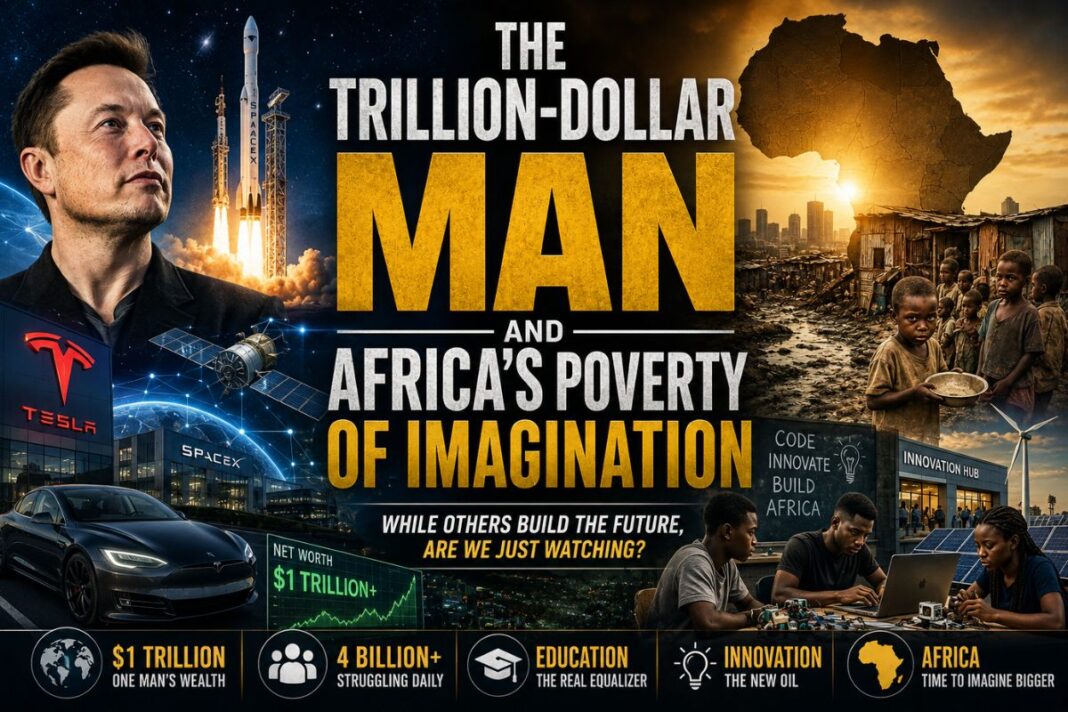

When news broke that Elon Musk had become the world’s first trillionaire, many people reacted with disbelief. Others reacted with anger. How can one individual control wealth valued at more than one trillion dollars while billions of people struggle daily for food, healthcare, education, and shelter?
According to reports following the public listing of SpaceX, Musk’s net worth has risen above $1 trillion, making him the richest person in human history. Much of this wealth is tied to ownership stakes in companies such as SpaceX, Tesla, xAI, Neuralink and X. His fortune is estimated at between $1 trillion and $1.1 trillion, depending on market valuations.
For many Africans, such a figure is difficult to comprehend.
At an exchange rate of roughly ₦1,370 to one US dollar, one trillion dollars translates to approximately ₦1.3 quadrillion. To put that into perspective, the entire 2026 Nigerian national budget is only a tiny fraction of that amount. Musk’s wealth exceeds the annual economic output of many countries combined.
The obvious question follows: should any individual be allowed to possess such enormous wealth?
The morality of extreme wealth has become one of the defining debates of the twenty-first century. Critics argue that trillionaires are evidence of a broken economic system. They point to widening inequality, declining opportunities for ordinary workers, and the concentration of power in the hands of a few unelected individuals. Around the world, calls for wealth taxes have intensified as people question whether any person can ethically accumulate resources on such a scale.
Yet there is another side to the story.
Elon Musk did not become wealthy by discovering oil, inheriting a kingdom, or controlling a national treasury. His wealth emerged from building companies around technology, innovation, and ambitious visions of the future. Investors rewarded those ideas with extraordinary valuations. Whether one admires or dislikes Musk personally, the source of his wealth offers an important lesson.
Technology has become the most powerful wealth-creation engine in modern history.
The world’s largest fortunes are no longer built primarily from land, minerals, or natural resources. They are increasingly built from software, artificial intelligence, space technology, biotechnology, and digital platforms.
This is where Africa should pay attention.
For decades, many African nations have remained trapped in an extractive economic model. Governments depend heavily on oil, minerals, foreign aid, and commodity exports. Political competition often revolves around controlling state resources rather than creating new wealth.
As a result, leadership in many countries has become synonymous with access to public funds. Corruption diverts resources meant for infrastructure, education, healthcare, and industrial development. Each stolen billion dollars represents schools not built, roads not completed, hospitals not equipped, and opportunities denied to future generations.
While Silicon Valley entrepreneurs are building trillion-dollar enterprises, too many African leaders are fighting over shrinking national budgets.
The contrast is painfully sad.
The wealth generated by a company such as SpaceX did not exist twenty years ago. It was created through innovation, engineering, research, risk-taking, and long-term investment. Meanwhile, much of Africa’s political elite focuses on redistributing existing wealth rather than creating new wealth.
The future belongs to societies that innovate.
Artificial intelligence, robotics, biotechnology, renewable energy, quantum computing, aerospace engineering, and advanced manufacturing will define global prosperity over the next fifty years. Countries that invest in these sectors will create jobs, attract capital, and generate wealth on an unprecedented scale.
Africa possesses the youngest population in the world. By 2050, one in four people on earth will be African. This demographic advantage could become the continent’s greatest asset—or its greatest tragedy.
If young Africans are equipped with quality education, digital skills, research opportunities, and access to capital, they can become builders of globally competitive companies. If they are denied those opportunities through corruption, poor governance, and underinvestment, the continent risks becoming a consumer rather than a creator of the technologies shaping the future.
The lesson from Musk’s trillion-dollar milestone is not that every society needs a billionaire or a trillionaire.
The lesson is that wealth is increasingly generated by ideas.
Africa cannot steal its way to prosperity.
No nation has ever become rich through corruption. No continent has ever transformed itself by looting public treasuries. Sustainable prosperity comes from innovation, productivity, entrepreneurship, and investment in human capital.
The debate about whether a trillionaire should exist will not stop; it will continue. It is a legitimate debate. But for Africa, an even more urgent question demands attention.
While others are creating the future, are we preparing to build it? Or merely preparing to consume it?
The answer to that question may determine whether Africa produces the next generation of global innovators or continues to watch from the sidelines as others create the wealth of tomorrow.