

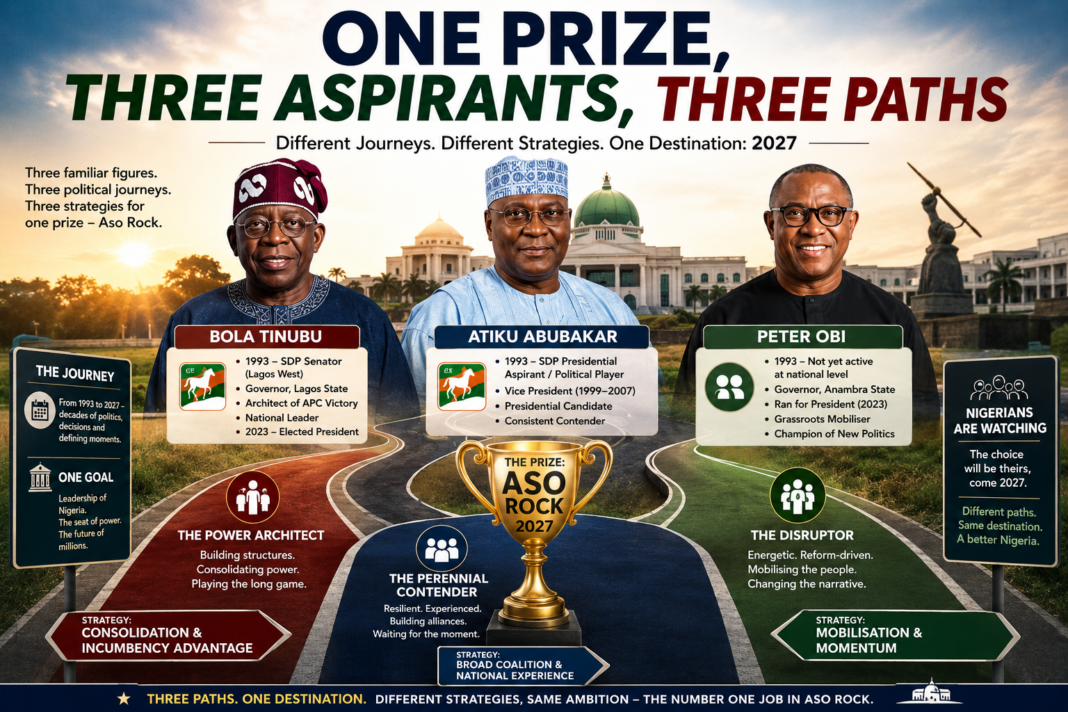

Nigeria’s presidential politics has always been a theatre of reinvention, endurance, and shifting alliances. As the road to 2027 gradually takes shape, three familiar figures dominate early calculations: Bola Tinubu, Atiku Abubakar, and Peter Obi. Each represents not just a candidacy, but a distinct philosophy of power, how to win it, how to keep it, and how to persuade a restless electorate. Their journeys tell a broader story of Nigeria’s evolving democracy: three aspirants, three paths, and three strategies.
1Bola Tinubu: The Architect of Power
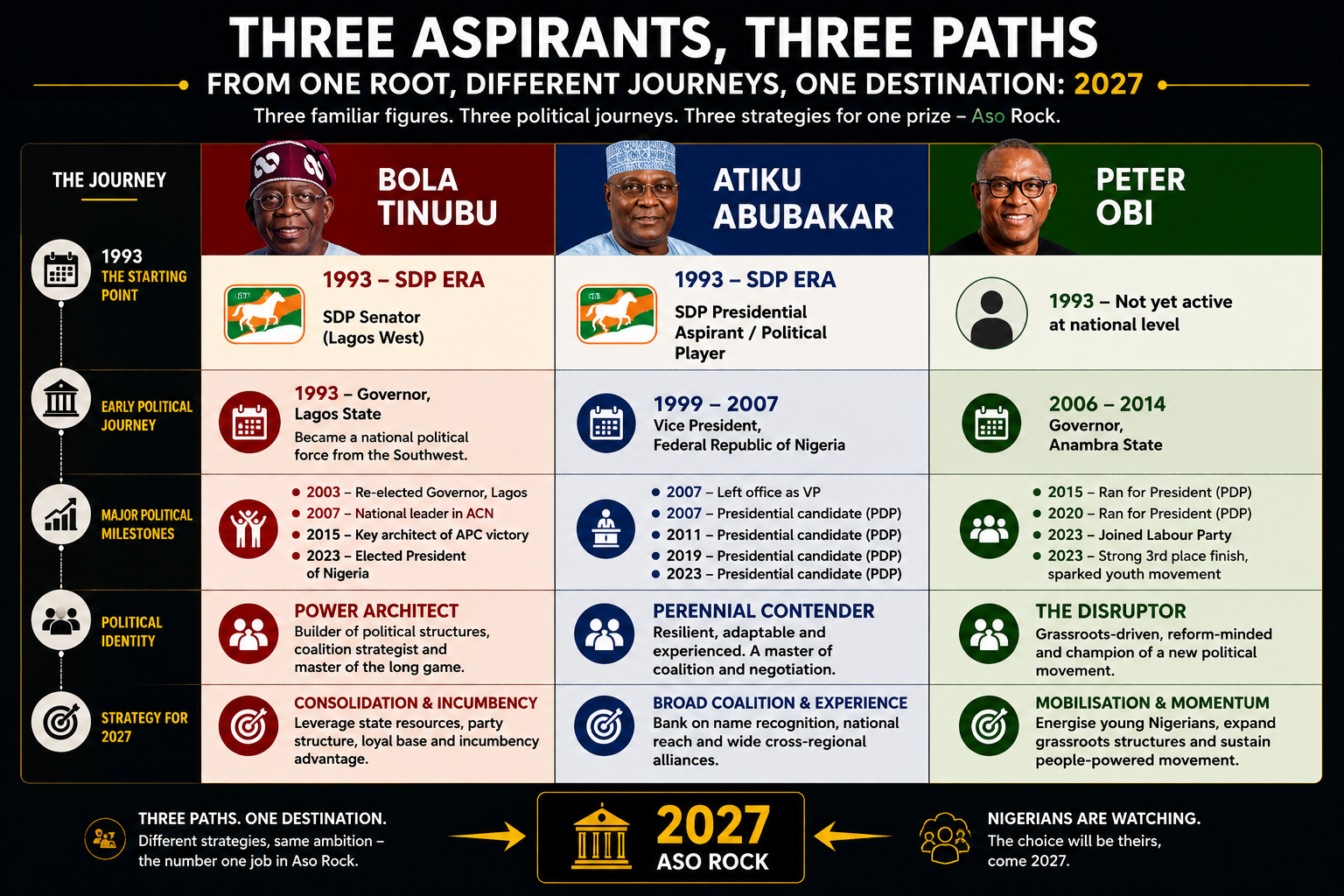
Few politicians in Nigeria have mastered the long game like Bola Tinubu. A former governor of Lagos State, Tinubu’s rise has been less about personal charisma and more about building an enduring political machine. From his early days in the pro-democracy struggles of the 1990s to his central role in the formation of the All Progressives Congress (APC), Tinubu has positioned himself as a kingmaker long before becoming a king.
His political journey has not been defined by frequent party switching in the same way as his rivals, but by strategic coalition-building. Tinubu helped stitch together disparate opposition blocs to wrest power from the People’s Democratic Party (PDP) in 2015, a historic turning point in Nigeria’s democratic history.
Strategy for 2027: Consolidation and incumbency. Tinubu’s approach relies on the advantages of office, deep patronage networks, and a loyal political base, particularly in the Southwest. His strength lies in structure, party machinery, loyalists, and the ability to negotiate elite consensus behind closed doors. Not forgetting state resources at his advantage
2Atiku Abubakar: The Perennial Contender
If persistence were a political ideology, Atiku Abubakar would be its foremost practitioner. A former vice president (1999 – 2007), Atiku has contested for Nigeria’s presidency multiple times, becoming a constant fixture in the nation’s electoral cycle. His journey is marked by flexibility—critics say opportunism—as he has moved across political platforms, from the PDP to the Action Congress, back to the PDP, and beyond.
Atiku’s political identity is rooted in his pro-business stance and his consistent advocacy for restructuring Nigeria’s federal system. His campaigns often emphasise economic liberalisation and national unity, even as his shifting party loyalties raise questions about ideological consistency.
Strategy for 2027: Broad coalition and name recognition. Atiku’s enduring visibility gives him a national reach that only a few can rival. His calculation often hinges on building a wide, cross-regional alliance, banking on his familiarity to voters and his ability to remain relevant across political cycles.
3Peter Obi: The Disruptor
In contrast to the old guard stands Peter Obi, whose political trajectory reflects a different kind of momentum. A former governor of Anambra State, Obi spent years within the PDP before making a dramatic shift to the Labour Party ahead of the 2023 elections. That move transformed him from a relatively quiet technocrat into the face of a political insurgency.
Obi’s rise has been powered not by entrenched structures but by grassroots enthusiasm, particularly among young Nigerians and urban voters disillusioned with traditional politics. His campaign style: data-driven, frugal, and message-focused, has redefined what modern political engagement can look like in Nigeria.
Strategy for 2027: Mobilisation and momentum. Obi’s strength lies in his ability to energise a demography that historically sat on the sidelines. His challenge, however, is translating that enthusiasm into a durable nationwide structure capable of matching the entrenched systems of his rivals.
Three Paths, One Destination
The contrast among these three men is stark. Tinubu represents the power of political architecture—carefully built, patiently maintained. Atiku embodies persistence and adaptability, navigating Nigeria’s shifting political terrain with remarkable resilience. Obi, meanwhile, symbolises disruption, channelling public frustration into a new kind of political movement.
Yet, beneath their differences lies a shared trait: ambition shaped by reinvention. Each has crossed party lines, recalibrated alliances, and redefined strategies in pursuit of the presidency. In Nigeria, where political ideology often bends to pragmatism, their journeys underscore a central truth—the path to power is rarely straight.
The Road to 2027
As the political season gathers momentum, the question is not just who will win, but which strategy will prove most effective in a changing Nigeria. Will it be Tinubu’s entrenched networks, Atiku’s enduring presence, or Obi’s insurgent appeal?
The answer will depend on an electorate that is increasingly unpredictable, a political landscape that continues to shift, and the ability of each aspirant to not just campaign, but to convince.
For the three aspirants, whose gaze is the number one job in Aso Rock, Nigerians are watching and would decide, come 2027.

