

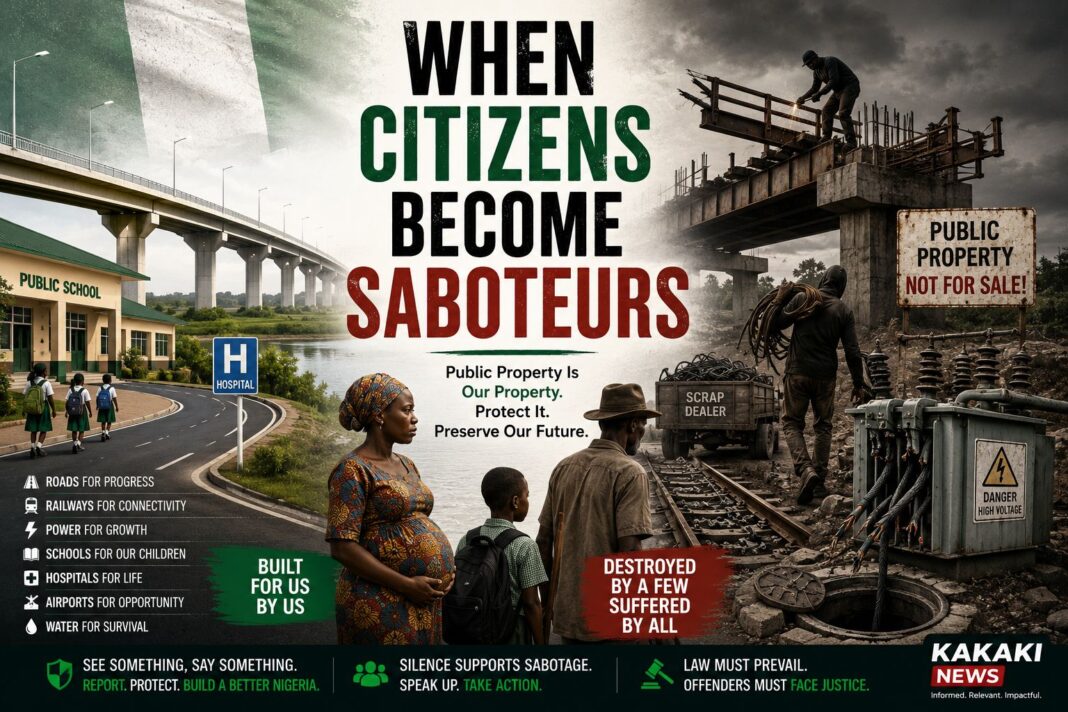

A community in my country once celebrated the commissioning of a new bridge that connected farmers to markets, children to schools, and patients to hospitals. Young and old, male and female rejoiced as the construction of the new bridge brought relief to years of pain and agony. For years, crossing the river had been a nightmare. The bridge changed everything. But barely two years later, some residents began removing its steel components at night and selling them as scrap. Others looked away, convinced it was none of their business. One rainy season, the weakened bridge collapsed. A pregnant woman could not reach the hospital in time. Farmers lost access to markets. Schoolchildren stayed at home. What was built for everyone was destroyed by a few, and the consequences were now borne by all.
This story, whether real or imagined, reflects a painful reality across many societies, especially Nigeria. Governments spend billions of naira every year constructing roads, schools, hospitals, airports, electricity infrastructure, water facilities, and other public amenities meant to improve the lives of citizens. Sadly, contractors often use substandard materials to execute the jobs. Other times, the contractors deliver shoddy projects that are meant for the populace. In all these, some individuals deliberately vandalize, steal, or destroy these facilities for personal gain, while others watch in silence.
From Benin to Kano, Abeokuta to Awka, Maiduguri to Warri roads are damaged by people who remove drainage covers and culverts. Railway tracks and components are stolen and sold as scrap. Electric cables, transformers, and poles are vandalized, plunging communities into darkness. Building materials are carted away from public projects. Even facilities at airports and other strategic national assets have not been spared from theft and destruction. Just few days away, 13 suspects were arrested for allegedly stealing building materials from construction sites at the Murtala Muhammed International Airport, Lagos. I hope that these will serve as a deterrent to many of such scoundrels among us
You may also like;
- When the Mob Becomes Judge, Jury and Executioner
- FAAC Windfall and the Missing Development Dividend: What Are Nigerian Governors Doing With the Money?
- When the Pepper Reaches the Pepper Seller’s Eye: The Lessons Nigeria Keeps Refusing to Learn
- The Age of Queens: Why Europe’s Female Monarchs Hold Important Lessons for Nigeria
The tragedy is that public property does not belong to the government alone. It belongs to all of us. Every road destroyed means higher transportation costs for citizens. Every stolen rail component threatens public safety and delays economic growth. Every vandalized power installation means businesses suffer losses, students cannot study effectively, and hospitals struggle to provide services.
It is rather unfortunate that many citizens still see public property as “government property,” thereby creating a dangerous disconnect. The truth is that government funds are derived largely from taxpayers’ money and national resources that belong to the people. When public infrastructure is destroyed, it is not the government that suffers; it is the ordinary citizen. The governed, not the government pay for this unpatriotic act.
This is why there is a dire need for a renewed campaign of civic reorientation. Citizens must be taught from childhood that public assets are collective assets. Schools, religious institutions, traditional rulers, community associations, and the media all have a role to play in promoting a culture of ownership and responsibility.
Civic education should emphasise that protecting public infrastructure is as important as protecting one’s personal property. A person who would never destroy the fence around his house should feel the same obligation toward a public school fence, a transformer, or a newly constructed road in his community.
However, reorientation alone is not enough. Those who deliberately vandalize or steal public infrastructure must face the full weight of the law. Too often, suspects are arrested only for cases to disappear quietly. This weakens public confidence and emboldens criminals.
The prosecution of offenders should be swift, transparent, and publicized. When individuals see that those who vandalise rail lines, steal electrical components, or sabotage public projects are being convicted and punished, it sends a strong message that such acts carry serious consequences. Effective punishment serves not only as justice but also as a deterrent.
It is also important to state that citizen participation in protecting public assets cannot be overemphasised. The responsibility should not be left to law enforcement agencies alone. Police officers, civil defence personnel, and other security agencies cannot be everywhere at all times. Communities are often the first to notice suspicious activities around public facilities.
But security men cannot be at every pole and public facility. Citizens must therefore develop the habit of reporting vandalism, theft, and sabotage to relevant authorities. Community vigilance groups, neighbourhood associations, and local leaders should work together to safeguard infrastructure within their areas. Silence and indifference only empower criminals.
Countries that have successfully developed strong public infrastructure did not achieve it through government action alone. They succeeded because citizens understood that protecting public assets was in their collective interest. Development thrives where people value what belongs to everyone.
Nigeria’s development challenges are already enormous. The country cannot afford to keep rebuilding infrastructure destroyed by the very people meant to benefit from it. Every naira spent replacing stolen cables or repairing vandalized facilities is money that could have been invested in new schools, hospitals, roads, or jobs.
The message is simple: public property is our property. Protecting it is a civic duty, not a favour to the government. Until citizens embrace this responsibility, and until vandals face meaningful consequences for their actions, the cycle of destruction and waste will continue. A nation grows not only through what it builds, but also through what its citizens choose to preserve.