


Guess what? Europe is quietly witnessing a historic shift.
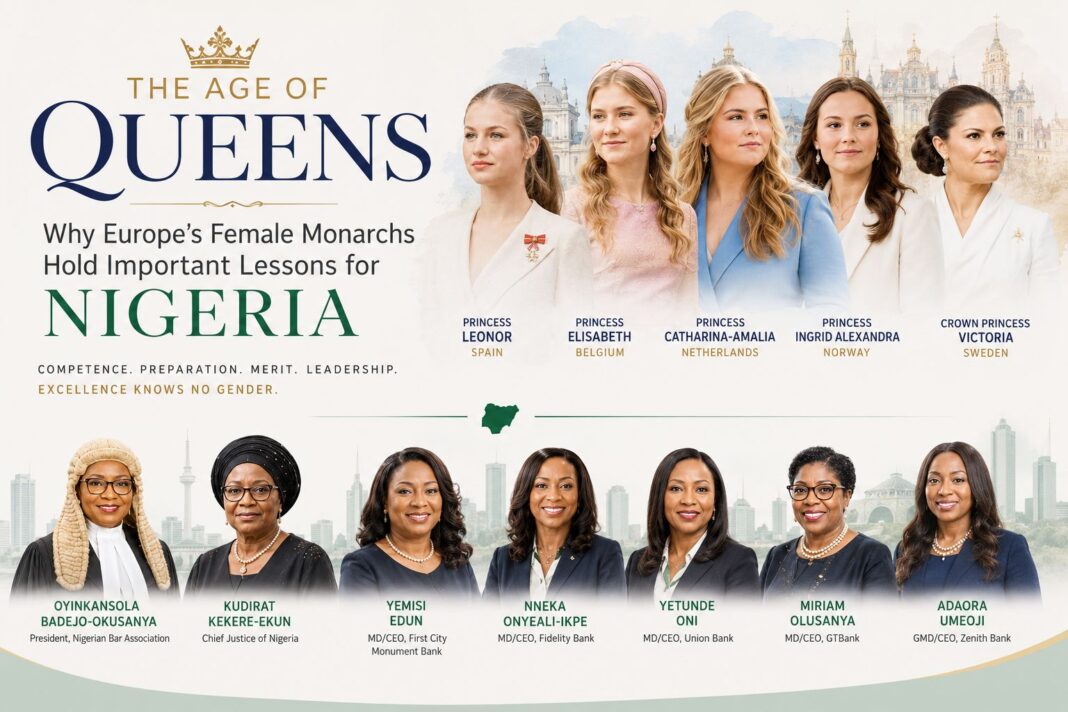
For the first time in modern history, some of the continent’s most prominent monarchies are preparing for the reign of women. Spain’s Princess Leonor, Belgium’s Princess Elisabeth, the Netherlands’ Princess Catharina-Amalia, Norway’s Princess Ingrid Alexandra, and Sweden’s Crown Princess Victoria are all positioned to inherit their respective thrones.
The emergence of these future queens is not merely a royal affair. It is a reflection of a broader societal transformation—one that places competence, preparation, and merit above gender.
Predictably, some may ask what this means for men. The answer is straightforward: absolutely nothing negative.
You may also read;
- When the Mob Becomes Judge, Jury and Executioner
- Why Nigerians Naturally Turn to Prayer During Crisis and Why Action Still Matters
- If You Grew Up in a Nigerian Neighbourhood, These 15 Memories Will Hit Differently
- When the Pepper Reaches the Pepper Seller’s Eye: The Lessons Nigeria Keeps Refusing to Learn
The rise of women is not the decline of men. Leadership is not a limited resource that diminishes when shared. A society does not become weaker because women occupy positions of authority. Rather, it becomes stronger because it is drawing from a larger pool of talent.
Europe’s future queens are evidence of a principle that many societies are increasingly embracing: leadership should be determined by capability, not chromosomes.
Interestingly, while Europe prepares for a generation of queens, Nigeria is experiencing a quieter but equally significant revolution of its own.
Across key sectors of national life, women are increasingly occupying positions that were once considered the exclusive preserve of men.
In the legal profession, Nigerian lawyers recently elected Oyinkansola Badejo-Okusanya as President of the Nigerian Bar Association, while women continue to occupy strategic leadership positions within the association. She was hosted by President Bola Tinubu. More notably, the legal profession has produced some of the country’s most influential female figures, including former NBA President, Chief Mrs. Priscilla Kuye, the first woman to hold that office, and respected legal icons such as Amina Augie and Kudirat Kekere-Ekun, who rose to become the incumbent Chief Justice of Nigeria.
In the judiciary, Justice Kudirat Kekere-Ekun’s emergence as Chief Justice of Nigeria marked another significant milestone in the country’s journey toward inclusive leadership. Few positions in Nigeria carry as much authority and prestige as the office of the Chief Justice.
The banking sector tells an even more compelling story. For decades, Nigeria’s financial industry was dominated by men. Today, women are at the helm of some of the country’s biggest financial institutions.
Yemisi Edun serves as the Managing Director and Chief Executive Officer of First City Monument Bank. Nneka Onyeali-Ikpe leads Fidelity Bank. Yetunde Oni became the Managing Director and Chief Executive Officer of Union Bank. Miriam Olusanya heads Guaranty Trust Bank. Adaora Umeoji was appointed Group Managing Director and Chief Executive Officer of Zenith Bank, becoming the first woman to occupy the position in the bank’s history.
These are not symbolic appointments. These women oversee institutions that manage billions of dollars in assets, employ thousands of workers, and influence critical sectors of the Nigerian economy.
What about our tertiary institutions? The university system is witnessing a similar transformation. For many years, the office of Vice Chancellor was overwhelmingly occupied by men. Today, female scholars are increasingly breaking that barrier. They are now following in the footsteps of Professor Grace Alele-Williams, the first female Vice Chancellor at a Nigerian university.
Professor Folasade Ogunsola made history as the first female Vice Chancellor of the prestigious University of Lagos. Professor Florence Obi became the first substantive female Vice Chancellor of the University of Calabar. Professor Lilian Salami served as Vice Chancellor of the University of Benin, while Professor Ibiyemi Olatunji-Bello became the first female Vice Chancellor of Lagos State University.
These appointments did not occur because quotas demanded them. They occurred because these women built distinguished academic careers and demonstrated the competence required to lead complex institutions.
This is precisely the lesson Europe is teaching through its future queens.
Princess Leonor will inherit the Spanish throne not because she is a woman but because she is next in line and has undergone years of preparation, including military training and statecraft education. The same applies to Princess Elisabeth of Belgium and Crown Princess Victoria of Sweden.
The common denominator for all these achievers is preparation. The lesson for Nigeria is therefore not about replacing men with women. It is about ensuring that opportunities are available to the most qualified individuals regardless of gender.
Unfortunately, many parts of Africa still struggle with outdated assumptions about leadership. Women are often expected to prove themselves repeatedly in ways their male counterparts are not. Leadership positions are frequently viewed through the lens of gender rather than competence.
Yet the evidence increasingly suggests that societies benefit when barriers are removed.
When Professor Folasade Ogunsola became Vice Chancellor of UNILAG, the institution did not cease to function because a woman was in charge. When Adaora Umeoji took over Zenith Bank, Nigeria’s banking system did not collapse. When Justice Kudirat Kekere-Ekun became Chief Justice of Nigeria, the judiciary did not lose its authority.
Instead, these institutions continued to operate, demonstrating a truth that should have been obvious long ago: leadership ability is not a male trait.
There is another lesson that Nigeria should draw from Europe’s coming age of queens.
Strong institutions survive because they adapt.
European monarchies have remained relevant partly because they abandoned succession systems that automatically favored men over women. They recognized that modern societies expect fairness and equal opportunity.
Nigeria’s institutions must embrace a similar mindset. Political parties, universities, professional bodies, government agencies, and corporations should focus on identifying and nurturing talent wherever it exists.
A nation battling unemployment, insecurity, poverty, and economic uncertainty cannot afford to sideline half of its population.
The future belongs to societies that maximize talent, not those that restrict it.
Europe’s future queens therefore symbolize something far greater than royal succession. They represent a world gradually moving beyond the belief that leadership is inherently masculine.
Nigeria’s female vice chancellors, bank CEOs, judges, entrepreneurs, and professionals are carrying the same message.
The question is no longer whether women can lead. They already do.
The real question is whether society is willing to fully embrace a future in which leadership is defined not by gender, but by character, competence, vision, and results.
Europe may be entering an age of queens, but Nigeria is already witnessing the rise of women who are proving every day that excellence knows no gender. Let’s maintain that standard.