


For years, WhatsApp Business has been one of the most useful free tools available to small businesses.
A salon could answer customers from a phone. A restaurant could receive orders. A fashion seller could display a catalogue. A consultant could communicate with clients without paying WhatsApp a monthly subscription.
That basic model has not suddenly disappeared.
But Meta is changing how it charges for some business communications, and that has created confusion among business owners who now fear that WhatsApp Business itself is becoming a paid service.
So, is WhatsApp Business still free in 2026?
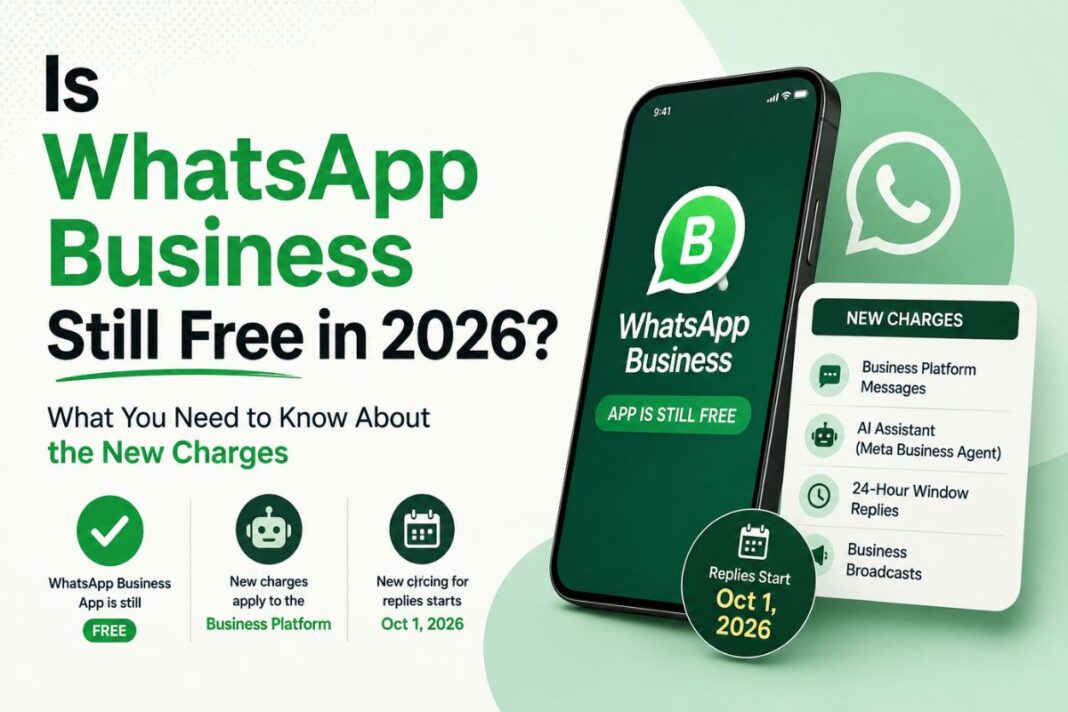
The quick answer: Yes, but it depends on which WhatsApp Business product you use.
The WhatsApp Business app, the free mobile application designed for small businesses, remains free to download and use. Meta itself describes it as a free-to-download app for small businesses.
What is attracting new charges is the WhatsApp Business Platform, the system used by larger businesses and software developers for automation, chatbots, integrations and high-volume messaging.
There is also a newer development affecting Business broadcasts in countries where that feature is available.
In other words, the headline “WhatsApp Business is no longer free” is too broad.
The reality is more complicated.
You may also read;
- 24 Legit Websites Where Nigerians Are Getting Paid in Dollars Working Remotely
- Can ₦50,000 Start an Akara Business in Nigeria in 2026? Here’s the Real Cost
- 24 Legit Websites Where Nigerians Are Getting Paid in Dollars Working Remotely
- How to Make Money With AI in Nigeria (Part 3)
The First Thing to Understand: There Are Two WhatsApp Business Products
This is where much of the confusion comes from.
Meta offers businesses two very different ways to use WhatsApp.
| Feature | WhatsApp Business App | WhatsApp Business Platform |
|---|---|---|
| Main users | Small businesses | Medium and large businesses |
| How it is used | Phone, WhatsApp Web and manual communication | Software, APIs, automation and integrations |
| Business profile | Yes | Yes |
| Catalogue/tools | Yes | Through integrations and business systems |
| Manual customer conversations | Yes | Yes, through connected systems |
| Chatbots and advanced automation | Limited | Yes |
| CRM/software integration | Limited | Yes |
| High-volume messaging | Limited | Designed for it |
| Meta messaging charges | Some paid features may apply | Applicable message-based charges |
| Main purpose | Everyday customer communication | Communication at scale |
Meta specifically says the WhatsApp Business app is designed for small businesses, while businesses looking for an enhanced experience can use the WhatsApp Business Platform.
That distinction should be at the centre of any discussion about the new charges.
Is the WhatsApp Business App Still Free?
Yes.
The ordinary WhatsApp Business app remains free to download.
A small business owner can still use features such as a business profile, messaging tools and other basic business functions without paying a WhatsApp monthly subscription.
So, imagine a Nigerian business owner who sells shoes.
She receives a message:
“How much is this shoe?”
She replies manually from her WhatsApp Business app:
“It is ₦45,000. We deliver nationwide.”
That ordinary interaction is not suddenly being converted into a mandatory WhatsApp subscription.
The major pricing changes concern commercial messaging features and the WhatsApp Business Platform, not the basic free app itself.
What Is Actually Changing in 2026?
There are several developments that businesses need to understand.
1. Meta Business Agent Has Introduced New AI Charges
Meta is also introducing paid access to its Meta Business Agent, its AI-powered business assistant.
From August 1, 2026, Meta began charging for Meta Business Agent usage at a rate of US$2 per one million tokens. The charging model is token-based rather than a simple fixed price per message.
This is important because not every WhatsApp Business user is using Meta Business Agent.
A small business owner manually responding to customers on the free app is not automatically paying this AI charge.
The fee applies to businesses actually using Meta’s AI business-agent functionality.
In practical terms, the cost can vary according to the amount of text the AI processes.
2. Service Messages on the Business Platform Are Becoming Chargeable
This is likely to be the more important change for businesses operating on the WhatsApp Business Platform.
Beginning October 1, 2026, Meta is scheduled to begin charging for service messages sent through the Business Platform. Utility messages sent in response to users within an open customer-service window will also become chargeable under the updated pricing structure.
This matters because businesses have historically benefited from free service responses during the relevant customer-service window.
For companies handling huge volumes of customer conversations, even a small per-message fee can become significant.
What Is the 24-Hour Customer-Service Window?
This phrase is central to understanding the change.
When a customer contacts a business on WhatsApp, a customer-service window can open.
For example:
Customer:
“Where is my order?”
Business:
“Your order is out for delivery.”
Customer:
“When should I expect it?”
Business:
“Your rider should arrive this afternoon.”
These are customer-service interactions.
The important change is that businesses using the Business Platform should not assume that every such response will continue to receive the previous free treatment after October 1.
Meta’s updated pricing rules make certain service and utility communications chargeable.
So the 24-hour window should not be described simply as “being abolished.”
The better explanation is:
The customer-service window remains, but the pricing treatment of certain messages inside that window is changing.
What Is Staying Free?
This is equally important.
A business owner reading the headlines could easily assume that WhatsApp now wants everyone to pay simply to chat with customers.
That is not what Meta’s documentation shows.
The basic WhatsApp Business app remains free
Meta continues to describe the WhatsApp Business app as a free-to-download product for small businesses.
Customer messages are not suddenly being turned into paid messages
A customer does not have to pay WhatsApp simply because they send a message to a business.
Manual business communication is different from Business Platform messaging
The new charges should not be interpreted as a compulsory monthly subscription for every small business using the app.
But There Is Another Change: Business Broadcasts
There is another development that small businesses should watch.
Meta’s current Help Center says businesses can send Business broadcasts for a fee in countries where the feature is available. After a business uses its free messages, it can add a payment method and pay for additional broadcasts. Businesses are charged for messages that are successfully delivered.
This is particularly relevant to businesses that use WhatsApp to send promotional messages to many existing customers at once.
For example:
“Our weekend sale starts tomorrow. Get 20% off selected products.”
That is not the same thing as replying individually to a customer who has asked a question.
Meta says Business broadcast pricing depends on the country code of the recipient, and the final cost is shown before the business completes payment. The feature is currently available only in limited countries.
Who Is Actually Affected?
A simple way to understand the changes is to look at the type of business.
| Business type/use | Likely impact |
|---|---|
| Small shop using the free WhatsApp Business app manually | Low or no impact from Platform changes |
| Restaurant taking orders manually through the app | Low impact from Platform changes |
| Freelancer replying personally to customers | Low impact |
| Business using paid Business broadcasts where available | May incur broadcast charges |
| Business using a chatbot | Potentially affected |
| Business using CRM/API integration | Affected by Platform pricing |
| Bank sending automated notifications | Significant potential impact |
| Fintech sending large volumes of messages | Significant potential impact |
| Large retailer using automated WhatsApp support | Potentially significant impact |
The size of the business is not the only factor.
The technology it uses matters just as much.
What About Nigerian Businesses?
This is where the issue becomes especially relevant.
WhatsApp is deeply integrated into everyday business communication in Nigeria. Small merchants use it to sell products, while banks, fintech companies, logistics firms, online retailers and technology companies use more sophisticated WhatsApp systems for customer service, notifications and automation.
However, Nigerian businesses should be careful about quoting a single fixed naira amount for WhatsApp’s upcoming October service-message pricing.
Why?
Because WhatsApp pricing is based on factors including the message category and recipient market, and Meta’s rates can be revised. Meta’s own documentation on Business broadcasts confirms that country-level pricing applies according to the recipient’s country code.
So figures such as ₦14 per message or ₦84 per message should be treated as estimates unless they have been checked against the applicable Meta rate card for the relevant date and message category.
Why Small Charges Can Become Big Bills
The individual cost of a message can appear insignificant.
Imagine a business pays an effective average of ₦14 for a chargeable message.
Sending 1,000 messages would be:
₦14,000
Sending 10,000 would be:
₦140,000
Sending 100,000 would be:
₦1.4 million
And at 500,000 messages:
₦7 million
These calculations are only illustrations. They are not a statement of Meta’s final October 2026 Nigerian rate.
The important lesson is that businesses operating at scale need to monitor their message volume closely.
A few naira multiplied by hundreds of thousands of messages becomes a serious operating cost.
What Small Business Owners Should Do Now
For most small businesses, there is no reason to panic.
If you only use the free WhatsApp Business app
Continue using it normally.
Your business profile, catalogue and ordinary manual customer conversations are not being turned into a compulsory monthly subscription simply because Meta has changed Business Platform pricing.
If you use a chatbot or automation service
Find out exactly what technology sits behind it.
Ask your provider:
“Are we using the WhatsApp Business Platform?”
Then ask:
“How will the October 1, 2026 pricing change affect our monthly bill?”
This is particularly important if an agency manages your WhatsApp automation for you.
If you send large promotional campaigns
Check whether your campaigns are being sent as paid Business broadcasts or through the Business Platform.
Meta says Business broadcasts are charged based on delivered messages where the feature is available.
How Businesses Can Reduce WhatsApp Costs
The coming changes make communication efficiency more important.
Businesses should avoid unnecessary message chains.
Instead of sending:
Hello.
Your order is ready.
You can come tomorrow.
We close by 5pm.
Thank you.
A business could communicate the same information in one well-written message:
Your order is ready for collection tomorrow. We are open from 9am to 5pm. Thank you.
For a business sending thousands of automated messages, reducing unnecessary message volume can make a substantial financial difference.
Businesses should also distinguish between:
Customer support
Transactional messages
Authentication
Marketing
Each serves a different purpose and can have different pricing implications on the Business Platform.
Should Businesses Stop Using WhatsApp?
Not necessarily.
For many businesses, WhatsApp remains extremely valuable.
The better question is:
Does the value generated by WhatsApp justify the cost of using its paid business features?
For an e-commerce company, paying for an order notification that helps complete a sale can make sense.
For a bank, automated customer communication may be essential.
For a small trader, paying for sophisticated automation may not yet be necessary.
The right answer will depend on the business model, customer volume and communication strategy.
WhatsApp Is Becoming More of a Business Platform
What is happening in 2026 is bigger than one new charge.
WhatsApp has evolved from a messaging application into a serious business communication platform.
Companies now use it for:
| Business function | Typical WhatsApp use |
|---|---|
| Sales | Product enquiries and customer conversations |
| Marketing | Promotions and business broadcasts |
| Customer support | Questions and complaints |
| E-commerce | Orders and delivery updates |
| Banking | Notifications and customer service |
| Authentication | OTPs and verification |
| Automation | Chatbots and AI assistants |
| CRM | Customer-management integrations |
As businesses use more sophisticated tools, it is increasingly understandable that Meta is looking to monetise some of those business services.
The implication for companies is straightforward:
WhatsApp should now be treated as a business communication channel with costs that need to be planned for.
The Bottom Line
Is WhatsApp Business still free in 2026?
Yes.
The WhatsApp Business app remains free to download and is still designed for small businesses.
But that does not mean every WhatsApp business feature is free.
Meta has introduced charges around its business ecosystem, including paid Business broadcasts in supported markets, while businesses using the WhatsApp Business Platform are facing further pricing changes. Meta Business Agent also has its own token-based pricing.
From October 1, 2026, service messages and certain utility messages within the customer-service window are scheduled to become chargeable for businesses using the WhatsApp Business Platform.
That means the popular statement that “WhatsApp Business is no longer free” is misleading.
The more accurate conclusion is:
WhatsApp Business is still free for ordinary small-business use through the app, but Meta is increasingly charging businesses for messaging, automation and other commercial services at scale.
For the small shop owner answering customers manually from a phone, this may make little immediate difference.
For a bank, fintech, retailer, logistics company or technology business sending hundreds of thousands of automated messages, it could become an important new operating expense.
The smartest thing businesses can do now is not panic, but identify which WhatsApp product they use, understand which messages they send, calculate their monthly volume and confirm the applicable Meta rates before October 1.
Frequently Asked Questions
1Is WhatsApp Business free in 2026?
Yes. The WhatsApp Business app remains free to download and is designed for small businesses.
2Is WhatsApp Business becoming a paid subscription?
There is no indication that the standard WhatsApp Business app is becoming a compulsory paid monthly subscription. The new charges are associated with particular business services and the WhatsApp Business Platform.
3What is the WhatsApp Business Platform?
It is Meta’s business messaging system designed for companies that need advanced automation, software integrations, chatbots and communication at scale.
4What is changing on October 1, 2026?
Meta is scheduled to begin charging for service messages and certain utility messages sent within an open customer-service window on the WhatsApp Business Platform.
5Are WhatsApp Business broadcasts free?
Meta’s current Help Center says Business broadcasts can be paid, with businesses charged for successfully delivered messages after applicable free messages are used. Availability varies by country.
6Does the new pricing affect every small business?
No. A small business using the ordinary WhatsApp Business app manually is in a very different position from a company operating automated messaging through the Business Platform.
7Is Meta Business Agent free?
No. Meta introduced token-based pricing for Meta Business Agent from August 1, 2026, at US$2 per one million tokens.
8What should a Nigerian business owner do?
First determine whether you are using the standard WhatsApp Business app or the Business Platform. If you use automation or a third-party provider, ask the provider how the October 2026 pricing changes will affect your bill.
Editorial Credit
This article was independently prepared by the KakakiNews Editorial Team using current Meta/WhatsApp documentation and reporting on the company’s 2026 business-messaging pricing changes.
Note: WhatsApp pricing, product availability and country-specific rates can change. Businesses should confirm the latest applicable rates directly with Meta or their WhatsApp Business Platform provider before making financial decisions.