

By the time the 2026 FIFA World Cup kicked off across the United States, Canada, and Mexico, fans anticipated several surprises on the pitch. Few expected the biggest culture shock to arrive at the restaurant table.
In stadium districts from New York to Los Angeles, from Dallas to Miami, thousands of football supporters from around the world have been confronted with a uniquely American tradition: that is, tipping.
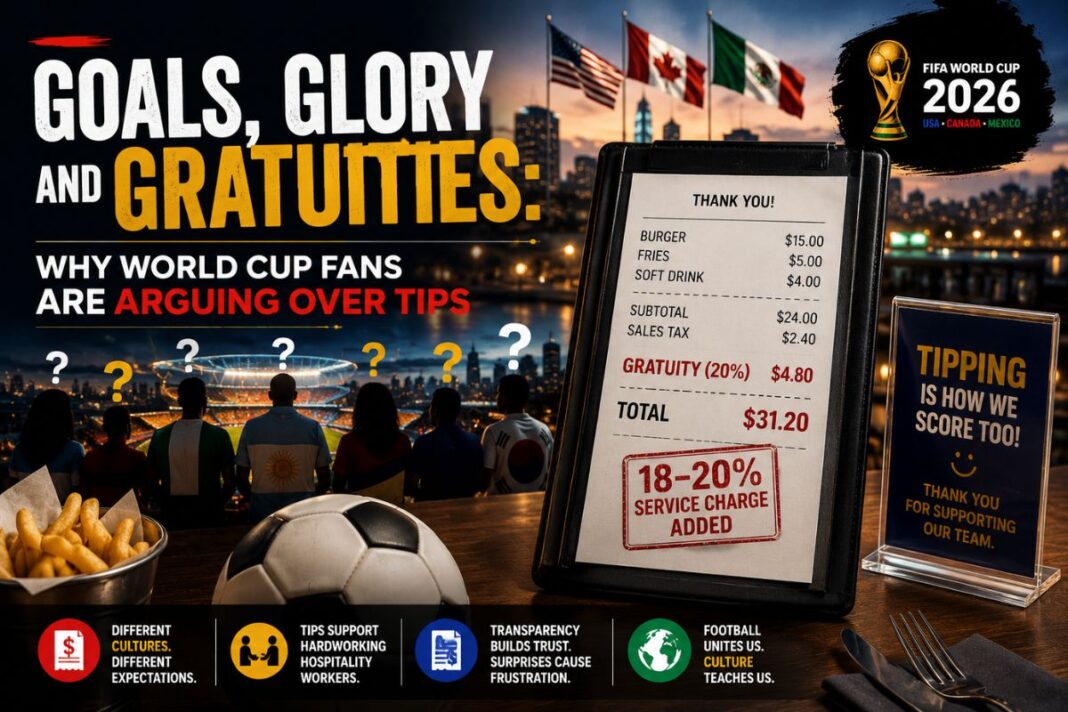
For many visitors, particularly those from countries where service charges are included in the bill or where tipping is rare, optional or symbolic, the experience has been confusing. A burger listed at $15 suddenly becomes a $18 bill. A family meal costing $120 quietly turns into $144 after an automatic 20 percent gratuity is added.
You may also like;
- Match Review: England 2-1 DR Congo: Harry Kane Fires Three Lions into FIFA World Cup 2026 Round of 16
- FIFA World Cup 2026 Matchday 6 Review: France, Norway, Argentina and Austria Win as Mbappé and Messi Shine
- Which African Teams Are Playing at World Cup 2026 and Can They Go Far?
- Match Review: Belgium 3-2 Senegal: Red Devils Complete Dramatic Comeback Amid Penalty Controversy
As a result, some restaurants in World Cup host cities have taken matters into their own hands. Rather than risk receiving little or no gratuity from international visitors unfamiliar with local customs, they are automatically adding service charges of between 18 and 20 percent to customers’ bills.
The issue has sparked debates among fans, business owners and hospitality workers, revealing an unexpected cultural clash beneath football’s global celebration.
Imagine a supporter from Japan, South Korea, Nigeria, Sweden or Argentina, who has just finished lunch near a stadium. Back home, excellent service is considered part of the job. In Japan, tipping can even be considered awkward or unnecessary. Across much of Europe, a small rounding-up of the bill is often sufficient. In many African countries, tipping is appreciated but not mandatory.
Then comes the American bill.
A visitor orders a cheeseburger for $15, fries for $5 and a soft drink for $4. The menu suggests a total of $24. But after local sales taxes and a 20 percent gratuity, the actual amount climbs toward $30.
For a family of four attending multiple matches during a month-long tournament, those differences add up quickly.
Restaurant owners argue they are not trying to exploit tourists. Many servers in the United States depend heavily on tips because their base wages are often significantly lower than in other developed economies. Unlike many countries where hospitality workers receive higher fixed salaries, American servers frequently rely on gratuities to make a living wage.
The World Cup has therefore exposed a collision between two legitimate realities.
On one side are international visitors who believe the advertised price should be the final price.
On the other hand are hospitality workers whose earnings depend on customers understanding a deeply rooted local practice.
This situation illustrates something fascinating about modern globalization. Football may be universal, but cultures are not. They are simply peculiar.
Fans arrive at the World Cup carrying more than passports and jerseys. They come with their own expectations shaped by their societies. What seems perfectly normal in Houston may seem strange to a visitor from Seoul. What is customary in Miami may appear excessive to someone from Copenhagen or Accra.
The issue has become especially noticeable because this World Cup is the largest in history, featuring 48 teams and millions of travelling supporters. There was never a period that so many cultures converged in North America at the same time.
The debate also raises broader questions about transparency in pricing.
Many international visitors have expressed their frustration not necessarily because of the amount itself, but because the final price often differs substantially from what is displayed on menus. Critics argue that businesses should clearly communicate service charges before customers order rather than surprise them at payment time.
Supporters of automatic gratuities counter that such policies protect workers from misunderstandings and ensure fair compensation regardless of a customer’s familiarity with local customs.
Beyond economics, the controversy reveals one of the hidden attractions of a World Cup. The tournament is not merely a football competition. It is a giant cultural exchange programme.
As usually anticipated, fans discover different foods, different accents, different transportation systems, different laws and different social norms. They learn how other societies work. Sometimes that learning experience happens in museums and tourist attractions. Sometimes it happens over a restaurant bill.
Twenty years from now, supporters may not remember every scoreline from the 2026 tournament. They may forget who scored in a Round-of-16 match or who topped a particular group.
But many will remember their experience at the restaurant, ordering a meal, checking the bill, spotting an unexpected 20 percent charge and asking the waiter, “What exactly is this?”
And in that moment, they will have experienced one of the World Cup’s oldest traditions. Not football itself, but the encounter between cultures.
Because every World Cup is ultimately about more than the game. It is about the people who travel thousands of miles to watch it, and the discoveries they make along the way.
Sometimes those discoveries come with surprises inside a stadium.
Sometimes they arrive with shock over the bill.