

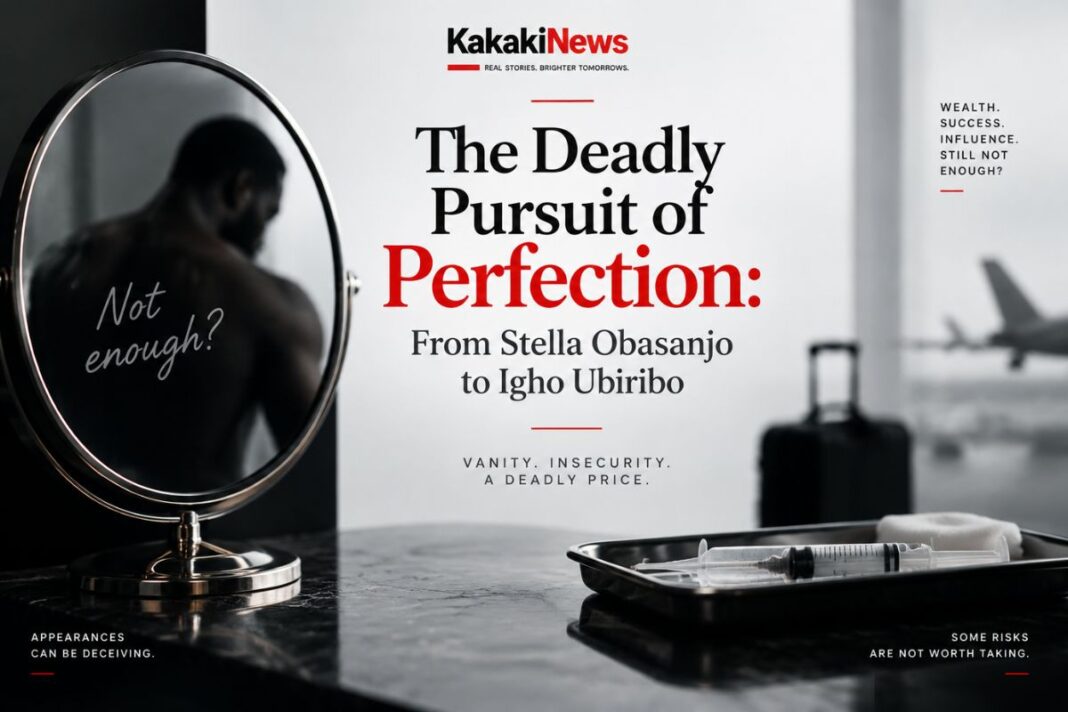

The death of a British-Nigerian businessman and social media influencer, Igho “Tiny” Ubiribo, following a penis enlargement procedure in Thailand, has once again raised troubling questions about human vanity, insecurity, and the dangerous pursuit of physical perfection. Reports indicate that the procedure involved the injection of hyaluronic acid fillers, which later caused a fatal pulmonary embolism that claimed his life.
The news shocked many people, not only because of the unusual nature of the procedure but also because the deceased was reportedly wealthy, successful, married, and living a life that many would envy. He owned properties in London and Los Angeles, enjoyed influence on social media, and had access to comforts beyond the dreams of most people. Yet, something convinced him that his natural body was not enough.
That reality forces society to confront an uncomfortable truth: wealth does not cure insecurity. Whenever stories like this emerge, the first question people ask is simple: Did the doctors not warn him of the risks? The answer is that reputable medical practitioners typically explain potential complications before carrying out elective cosmetic procedures. Informed consent is a standard requirement in modern medicine. Patients are usually told about possible side effects, complications, and, in rare cases, death. Yet human beings often hear what they want to hear.
You may also like;
- FAAC Windfall and the Missing Development Dividend: What Are Nigerian Governors Doing With the Money?
- The Man Who Never Cried — A Story About Men, Mental Health, and the Silence That Kills
- Inside Mentor To Marry: Pastor Kingsley Okonkwo’s ₦700k Christian Matchmaking Platform
- Before You Laugh at Men Who Squat to Pee, Read What Doctors Are Discovering
When a person desperately desires a particular outcome, the promised benefits frequently drown out the warnings. The possibility of gaining a larger body part, a younger face, smoother skin, or a more attractive appearance appears more real than the remote possibility of death. The mind convinces itself that tragedy happens to other people. Unfortunately, history tells a different story.
Nigeria has witnessed similar tragedies involving prominent personalities who sought medical procedures intended to improve their appearance or health. One of the most notable examples remains Stella Obasanjo, wife of former President Olusegun Obasanjo. In 2005, she died in Spain following cosmetic surgery complications. Her death generated national mourning and global headlines. The procedure was supposed to enhance life, yet it ended it.
Beyond Nigeria, the list is extensive. International celebrities, wealthy businessmen, entertainers, and socialites have died or suffered permanent injuries from cosmetic surgeries. Some wanted slimmer waists. Others wanted fuller lips, larger buttocks, firmer skin, or younger-looking faces. A few desired enhancements in private areas that the public would never see.
The irony is striking. Many of these individuals were already admired by society. They were not poor. They were not rejected. They were not lacking affection or companionship. Yet they pursued changes that ultimately brought disaster. Why? You may ask.
The answer lies partly in the psychology of human dissatisfaction.
Human beings have a remarkable ability to ignore what they possess while obsessing over what they lack. A man may have wealth, fame, a loving spouse, and good health, yet spend sleepless nights worrying about the size of a body part. A woman may be beautiful by every objective standard, yet become convinced that her nose, waistline, or skin needs correction.
The mirror often reflects less than the mind imagines.
Social media has worsened this condition. Every day, people are bombarded with edited images, artificial beauty standards, and exaggerated portrayals of physical perfection. Men compare themselves with actors, athletes, and adult-content performers. Women compare themselves with influencers whose images have often been altered digitally or surgically. The result is a growing industry built on insecurity.
Clinics around the world now market procedures that would have seemed unimaginable decades ago. They promise larger muscles, whiter teeth, younger skin, fuller hair, reshaped noses, enhanced buttocks, enlarged breasts, and even enlarged penises.
Among men especially, penis enlargement has become a booming business despite medical experts repeatedly warning that most men seeking such procedures already fall within the normal range of size. Studies have shown that many men underestimate their own size while overestimating what is average. Some experts describe this as a form of body-image distortion.
For many men, the desire for enlargement is not rooted in medical necessity but in perception. They fear inadequacy. They worry about sexual performance. They seek validation. Some believe a larger organ will increase confidence, attract partners, or improve relationships.
Ironically, confidence rarely comes from surgery. A man who is insecure before a procedure may remain insecure afterward. Once one perceived flaw is corrected, another often emerges. The search for perfection may never end.
This is not to say that all cosmetic procedures are wrong. Modern medicine has transformed countless lives. Reconstructive surgery helps accident victims. Corrective procedures restore function and dignity. Some treatments address genuine medical conditions.
The problem arises when medicine becomes a servant of vanity rather than necessity. In the case of genital enlargement procedures, even professional medical organisations have expressed concerns about safety and effectiveness. Complications can include infections, scarring, deformity, erectile dysfunction, and, in rare cases, life-threatening events.
Despite this, the demand continues to grow. The rich are especially vulnerable because they possess the resources to pursue every desire. Money creates access. If one clinic refuses a procedure, another clinic somewhere in the world may agree to perform it. Medical tourism has expanded this possibility. Individuals travel across continents seeking treatments unavailable, unapproved, or discouraged in their home countries.
Sometimes they return satisfied. Sometimes they never return at all.
What makes these deaths particularly tragic is their preventability. Many of the conditions being “treated” are not diseases. They are not cancers. They are not life-threatening disorders. They are often perceived imperfections that exist more in the mind than in reality.
One wonders what conversation took place before Ubiribo entered that clinic in Thailand. Did he pause to consider the risks? Did he think about his family? Did he imagine that a routine cosmetic enhancement could become his final decision on earth?
Perhaps he did. Perhaps he believed the odds were in his favour. Most people do. No one undergoes cosmetic surgery expecting a funeral. Yet funerals have become the lot of many.
That is why his death should serve as more than a sensational headline. It should become a moment of reflection for a generation increasingly obsessed with appearances. We live in an age where people alter photographs before posting them online, where filters replace reality, and where physical perfection has become a billion-dollar industry.
But perfection remains an illusion. The human body will age. Skin will wrinkle. Hair will grey. Muscles will weaken. No procedure can permanently defeat nature.
The ancient writer of Ecclesiastes in the Bible understood this truth centuries ago when he described life’s pursuits as vanity. Wealth, status, beauty, power, and possessions often promise fulfilment yet leave people yearning for more.
The tragedy of Igho Ubiribo is not merely that a wealthy man died after a cosmetic procedure. The deeper tragedy is that modern society continues to convince millions that happiness lies one surgery away, one enhancement away, one correction away. But in reality, it does not.
The woman he wanted to impress would now become that of another man elsewhere. Perhaps with the same size. With his money and all, she can now buy whatever size she wants that he could not satisfy her. How tragic!
A person’s worth cannot be measured by the size of a body part, the smoothness of skin, the shape of a nose, or the approval of strangers online.
In the end, death remains the great equaliser. It does not ask how rich a person was, how many followers they had, or how attractive they appeared. It arrives without regard for status, beauty, or influence.
And when it does, all the things we spent our lives chasing suddenly reveal their true value. Very often, that value is far less than we imagined. Life, after all, is vanity.








This is a deeply tragic reminder of how far the pursuit of physical perfection can take us. What strikes me most is that wealth, success, influence, and even having a loving family do not necessarily shield a person from insecurity or the pressure to conform to society’s idea of perfection.
We must learn to appreciate ourselves and understand that not every perceived imperfection requires correction. There is nothing wrong with seeking medical help when there is a genuine health or reconstructive need, but when vanity and insecurity begin to dictate life-threatening decisions, we need to pause and ask ourselves what we are really trying to achieve.
The saddest part is that no physical enhancement is worth losing one’s life over. At the end of the day, the body we are so desperate to perfect is temporary. Perhaps the greatest lesson from this tragedy is that self-acceptance may be one of the most important forms of self-preservation.