

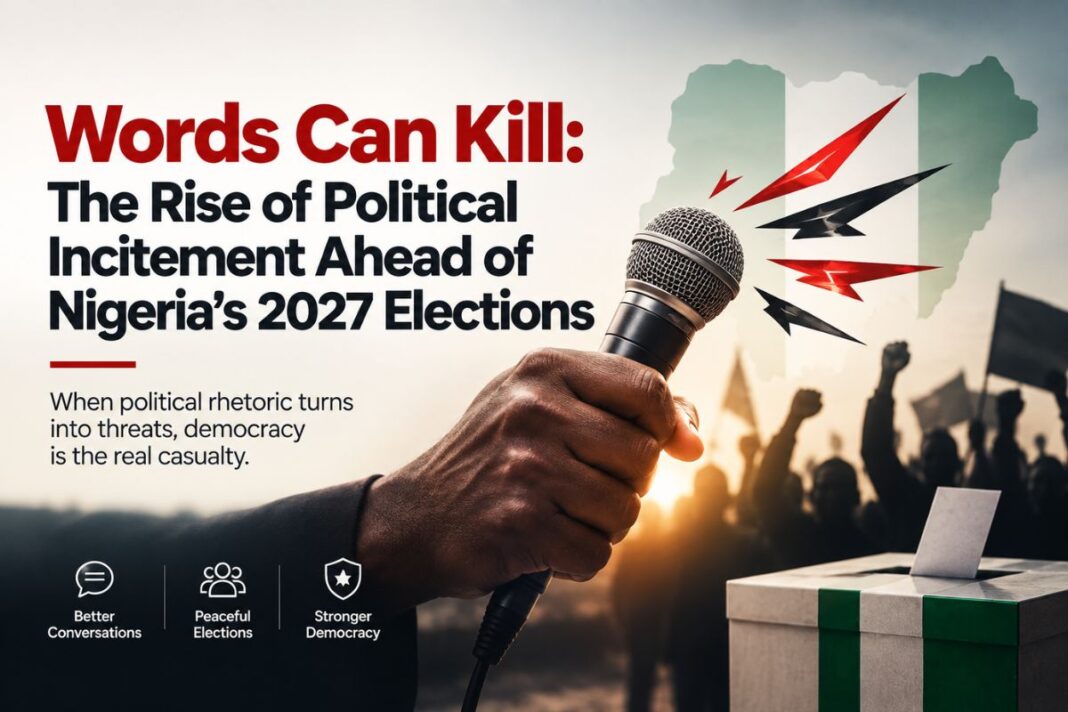

As Nigeria gradually inches toward the 2027 general elections, disturbing signals are already emerging from the political landscape. The campaigns have formally commenced, political parties have unveiled their candidates, and the language of confrontation, intimidation, and violence is already creeping into public discourse. From governors to senators, party chairmen to local political leaders, some public officials appear increasingly comfortable making statements that suggest aggression against political opponents. Such utterances may be dismissed by supporters as mere political rhetoric, but history teaches us that careless words often become dangerous actions.
Democracy thrives on persuasion, not coercion. Elections are contests of ideas, policies, competence, and vision. The moment political actors begin to frame elections as warfare, they create an atmosphere where violence becomes acceptable and opponents become enemies rather than fellow citizens exercising democratic rights.
Recent statements from political figures across the country should worry every Nigerian who values peace. Before the Osun State governorship election, a senator reportedly urged supporters to “kill” opponents. Whether intended literally or figuratively, such language has no place in a democratic society. In Kebbi State, a governor reportedly called on party supporters to fight. In Ebonyi State, statements allegedly made by political leaders were interpreted by many as threats directed at opposition parties. In Yobe State, an APC chairman reportedly advised women whose husbands prevented them from voting for his party to consider divorce.
While each statement emerged from different political contexts, they share a dangerous common denominator: they promote hostility rather than healthy democratic competition.
The tragedy is that Nigeria is not a country that can afford to joke with inflammatory political language. Our history is littered with painful reminders of what happens when political tensions are allowed to escalate unchecked. Operation wet e and Wild Wild West are still on our minds!
You can also read;
- When the Pepper Reaches the Pepper Seller’s Eye: The Lessons Nigeria Keeps Refusing to Learn
- FAAC Windfall and the Missing Development Dividend: What Are Nigerian Governors Doing With the Money?
- When the Mob Becomes Judge, Jury and Executioner
- Imole Shines On: Ademola Adeleke Wins Osun 2026 Governorship Election With 511,067 Votes to Beat APC’s Oyebamiji
Let me not go too far. The violence that followed the 2011 presidential election remains one of the darkest chapters in Nigeria’s democratic journey. Hundreds of people lost their lives. Communities were destroyed. Families were displaced. Businesses collapsed. The scars remain visible in many affected areas. That violence did not start with guns and machetes. It started with words, threats, rumours, incitement, and political manipulation.
Words matter. Political leaders often underestimate the influence they wield over their followers. A governor addressing thousands of supporters may see his comments as ordinary political talk. A senator speaking at a rally may believe he is merely energizing his base. Yet many supporters view political leaders almost as unquestionable authorities. Their words carry enormous weight.
When a respected political figure uses violent language, some followers may interpret it as permission to attack opponents. Others may see it as a directive. The result is often the normalization of aggression.
This is particularly dangerous in a country where millions of young people are unemployed, frustrated, and vulnerable to political manipulation. Every election cycle witnesses the recruitment of youths as political thugs. Some are paid to disrupt rallies, intimidate voters, snatch ballot boxes, or attack perceived opponents.
Many of these young men and women are not inherently violent. They simply become tools in the hands of desperate politicians who seek victory at all costs. When political leaders employ inflammatory language, they justify actions that should never occur in a democracy.
Even more troubling is the fact that violence-prone statements are increasingly coming from individuals occupying public offices. These are not obscure social media influencers or anonymous commentators. They are governors, senators, party leaders, and other public officials who swore to uphold the Constitution and protect democratic values.
Public office comes with responsibilities beyond policy implementation. It also requires leadership by example. Citizens look to elected officials for guidance on acceptable conduct. When those entrusted with governance become sources of inflammatory rhetoric, they undermine the very institutions they represent.
Political leaders must understand that their primary duty is not merely to win elections but to preserve the stability of the nation.
No election is worth the blood of a single Nigerian. This principle should guide every political speech, campaign strategy, and public engagement leading up to 2027.
The Independent National Electoral Commission (INEC) has repeatedly emphasized the need for issue-based campaigns. Unfortunately, issue-based politics remains scarce. Instead of discussing education, healthcare, insecurity, inflation, unemployment, infrastructure, and economic development, political conversations frequently descend into insults, threats, ethnic sentiments, and inflammatory remarks.
The consequence is a poisoned political environment where voters become emotionally charged rather than intellectually engaged.
Political actors should remember that opponents today may become allies tomorrow. Nigerian politics is filled with examples of fierce rivals who eventually joined forces. Individuals who once exchanged harsh words on campaign platforms later sat together in coalition meetings and government offices.
This reality exposes the foolishness of promoting hatred among supporters. Politicians often reconcile after elections, but ordinary citizens who fought one another in their names are left with injuries, criminal records, damaged businesses, or even bereavement.
The role of security agencies in this matter cannot be overemphasised. One of the reasons inflammatory statements continue to flourish is the perception that there are no consequences. Politicians frequently make provocative remarks without facing legal scrutiny. This culture of impunity emboldens others to push the boundaries further.
Security agencies must become more proactive. The Nigeria Police Force, Department of State Services, Civil Defence Corps, and other relevant agencies should not wait until violence erupts before taking action. Prevention is far more effective than reaction.
When public officials make statements capable of inciting violence, security agencies should investigate promptly. Where laws have been violated, appropriate legal measures should follow irrespective of political affiliation.
Such interventions should not be viewed as political persecution. Rather, they should be regarded as necessary steps to preserve public order and democratic stability. The law should apply equally to everyone. A local government chairman, a senator, a governor, or a party chairman should be held to the same legal standards. Selective enforcement only deepens public distrust and encourages further recklessness.
The National Broadcasting Commission also has a role to play. Radio and television stations must exercise greater caution when airing political content. Programmes that provide platforms for hate speech and incitement should be monitored closely. Freedom of expression is a cornerstone of democracy, but it does not extend to incitement, threats, or calls for violence.
Political parties themselves must accept greater responsibility. Every major political party has constitutions, disciplinary committees, and codes of conduct. Unfortunately, enforcement often depends on political convenience. Party leaders who engage in inflammatory rhetoric should face disciplinary measures regardless of their influence or popularity.
Silence from party leadership often sends the message that such behaviour is acceptable. Religious leaders, traditional rulers, civil society organizations, and the media also have critical roles to play. They must consistently condemn violent rhetoric regardless of which political party is involved. Selective outrage weakens moral authority. A threat remains a threat whether it comes from a member of the ruling party or the opposition.
The media, in particular, should continue to expose dangerous statements and hold public officials accountable. Journalists must resist the temptation to sensationalize inflammatory comments merely for audience engagement. Instead, media organizations should provide context, fact-check claims, and emphasize the consequences of political violence.
Parents and community leaders must equally educate young people about the dangers of becoming instruments of political violence. The politician who distributes money before an election is unlikely to care for the families of supporters injured or killed in political clashes.
History repeatedly shows that political sponsors often abandon their foot soldiers once elections are over.
As 2027 approaches, Nigeria stands at a crossroads. The country is already grappling with insecurity, economic hardship, social tensions, and declining public trust in institutions. The last thing the nation needs is an election season characterized by intimidation, violence, and bloodshed.
The warning signs are already visible. Responsible leaders should heed them now rather than express regrets later.
Democracy is strongest when citizens can campaign, vote, and express political preferences without fear. It is strongest when political opponents debate policies rather than trade threats. It is strongest when leaders inspire hope rather than hostility.
Nigeria’s public officials must therefore choose their words carefully. Their statements can calm tensions or inflame them. They can strengthen democracy or weaken it. They can promote peaceful participation or encourage violence. The choice is theirs.
For security agencies, the message is equally clear. Eternal vigilance is not merely a democratic virtue; it is a constitutional responsibility. They must monitor, investigate, and address inciting statements before they evolve into physical violence. Waiting for lives to be lost before acting would be a costly failure of duty.
The road to 2027 has already begun. If Nigeria desires peaceful elections, the work must start now. Violent rhetoric must be rejected. Political leaders must embrace responsibility. Security agencies must remain alert. Political parties must enforce discipline. Citizens must refuse manipulation.
The future of Nigeria’s democracy may depend not only on how votes are cast but also on how words are spoken. Before ballots are counted, language must be moderated. Before campaigns intensify, responsibility must prevail. And before another election cycle unfolds, every stakeholder must remember a simple truth: in politics, words can either build a nation or set it on fire.