

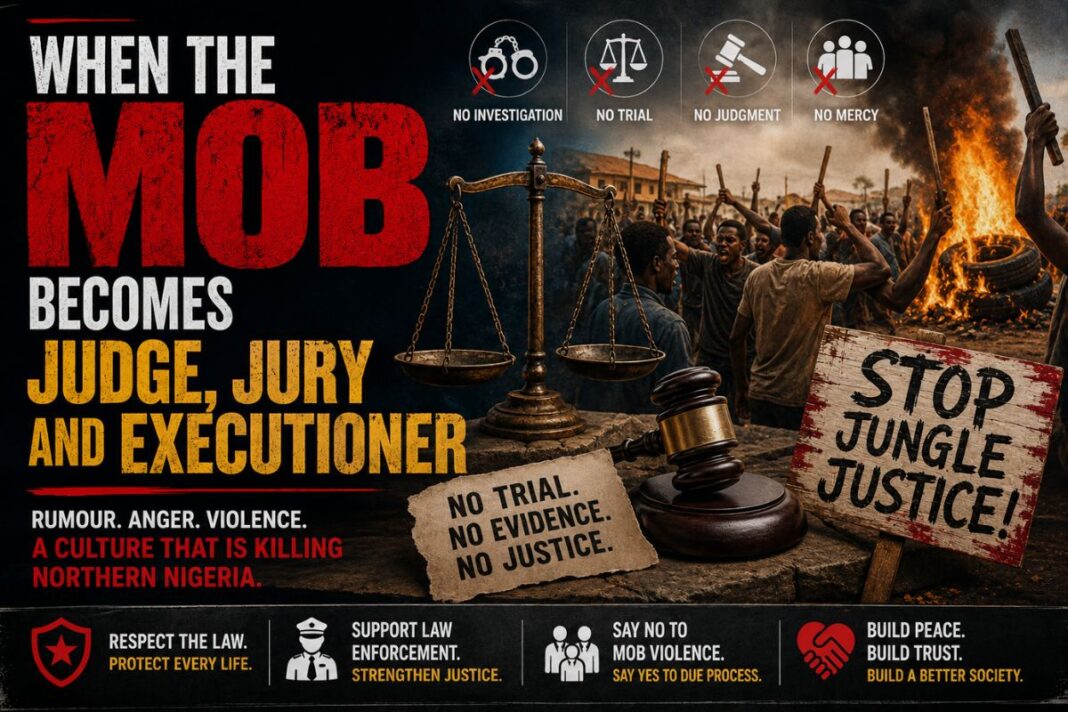

On a dusty Sunday evening in Balare, Ajingi Local Government Area of Kano State, a young man named Ahmad Dankoli allegedly attempted to steal a motorcycle. Before investigators could establish the facts, before a court could hear the matter, before the law could take its course, the crowd had already reached a verdict. He was beaten to death and his body set ablaze. Security operatives reportedly attempted to intervene, but the mob overpowered them.
Just two weeks earlier, another horrifying scene unfolded in Mararaban Jos, Kaduna State. An Islamic school teacher, Ummulkhairi, was accused of attempting to steal a child. Police officers rescued her and took her into protective custody. Yet hundreds of residents reportedly stormed the police station, dragged her out, killed her, and set her body on fire. Could you believe that? Investigations later showed that no evidence had been produced to support the allegation against her. Twenty-four suspects were subsequently arraigned.
Different victims. Different accusations. The same ending.
It is sad that while the mob acted, the law watched helplessly.
And therein lies one of the most troubling realities of contemporary Northern Nigeria: mob justice is no longer an occasional outburst. It is becoming a culture.
You may also read;
- FAAC Windfall and the Missing Development Dividend: What Are Nigerian Governors Doing With the Money?
- Faith Without Risk Is Not Faith: Why Many Young Christians Struggle With Consistency
- When the Pepper Reaches the Pepper Seller’s Eye: The Lessons Nigeria Keeps Refusing to Learn
- 10 Bible Verses That Will Strengthen Your Faith During Hard Times
1The Story We Keep Repeating
For decades, Northern Nigeria has witnessed numerous episodes of jungle justice. Sometimes the accusation is theft. Sometimes it is kidnapping. Sometimes it is blasphemy. At other times, mere rumours are enough to trigger violence.
Many Nigerians still remember the killing of Deborah Samuel in Sokoto in 2022 after allegations of blasphemy. The images shocked the nation and the world. Years earlier, in Kano, mobs attacked churches and homes following allegations involving religious disputes. Similar incidents have occurred in Bauchi, Kaduna, Katsina, Jigawa, Zamfara and other northern states.
The pattern is familiar in a frightening order.
Someone shouts “thief!”
Someone screams “blasphemy!”
Someone alleges “child kidnapper!”
Within minutes, facts become irrelevant. Suspicion becomes evidence. Rumour becomes judgment. Pronto, the crowd becomes court.
And a human being loses his or her life.
2Why Is This Becoming a Culture?
The easy answer is ignorance. But that is only part of the story.
The deeper problem is the collapse of public confidence in institutions.
Many citizens believe the police will not investigate properly. Others believe courts are too slow or too corrupt. Victims of crime often complain that suspects are released shortly after arrest. Communities that are repeatedly traumatized by banditry, kidnapping and theft become angry and impatient.
When institutions fail, vigilantism emerges.
But vigilantism quickly mutates into barbarism.
A community frustrated by motorcycle theft may feel justified in attacking a suspect. Yet once a society accepts mob violence as a legitimate response, no one is safe anymore. The innocent and the guilty become equally vulnerable.
History is full of examples where mobs killed people who later turned out to be innocent.
The dead never get an opportunity to prove their innocence.
3The Dangerous Silence of the Northern Elite
Another factor that deserves scrutiny is the response—or lack of response—from the northern political and traditional establishment.
Northern Nigeria remains one of the most socially influential regions in Africa. The Emirs, district heads, clerics, governors and political leaders wield enormous authority. When they speak, communities listen.
Yet many mob killings are followed by ritual condemnations, after which attention shifts elsewhere.
I am yet to see or hear of sustained campaigns against jungle justice. Rarely do we see community-wide civic education programmes. Perpetrators are consistently prosecuted. Expectedly, the consequence is predictable: impunity.
When citizens repeatedly see murderers escape punishment, they conclude that mob action carries little risk. A culture of impunity then develops.
The same northern oligarchy that can mobilise communities during elections, religious celebrations or political campaigns often appears unable—or unwilling—to mobilize society against mob violence with equal determination.
That failure has consequences.
4A Society at War with Due Process
The tragedy is that mob justice destroys the very foundation of civilization.
Every modern society is built on a simple principle: accusations must be tested before punishment is imposed.
Once that principle disappears, everyone becomes vulnerable.
Today, the victim is a suspected thief.
Tomorrow, it may be a political opponent.
The day after, it may be someone targeted because of ethnicity, religion or personal rivalry.
The mob does not require evidence.
The mob requires only emotion.
And emotions are easily manipulated.
A false accusation can travel through a marketplace faster than truth can travel through an entire city.
5What Does This Portend?
If this culture grows unchecked, the normalization of jungle justice poses grave dangers.
First, in a society like ours, it weakens the legitimacy of the state. Citizens begin to perceive that force is more effective than law.
Second, it encourages criminality. Ironically, communities that kill suspected criminals without trial often become more insecure because genuine investigations never occur.
Also, it deepens social divisions. Ina multi ethnic and multi religious society like Nigeria, ethnic, religious and communal tensions can easily be weaponised through false accusations.
Fourth, it discourages investment and development. Investors are reluctant to commit resources to societies where law enforcement appears weak and crowds can unleash deadly violence at any moment.
Most importantly, it erodes the value of human life.
A society that becomes comfortable watching people burned alive is gradually losing its moral compass.
As it is, Northern Nigeria stands at a crossroads.
The region can either continue down the path where mobs replace courts and rumours replace evidence, or it can reaffirm its commitment to justice and civilization.
The solution begins with consistent prosecution. Every participant in mob killings must face the law regardless of status, influence or connections.
Traditional rulers and religious leaders cannot continue to look the other way when mob action is reported within their region/state. In addition to prosecuting persons who indulge in such act, they must launch sustained public campaigns condemning jungle justice. Not once. Not occasionally. Consistently.
The Police formations must be strengthened and equipped to respond rapidly before crowds become uncontrollable.
Schools, mosques, churches and community organisations must educate citizens on the dangers of mob violence.
Most importantly, political leaders must demonstrate through action that the state alone possesses the authority to investigate, prosecute and punish crime.
Because once a crowd acquires the power to decide who lives and who dies, society itself becomes the victim.
For those who care to listen, the deaths of Ahmad Dankoli in Kano and Ummulkhairi in Kaduna are not isolated tragedies. They are warning signs.
A civilization is measured not by how it treats the powerful, but by how it treats the accused.
If Northern Nigeria fails to confront the culture of jungle justice today, tomorrow’s victims may not be thieves, alleged blasphemers or suspected kidnappers.
They may simply be innocent people who happened to be standing in the wrong place when the mob arrived.