
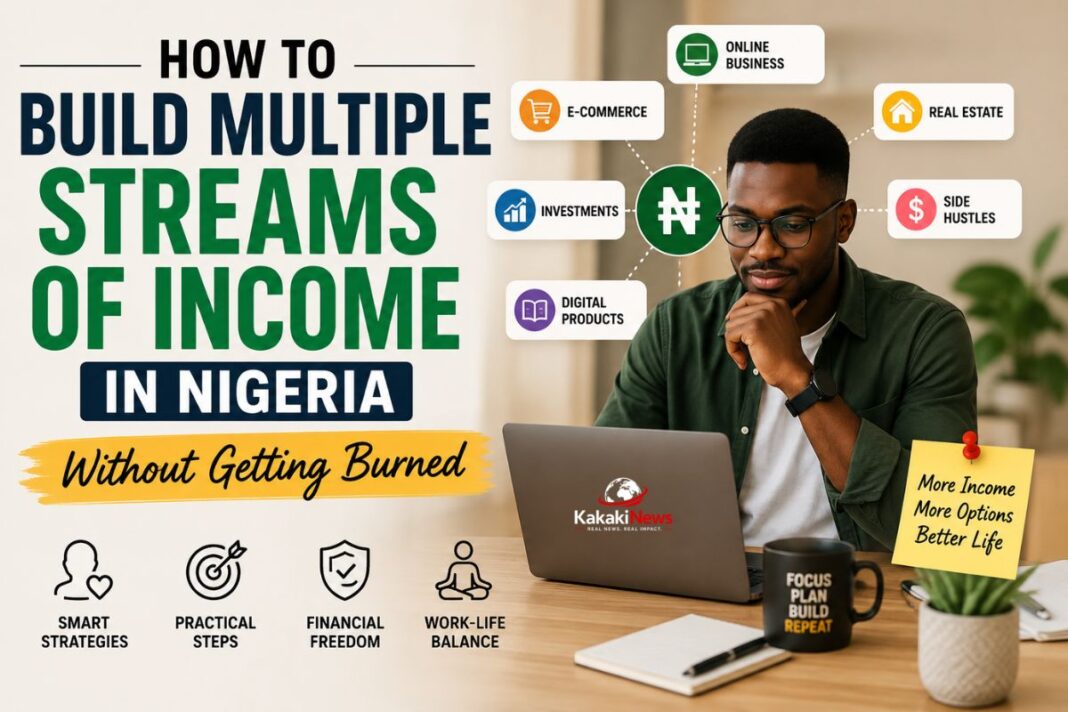

A practical, Nigeria-focused roadmap to financial security — told through real lessons, real case studies, and a personal story that started it all.
How to Build Multiple Streams of Income in Nigeria Without Getting Burned is a topic that, frankly, should be a compulsory course in our schools. I still remember the day this idea first planted itself in my head. I was working at a digital marketing firm in Lekki, Lagos, when one of my elder childhood friends — a man considerably older than me — walked into my boss’s office for a meeting. He was visibly happy to see me, and we exchanged the usual pleasantries before he went in to see my boss.
“Never depend on a single income. Make investments to create a second source.” — Warren Buffett
What happened next stuck with me for years. As I was stepping out of the office, I overheard him tell my boss something that stopped me in my tracks: “To survive comfortably in a country like Nigeria, you need at least five streams of income.” Five. Not one side hustle. Not a “small something” on the side. Five distinct, deliberate sources of money flowing into your account.
At the time, I remember thinking, “What? Five? How is that even realistic?” But the idea refused to leave me. It sat quietly in the back of my mind, resurfacing every time I faced a financial shock — a sudden fuel price hike, a salary delay, an emergency I wasn’t prepared for. Slowly, that overheard conversation became a personal mission. I started studying how people actually build multiple income streams in Nigeria’s current economy, what works, what fails, and why so many people get burned chasing “quick money” schemes.
“Formal education will make you a living; self-education will make you a fortune.” — Jim Rohn
You may also like:
- How AI Is Changing Jobs and Businesses in Nigeria
- Google Merchant Center Terms Are Changing in 2026: What Online Businesses Need to Know
- How to Start a Small Business in Nigeria with Low Capital
- 10 Remote Job Skills Nigerians Should Learn in 2026
This article is the result of that journey — a grounded, no-hype guide to building multiple streams of income in Nigeria today, backed by real-life case studies and practical steps you can start applying immediately.
Why Multiple Streams of Income Matter More Than Ever in Nigeria
Nigeria’s economy has never rewarded a single-income lifestyle, but in recent years, the gap between a single salary and the actual cost of living has widened dramatically. Inflation, currency devaluation, and rising transport and food costs mean that what comfortably covered your needs two years ago may barely stretch halfway today.
A single income stream is also a single point of failure. If that job disappears — through a layoff, a company restructuring, or even a forced career break due to health — everything connected to that income disappears with it: rent, school fees, feeding, transportation, and savings contributions all grind to a halt simultaneously.
Multiple streams of income work like a financial safety net with several layers. If one thread snaps, the others hold. This is not about greed or chasing endless money; it is about building resilience into your personal economy.
If you don’t find a way to make money while you sleep, you will work until you die.” — Warren Buffett
The “Getting Burned” Part: Why So Many People Fail at This
Here is the uncomfortable truth: most Nigerians who attempt multiple streams of income do not fail because the concept is flawed. They fail because of how they go about it. The phrase “without getting burned” in this article’s title is deliberate, because the road to multiple income streams in Nigeria is littered with the wreckage of Ponzi schemes, fraudulent forex “mentors,” and businesses started on borrowed capital with no clear plan.
The most common mistakes include jumping into an income stream purely because someone else is making noise about it on social media, investing scarce capital into schemes promising unrealistic returns, neglecting your primary income source while chasing a side hustle that has not yet proven itself, and failing to separate personal funds from business or investment funds.
Avoiding these traps requires patience, research, and a willingness to start small. The goal is sustainable diversification, not a financial gamble.
“The successful person makes a habit of doing what the failing person doesn’t like to do.” — Thomas Edison
A Practical Framework for Building Multiple Income Streams
Before diving into specific income streams, it helps to have a framework — a way of thinking about how these streams fit together. Here is the approach that has worked for many Nigerians who have successfully diversified their income without losing their primary job or going into debt.
1Secure and Strengthen Your Primary Income First
Your first stream — typically your job or main business — is your foundation. Before adding new streams, make sure this one is stable. This means understanding your role’s value, continuously upgrading your skills, and ensuring your income from this source is consistent. A shaky foundation makes everything built on top of it unstable.
2Choose a Second Stream That Uses Skills You Already Have
The fastest way to add a second stream is to monetize a skill you already possess, rather than starting from zero. If you are good at writing, graphic design, social media management, accounting, or teaching, these skills can be converted into freelance income with minimal upfront investment, often through platforms accessible from a smartphone.
3Add a Stream That Generates Passive or Semi-Passive Income
This is where many people get impatient. Passive income — money that continues to come in with reduced ongoing effort — typically takes time to build. Examples in the Nigerian context include rental income from property, dividends from stocks or mutual funds, interest from fixed deposits or treasury bills, and royalties from digital products like e-books, courses, or templates.
4Build a Small Business or Trading Activity
This could be anything from reselling goods, agro-processing, a small provisions store, or an online store selling niche products. The key word here is small — start with capital you can afford to lose, test the market, and only scale once you see consistent demand.
5Invest for the Long Term
The fifth stream, for many, is long-term investment — money set aside in instruments like mutual funds, government bonds, dollar-denominated assets, or retirement savings accounts. This stream may not produce visible income today, but it compounds quietly in the background, building wealth for the future.
Wealth consists not in having great possessions, but in having few wants.” — Epictetus
Real-Life Case Studies: Multiple Income Streams in Action
Concepts are easier to grasp when grounded in real examples. Below are case studies inspired by common, realistic patterns seen across Nigerian professionals and entrepreneurs who have successfully built multiple income streams.
Case Study 1: The Lagos Digital Marketer Who Built a Content Side Business
A mid-level digital marketer working at an agency in Lagos earned a stable monthly salary but found it stretched too thin by the third week of every month. Rather than quitting to chase a “big idea,” she began offering social media management services to two small businesses during her evenings and weekends — a skill she already used daily at work.
Within eight months, this freelance work grew to four clients, generating a second income stream roughly equal to 60 percent of her salary. She reinvested part of these earnings into a content creation course, which later opened the door to a third stream: selling digital templates for small business owners. Her foundation remained her job, but two additional streams were built directly from existing skills, with zero borrowed capital.
Case Study 2: The Civil Servant Who Diversified Through Agriculture and Treasury Bills
A civil servant in a state capital outside Lagos used a portion of his savings, accumulated over several years, to lease a small plot of farmland for poultry and vegetable production, managed by a trusted relative. The farm did not generate significant profit in its first year, but by year two, it was producing a modest but consistent monthly surplus from egg sales.
Separately, he began investing smaller, regular amounts into Nigerian treasury bills through his bank, building a low-risk stream that grew steadily due to compounding interest. Combined, these two additional streams — one active (farming) and one passive (treasury bills) — added meaningful financial cushioning without requiring him to leave his civil service job.
Case Study 3: The Cautionary Tale of the Forex “Quick Money” Trap
Not every attempt at diversification ends well, and this case is a reminder of why caution matters. A young professional, eager to add a second income stream quickly, invested a significant portion of his savings into a forex trading scheme promoted by an online “mentor” promising guaranteed weekly returns.
The scheme operated smoothly for the first two months, with small payouts encouraging him to invest more. By the fourth month, withdrawals were delayed, then stopped entirely, and the platform eventually disappeared. The lesson here is not that forex trading itself is bad — legitimate trading education and practice exist — but that any income stream promising guaranteed, unusually high returns with little effort should be treated with extreme skepticism.
Don’t put all your eggs in one basket.” — Miguel de Cervantes (Don Quixote)
Practical Tips for Nigerians Starting Their Income Diversification Journey
- Start with what you have: skills, time, or small capital — not borrowed money.
- Treat your first additional stream as an experiment, not a guaranteed win.
- Keep separate records and, where possible, separate bank accounts for each stream.
- Be wary of any opportunity that pressures you to “act fast” or recruit others to earn.
- Reinvest early profits into growing the stream rather than spending them immediately.
- Give passive income streams time — most take one to three years to become meaningful.
- Continue learning; the skills that open new income doors today may need updating tomorrow.
Final Thoughts: From an Overheard Conversation to a Way of Life
Years after overhearing that conversation in a Lekki office, I now understand why it stayed with me. The idea of five income streams was never really about the number five — it was about a mindset. A mindset that says your financial wellbeing should never depend entirely on one employer, one client, or one source of money, especially in an economy as unpredictable as Nigeria’s.
Building multiple streams of income without getting burned is less about hustle culture and more about deliberate, patient, and informed financial planning. Start with one additional stream. Get it right. Let it stabilize. Then build the next. Over time, what feels impossible today — five streams of income — becomes simply how you live.