

Why Every Great Tool Was Once Mocked, and AI Is No Different
In December 2022, when ChatGPT was released to the public, a friend of mine who works as a Java programmer introduced me to it. Like many people, I was immediately fascinated by what it could do. I spent weeks reading articles, watching YouTube tutorials, and experimenting with prompts. At first, like many others, I thought AI itself was the shortcut. The thing that would just handle everything.
I soon discovered the opposite.
AI did not replace my work. It helped me solve problems faster. Since then, I have used it to build online courses, troubleshoot WordPress websites, fix DNS and hosting issues, write proposals, create marketing campaigns, and accelerate software and IoT projects that would once have taken days or even weeks. The more problems I solved, the more opportunities I created.
But here is what I noticed as I worked.
Many Nigerian professionals around me were using the same tools. Quietly. In private. Some would ask me about AI prompts in a WhatsApp message, then post on LinkedIn two days later as if they had figured everything out on their own. Others would use ChatGPT to draft a proposal, win a client, and never once mention how the proposal was written.
I am not judging anyone for this. I have done versions of it myself.
What I am saying is that this behaviour, the quiet use of a helpful tool combined with public hesitation about admitting it, is not new. It is not a technology problem. It is a human problem. And it has happened with every significant tool in history.
You may also read;
How to Make Money With AI in Nigeria (Part 2)
How to Make Money With AI in Nigeria (Part 3)
How to Clean Up Your Gmail and Free Up Google Storage Space
24 Legit Websites Where Nigerians Are Getting Paid in Dollars Working Remotely
THE SUITCASE NOBODY WANTED
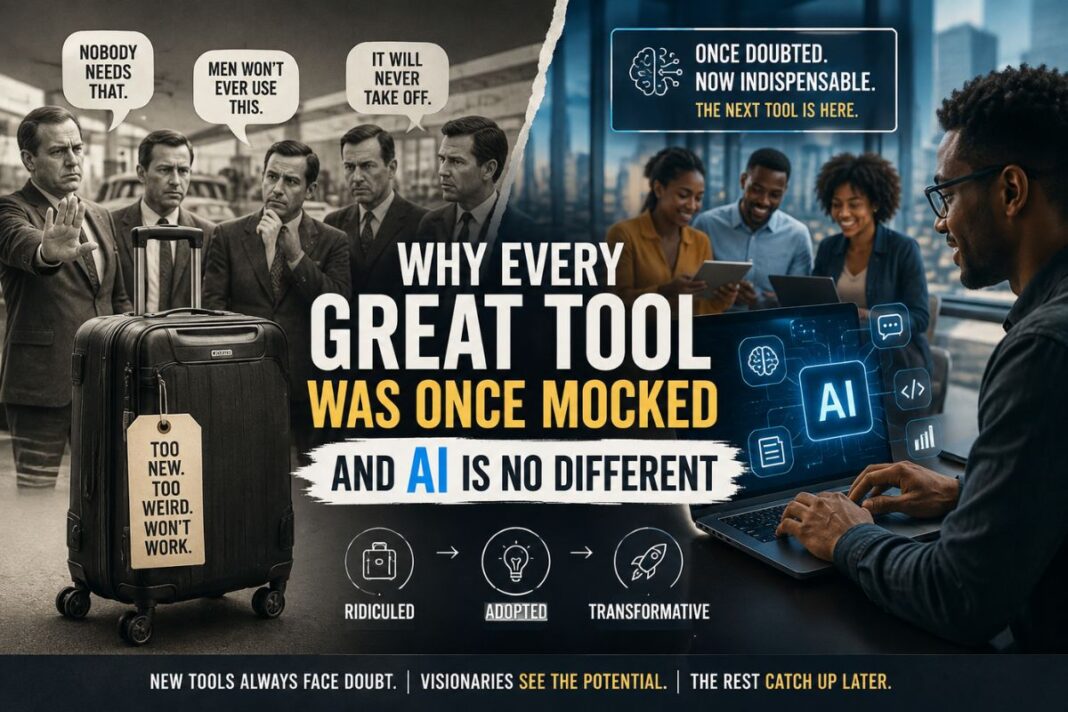
In 1970, a man named Bernard Sadow was dragging two heavy suitcases through an airport in Puerto Rico, returning from a family vacation. At customs, he watched an airport worker glide a heavy piece of machinery past him on a wheeled cart. Effortless. No strain, no sweat.
He turned to his wife and said simply: luggage should work like that.
He went home, pulled casters off a wardrobe trunk, attached them to a suitcase, and tied a strap to the front. The thing worked immediately. It was obvious once you saw it. He filed for a patent in 1970, received it in 1972, and went to the shops expecting immediate success.
Almost every store turned him down.
One department store told him flatly: men will never accept suitcases with wheels.
Read that again.
Wheels had existed for thousands of years. Rolling heavy things on wheels was not a new concept. But attaching wheels to a suitcase, in 1972, felt to many people like an admission of weakness. Carrying your own bag, however heavy, was a quiet signal of toughness. Rolling it said something about you that many men were not ready to say.
So a tool that clearly worked sat on the shelf for years. Not because it was complicated. Not because nobody could see how it worked. It sat there because using it felt like it said something about the person using it.
This is the story of almost every great tool ever built.
WHY HUMANS RESIST OBVIOUS IMPROVEMENTS
The resistance to new tools is never really about the tool. It is about what the tool implies about the person using it.
Every significant new technology touches three deep human anxieties.
The first is identity. If I have always defined myself as someone who can carry my own weight, literally or figuratively, then a tool that reduces the effort threatens that identity. Who am I if I no longer need to struggle the way I used to?
The second is status. In many societies, including Nigerian society, how you do something matters as much as whether you do it. There is status attached to certain kinds of effort. A lawyer who reads every case file manually signals something different from one who uses software to summarise them. The status question is: does using this tool make me look less capable or more capable?
The third is fear. Every new tool arrives with genuine uncertainty. Will it make mistakes? Will it cost me my job? Will it make me dependent on something I do not fully understand? These fears are not irrational. They are part of how humans protect themselves from novelty.
The problem is that these three anxieties, identity, status, and fear, can cause people to reject tools that are genuinely good for them. And history shows that they almost always lose that argument eventually.
NIGERIANS HAVE BEEN HERE BEFORE
If you are Nigerian, you do not need to look at American airports or European department stores to see this pattern. You have lived it yourself.
1POS Machines
Remember when roadside POS agents first appeared? People said they would never trust a random person on the street with their ATM card. What if the machine cloned your card? What if the agent ran away? What if the network failed and your money disappeared?
Today, POS agents are on every street corner in Lagos, Abuja, Kano, Port Harcourt, and in villages that have never seen a bank branch. Millions of Nigerians who swore they would never use them cannot imagine daily life without them. The fear was real. The resistance made sense at the time. And then the tool simply became ordinary.
2Mobile Banking
“I will never transfer money on my phone.” This was a genuine statement from genuine people not very long ago. The concern was reasonable. What if someone hacks your phone? What if you type the wrong account number? What if the app crashes after it takes your money?
Today, Nigerians pay school fees on their phones. They send money to family in other states in seconds. They buy electricity, pay subscriptions, book flights, and settle business invoices. The tool that felt dangerous became the tool that made everything easier. The people who adopted it early moved faster than those who waited.
3Online Shopping
When Jumia launched in Nigeria in 2012, people laughed. Why would anyone buy something online without seeing it, touching it, or bargaining for it? What if the product was fake? What if it never arrived? What if it looked nothing like the picture?
Today, Jumia, Konga, Temu, Instagram stores, and WhatsApp vendors form a significant portion of Nigerian retail. The same people who questioned online shopping now conduct business through it. Sellers who resisted building an online presence have watched customers move to competitors who did not resist.
4Online Degrees
Just recently, Miva Open University in Nigeria graduated 1,280 students at its maiden convocation. These were working adults, mothers, fathers, professionals who studied online and earned recognised degrees. A few years ago, the idea of a Nigerian university that existed entirely online would have been dismissed as not serious, not credible, not real education.
The 1,280 graduates who walked across that stage are very real.
Each of these examples follows the same pattern. Resistance. Quiet early adoption. Gradual normalisation. Then complete acceptance to the point where the original controversy is almost impossible to remember.
AI is simply the current chapter of this story.
MY OWN EXPERIENCE
When I began working seriously with AI tools in 2024, I noticed something in myself that reflected the wider pattern.
There were moments when a client asked how I had solved a technical problem so quickly, and I hesitated before mentioning AI. Not because I had done anything wrong. But because I was not sure how the answer would land. Would they think the work was less valuable? Would they feel they were paying for something that a machine had done?
The honest answer is that I had thought. I had identified the problem, framed it correctly, interpreted the AI’s response, verified the solution, and implemented it with experience that took years to develop. The AI was the tool. I was the craftsman. But the hesitation was still there, quiet and irrational, like a man in 1972 wondering what people would think if he rolled his suitcase instead of carrying it.
I got over it when I understood what the tool actually was.
WHAT AI ACTUALLY IS IN REAL LIFE
Here is what AI looks like when it is being used properly, not as a replacement for thinking, but as a sharpening tool for people who already know how to think.
For teachers: lesson note preparation, exam question generation, parent communication, and personalised study plans for students who learn differently.
For lawyers: case law summaries, first drafts of standard contracts, research organisation, and document review across large volumes of text.
For doctors: access to current medical literature, patient education materials, and the organisation of complex case histories. Not diagnosis. Research and communication support.
For farmers: weather pattern analysis, pest and disease identification from photographs, market price tracking, and access to agricultural best practices in local languages.
For journalists: research organisation, headline testing, fact cross-referencing, and the rapid development of background context on unfamiliar topics.
For small business owners: customer service email drafting, product description writing, social media content planning, Facebook and Instagram ad copy, and business proposal structuring.
For churches and religious organisations: Bible study outline preparation, youth programme planning, sermon research support, and social media communication to congregation members.
For students: personalised study plan creation, topic revision, practice question generation, and the organisation of complex notes into digestible summaries.
In every one of these cases, the tool does not do the work. It accelerates the work of someone who already brings knowledge, judgment, and purpose to the task.
TOOLS DO NOT REPLACE CHARACTER
This is the section that most articles about AI leave out. And it is the most important one.
A calculator cannot make a dishonest student honest.
A computer cannot make a lazy worker diligent.
A car cannot make a reckless driver careful.
AI cannot make a poor thinker brilliant.
Every tool amplifies what already exists in the person using it. Give a skilled craftsman better tools and the work improves. Give an unskilled person the same tools and you get faster mediocrity. The tool was never doing the thinking. You were.
This is why the anxiety about AI replacing workers misses the point. AI does not replace the judgment, the relationships, the creativity, the ethical reasoning, or the contextual understanding that experienced professionals bring to their work. It replaces the parts of work that were always mechanical. The parts that required effort but not intelligence. The heavy bag that did not need to be heavy.
The people who will thrive with AI are the people who already bring genuine capability to what they do and are willing to add a better tool to their hands.
The people who will struggle are not those who refuse to use AI. They are those who use AI without judgment and mistake faster production for better thinking.
Character is still the variable that matters most. The tool simply reveals it more quickly.
THE BIBLICAL PERSPECTIVE
Ecclesiastes 10:10 puts it plainly:
“If the iron is blunt and one does not sharpen the edge, then he must use more strength. But wisdom helps one to succeed.”
For centuries, people sharpened axes before cutting wood. The sharpening was not cheating. It was not laziness. It was the intelligent preparation that allowed the work to be done with less waste of effort. The person who sharpened their axe was not weaker than the person who hacked away with a blunt edge. They were wiser.
AI is a sharpening stone.
It does not cut the wood for you. It does not choose which tree to fell, or how to season the timber, or what to build with it. That is still your work, your judgment, your purpose. But a sharp edge makes the cutting faster, cleaner, and less exhausting. And every hour saved on the mechanical work is an hour available for the work that only you can do.
The question Solomon was asking in that verse is the same question facing every Nigerian professional today. Will you sharpen your tools before you work? Or will you use more strength than necessary and call it virtue?
WHERE THIS ENDS UP
Bernard Sadow’s wheeled suitcase eventually became so ordinary that we forgot it was ever controversial. Today, not rolling a suitcase through an airport looks strange. Carrying a heavy bag by hand across a terminal, when a wheeled alternative exists, would strike most people as unnecessary suffering dressed up as toughness.
Give AI a few more years. The professionals who use it well, who bring their own judgment, verify its outputs, shape its results, and stand behind the work it helped produce, will be indistinguishable from professionals who did everything manually. Except faster. And with more capacity to take on the work that actually matters.
The resistance will fade. It always does. The POS machine on your street corner was once a suspicious novelty. Your banking app was once a security risk nobody would touch. Jumia was once a joke. Online degrees were once not real.
They are all ordinary now.
AI is on the same road. The only question worth asking is not whether the tool is legitimate. History already settled that debate for every tool that came before it. The question is whether you are still quietly carrying something heavy out of habit, worried about what it looks like to set it down.
The wisdom is in the sharpening.
Not the struggle.
Do you use AI tools in your work or business? Drop your honest experience in the comments. No judgment here. This is a conversation worth having.
Editor’s Note: This article was inspired by a concept explored in independent technology writing. The suitcase anecdote references a historical fact documented publicly. All Nigerian examples, personal experience, industry breakdowns, biblical application, and editorial analysis are original KakakiNews content.