

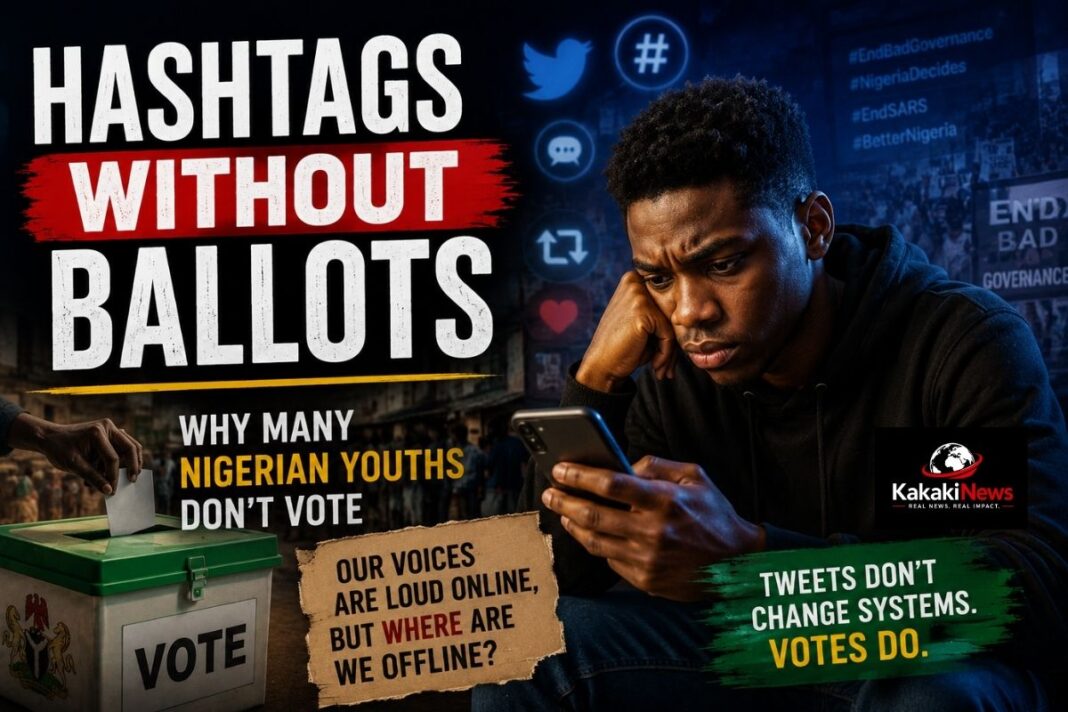

Across the globe, Nigerian youths are arguably the most politically vocal generation in this age. Get on X (formerly Twitter) on any given day, and you will find thousands of young Nigerians dissecting government policies, dragging politicians, debating ideologies and issues, exposing corruption, and creating viral political conversations. From fuel subsidy removal to police brutality, elections, and economic hardship, Nigerian youths dominate the online political space with so much passion and intensity.
Yet, when election day comes, the energy online does not translate into votes at polling units. The Twitter warriors are nowhere to be found.
That contradiction has become one of the biggest puzzles in Nigeria’s democracy: why do Nigerian youths tweet so much about politics but often fail to come out massively to vote?
The answer is complicated, but it starts with frustration.
Many young Nigerians genuinely do not believe the political system works for them. Years of broken promises, corruption scandals, election violence, and economic hardship have created deep distrust in government institutions. To many youths, elections feel less like opportunities for change and more like predetermined competitions between powerful elites.
So instead of seeing voting as meaningful participation, many see tweeting as the only accessible form of political expression left.
Online spaces give young Nigerians something traditional politics rarely offers them: visibility and voice. On social media, a young person with no political connection can trend a topic, challenge a minister, expose bad governance, or mobilise public outrage within hours. During the #EndSARS protests, for example, Nigerian youths demonstrated the enormous political power of digital activism. Twitter Spaces, hashtags, memes, and online campaigns became tools of resistance and mobilisation.
But digital activism and electoral participation are not always the same thing.
Many young Nigerians are politically active emotionally, but not institutionally. Ask them about their local government, and they are lost. They don’t know their ward or local government chairman. They can passionately argue about governance online yet remain disconnected from voter registration, PVC collection, party structures, and grassroots political organisation. Voting requires patience, logistics, transportation, security, and belief in the process. Tweeting only requires data and frustration.
There is also the issue of hopelessness.
After the 2023 elections, many young Nigerians felt emotionally exhausted. A large number believed their preferred candidates represented change, yet the outcome deepened public pessimism. Allegations of irregularities, technical failures, voter suppression, and intimidation reinforced the idea that votes do not truly count. Once people lose faith in elections, political participation naturally shifts from polling units to social media timelines.
Another reason is economic hardship.
In Nigeria today, majority of the youth population is battling unemployment, inflation, and survival pressures. Many people who spend hours discussing politics online are also struggling to afford transport fares or daily meals. On election day, some prioritise work, business, or survival over standing in long queues under the sun for a process they already distrust.
Ironically, politicians understand this disconnect very well. They know online outrage does not always equal electoral danger. A government can survive months of social media criticism if those angry citizens do not organise politically or vote massively. The effect of the outrage on social media may not be felt offline.
There is also the uncomfortable truth that social media sometimes creates the illusion of participation. Posting, reposting, dragging politicians, and joining online trends can make people feel politically engaged even when they are not taking concrete civic action offline. In some cases, outrage becomes performance rather than participation.
Still, it would be unfair to dismiss Nigerian youths as politically unserious. The real issue is not apathy alone; it is disillusionment. Many young Nigerians care deeply about the country, but years of disappointment have weakened their faith in politicians and democratic institutions.
The danger, however, is that when youths stop believing in voting, democracy itself becomes weaker. Social media can shape conversations, but it cannot replace ballots. Hashtags can pressure leaders, but they cannot formally remove them from office.
At some point, Nigerian youths would have to decide whether politics will remain something they mostly perform online or something they fully confront at the ballot box. Because in the end, governments are not changed by tweets alone. And political participation and decision is beyond online pontifications.


