

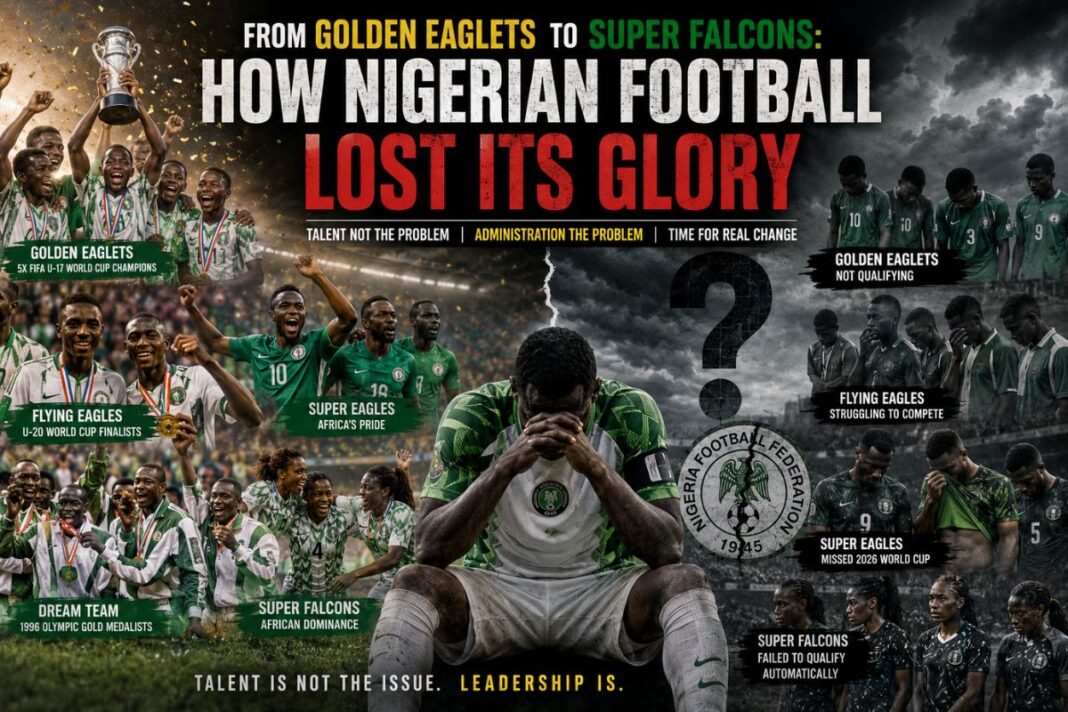

There was a time when Nigerian football inspired fear, respect and admiration across the world. The Golden Eaglets were the undisputed kings of age-grade football, winning a record five FIFA U-17 World Cups. The Flying Eagles regularly challenged the best teams on the planet and reached two FIFA U-20 World Cup finals. The Dream Team stunned Brazil and Argentina to win Olympic gold in 1996. The Super Eagles became a permanent fixture at the FIFA World Cup, while the Super Falcons dominated African women’s football for decades.
Today, that glorious history feels like a distant memory.
The reality is grim. The Golden Eaglets are no longer qualifying for major tournaments. The Flying Eagles have struggled to maintain their traditional status as one of Africa’s leading youth teams. The Super Eagles failed to qualify for the 2026 FIFA World Cup despite the tournament being expanded to 48 teams. Even the Super Falcons, once regarded as the queens of African football, recently failed to secure automatic qualification for the 2027 FIFA Women’s World Cup.
The question Nigerians must ask is simple: How did a nation blessed with enormous football talent become a serial underachiever?
The answer lies not in a lack of talent but in chronic administrative failure.
Football administration is often invisible when teams are winning. Goals, trophies and star players attract the headlines. Yet behind every successful football nation is a strong administrative structure that plans, develops and sustains success. Unfortunately, the Nigeria Football Federation (NFF) has increasingly become associated with instability, controversies, poor planning and recurring crises.
You may also like;
- The Goalkeeper Who Ended Nigeria’s Dream Now Breaks Morocco’s Heart: Cameroon Reach the WAFCON 2026 Final
- 35 Years Over: Nigeria Miss the FIFA Women’s World Cup for the First Time Ever After 2-1 Defeat to South Africa
- Nnadozie’s Error, Madugu’s Gamble and Bihina’s Brilliance: Three Moments That Ended Nigeria’s WAFCON Campaign
- Revenge or Regret? Nigeria vs South Africa World Cup Play-Off Preview: Everything the Super Falcons Must Do on August 13
The signs of decline did not begin today. For years, stakeholders have complained about inconsistent policies, frequent coaching changes, delayed payments, poor grassroots development and the neglect of the domestic league. The consequences are now impossible to ignore. Nigeria has missed successive FIFA World Cups despite possessing some of the finest footballers in Europe. Analysts have repeatedly pointed to administrative failures, coaching instability and off-field disruptions as key factors behind the country’s decline.
Indeed, one of the most embarrassing episodes during Nigeria’s World Cup qualification campaign involved disputes over unpaid allowances and bonuses, leading players and officials to boycott training shortly before a crucial playoff match. Such incidents would be unthinkable in countries with serious football governance structures.
What makes the situation more painful is that Nigeria’s problem is not a shortage of talent. Victor Osimhen, Ademola Lookman, Calvin Bassey, Alex Iwobi and dozens of other Nigerian players feature in some of the world’s most competitive leagues. Yet individual brilliance has repeatedly failed to compensate for institutional weakness. As many observers have noted, this is not a talent crisis; it is a leadership crisis.
The collapse of youth football is perhaps the most alarming indicator.
Nigeria built its football reputation through a strong youth development pipeline. The Golden Eaglets produced generations of stars who graduated into the Flying Eagles, the Olympic teams and eventually the Super Eagles. Today, that pipeline is broken. The once-feared Golden Eaglets have failed to qualify for major tournaments, including recent U-17 continental and global competitions. The Flying Eagles have also struggled to meet expectations, raising serious concerns about the future of Nigerian football.
When youth teams stop winning and stop qualifying, it is not merely a sporting problem. It signals a structural failure in talent identification, coaching, grassroots development and long-term planning.
Another major casualty of poor administration is the domestic league.
No football nation can consistently succeed without a vibrant local league. Europe remains the gold standard because its clubs develop players, coaches, referees and administrators. Nigeria, however, has allowed its domestic football ecosystem to deteriorate. Poor facilities, inadequate marketing, irregular scheduling, low attendance and weak youth structures have reduced the league’s ability to produce elite talent consistently. Stakeholders have repeatedly warned that the weakening of the Nigeria Premier Football League is directly affecting the national teams.
The irony is that football remains Nigeria’s most powerful unifying force. In a country divided by ethnicity, religion and politics, football has historically provided moments of collective pride. From Rashidi Yekini’s iconic goal celebration in 1994 to Nwankwo Kanu’s heroics in Atlanta, football gave Nigerians something to believe in.
Yet football cannot thrive on nostalgia.
Data, infrastructure, coaching development, financial accountability and strategic planning increasingly drive modern football. Countries with far fewer resources than Nigeria have overtaken us because they have invested in systems rather than personalities. Nations such as Morocco, Senegal, and even smaller football countries have demonstrated what can happen when administration supports talent rather than obstructs it.
The recurring controversies surrounding football governance in Nigeria also deserve attention. Critics have repeatedly accused football administrators of treating the federation as a political structure rather than a development institution. Concerns about accountability, transparency and the concentration of influence among a small circle of football power brokers continue to dominate discussions about the future of the game.
This is why the current moment should be viewed as an opportunity rather than merely a crisis.
The NFF recently established a fact-finding committee to investigate the poor performance of national teams. While that is a welcome step, Nigerians have seen committees come and go without meaningful reforms. What is needed now is not another report gathering dust on a shelf but genuine structural transformation.
First, football administration must become more professional and less political. Positions within the football federation should be occupied by competent individuals with proven expertise in sports management, finance, marketing and development.
Second, grassroots football must return to the centre of national planning. School sports, community competitions and youth academies should be strengthened and properly funded.
Third, the domestic league requires urgent revitalisation through better infrastructure, improved sponsorship models and stronger governance.
Fourth, coaching development must become a national priority. Successful football nations invest heavily in educating coaches because talent alone is not enough.
Finally, transparency and accountability must become non-negotiable principles. Every naira allocated to football development should be traceable. Every programme should have measurable outcomes.
The decline of Nigerian football did not happen overnight. It was the result of years of neglect, poor decisions and administrative failures. Likewise, recovery will not happen overnight.
However, the first step toward recovery is honesty.
The current state of Nigerian football cannot be blamed on players alone, coaches alone or bad luck. When the Golden Eaglets are failing, the Flying Eagles are struggling, the Super Eagles are missing World Cups and the Super Falcons are losing their continental dominance, the problem is bigger than any single team. It points to a system that is no longer functioning effectively.
Nigerians do not lack football talent. They never have. What Nigerian football lacks today is competent, visionary and accountable leadership capable of transforming potential into success.
Until that changes, the trophies will remain memories, the World Cups will continue without Nigeria, and the giant of African football will keep watching others celebrate the glory that once belonged to it.