

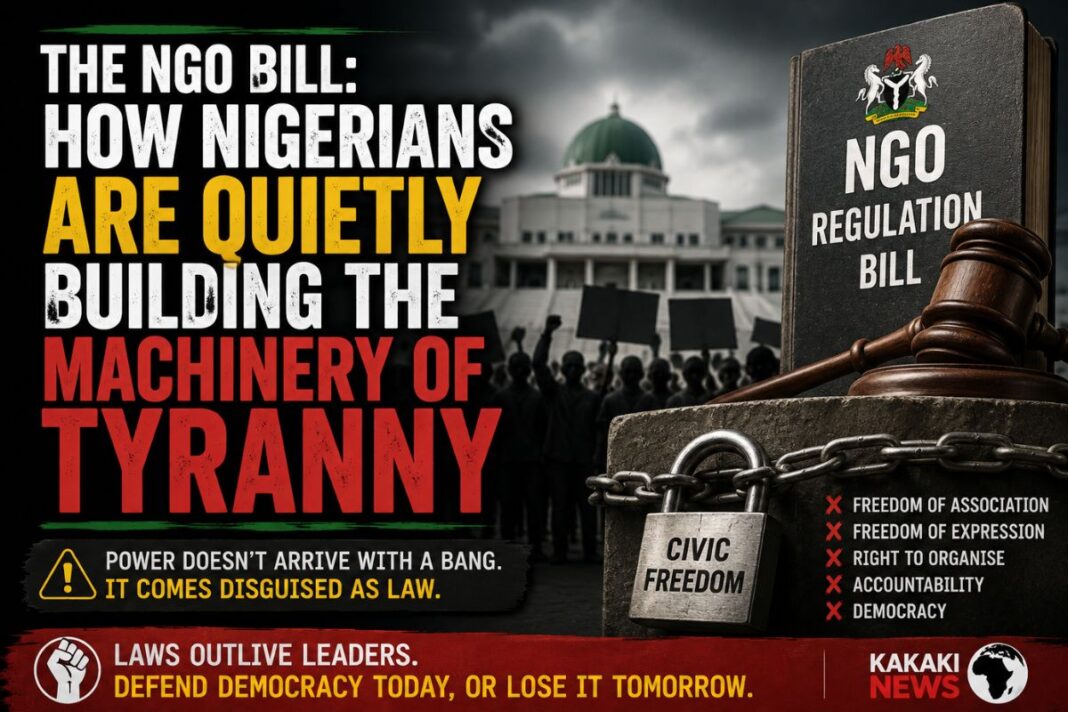

Many Nigerians have become accustomed to blaming President Bola Ahmed Tinubu for virtually every development that appears to threaten democratic freedoms in the country. Whether it is concerns about shrinking civic space, increasing executive influence, or fears of authoritarian tendencies, the President is often the first and only target of public criticism.
But a more uncomfortable question deserves to be asked: Are we paying enough attention to the institutions, laws, and structures that make authoritarianism possible in the first place? It is easy to say that the bulk falls on the table of the president, but other institutions influence our lives and living day after day.
The debate surrounding the proposed NGO Regulation Bill presents one of those moments when Nigerians must decide whether they are genuinely committed to protecting democracy or merely interested in complaining after the damage has been done.
For all the criticism directed at political leaders, history teaches us that authoritarianism is rarely born overnight. Dictatorships are not usually established with tanks rolling through the streets or dramatic declarations ending democracy. They often emerge gradually, through laws passed in legislative chambers, regulations introduced in the name of national security, and policies that seem harmless until they are placed in the hands of those willing to abuse them.
You may also read;
- When the Mob Becomes Judge, Jury and Executioner
- FAAC Windfall and the Missing Development Dividend: What Are Nigerian Governors Doing With the Money?
- When the Pepper Reaches the Pepper Seller’s Eye: The Lessons Nigeria Keeps Refusing to Learn
- Breasts Are Not Chests: Why Berlin’s Topless Swimming Rule Is a Step Too Far
That is why the proposed NGO Regulation Bill should concern every Nigerian, regardless of political affiliation, religion, ethnicity, or ideology.
At first glance, the bill may appear reasonable. Supporters argue that non-governmental organisations should be regulated to ensure transparency, accountability, and compliance with national laws. They insist that organisations receiving local and foreign funding should be properly monitored to prevent financial crimes, money laundering, and activities that may threaten national security.
Those objectives sound noble.
The problem, however, lies not in the stated intentions but in the powers the bill seeks to create.
According to reports, the proposed legislation would require NGOs and civil society organisations to obtain government registration, renew that registration periodically, and secure approvals for certain activities. More troubling is the provision that allows the suspension or cancellation of registrations, including on the recommendation of security agencies.
That should set off alarm bells across the country.
Civil society organisations exist precisely because governments need oversight. They monitor elections, expose corruption, advocate for vulnerable communities, defend human rights, challenge unlawful government actions, and amplify voices that may otherwise go unheard.
In every healthy democracy, NGOs serve as watchdogs.
How can a watchdog remain independent when the subject of its scrutiny controls whether it survives?
That is the fundamental contradiction at the heart of the proposed legislation.
Imagine an anti-corruption organisation investigating a powerful government official. Imagine a human rights group documenting abuses by state actors. Imagine an election-monitoring body exposing irregularities during a national poll.
Now imagine that these same organisations must depend on government approval to continue operating.
Can they truly be independent? Can they freely criticise government policies? Can they fearlessly investigate wrongdoing? Can they expose corruption without worrying that their registration might suddenly be suspended? The answer is obvious.
Even if such powers are never exercised, their mere existence creates a climate of fear and self-censorship. Organisations may begin to avoid controversial issues. Activists may soften their criticism. Researchers may hesitate before publishing uncomfortable findings.
The result is not accountability. It is compliance. And compliance is often the first casualty of democratic freedom.
What makes this situation particularly dangerous is that many Nigerians are viewing the bill solely through the lens of current politics.
Some assume that because the legislation is emerging during the Tinubu administration, opposition to it is simply another chapter in the ongoing political contest between supporters and critics of the government.
That would be a grave mistake.
This issue is much bigger than President Tinubu. It is bigger than the All Progressives Congress (APC). It is bigger than the current National Assembly. Laws outlive governments. Presidents come and go. Governors leave office. Legislators lose elections. Political parties rise and fall. But laws remain.
The powers created today may be exercised by entirely different people tomorrow. History is filled with examples of leaders who established powerful legal tools believing they would only be used for noble purposes, only for those same tools to be weaponised by future administrations.
Once a government acquires excessive powers, there is no guarantee those powers will always be exercised responsibly.
Indeed, experience suggests the opposite. The real danger therefore is not who controls the machinery today. The danger is that the machinery is being built at all.
Unfortunately, Nigerians have a troubling habit of ignoring threats while they are being constructed and protesting only after they have become reality.
We often watch legislation move through committees, public hearings, and parliamentary debates with little public engagement. We assume someone else will speak up. We expect civil society groups to fight the battle alone. We dismiss concerns as alarmist.
Then, when the consequences become obvious, we complain bitterly. By then, however, the damage has already been done.
Democracy is not preserved through hindsight. It is protected through vigilance. It survives because citizens recognise threats early and respond before those threats become law. The proposed NGO Regulation Bill represents precisely such a moment. This does not mean NGOs should operate without accountability. Far from it.
Any organisation handling public funds or donor resources should be transparent. Financial reporting requirements should be enforced. Laws against terrorism financing, money laundering, fraud, and financial misconduct should be respected. Regulatory agencies should investigate genuine wrongdoing wherever it occurs.
But Nigeria already possesses numerous legal frameworks that address these concerns.
The Corporate Affairs Commission regulates registration.
The Financial Reporting Council oversees reporting obligations.
The Economic and Financial Crimes Commission investigates financial crimes.
The Independent Corrupt Practices Commission addresses corruption-related offences.
Anti-money laundering laws already exist.
Counter-terrorism financing regulations are already in place.
If gaps exist, those gaps can be addressed without granting government the power to determine which civil society organisations deserve to exist.
The distinction is crucial. Accountability is not the same thing as control. Transparency is not the same thing as intimidation. Regulation is not the same thing as licensing dissent. A democratic government should welcome scrutiny, not seek mechanisms that could potentially suppress it.
Strong democracies thrive because independent institutions are allowed to challenge authority. They thrive because journalists investigate government actions. They thrive because civil society organisations raise uncomfortable questions. They thrive because citizens can organise freely without fearing administrative retaliation.
When those freedoms are weakened, democracy itself becomes weaker. This is why the debate over the NGO Bill should not be left to activists alone. The media should speak out. Professional associations should speak out. Labour unions should speak out. Religious organisations should speak out. Student groups should speak out. Ordinary citizens should speak out. This is not merely a battle for NGOs. It is a battle for civic freedom itself.
Today the target may be civil society organisations. Tomorrow it could be professional associations. The next day it could be independent media organisations. The day after that it could be religious groups or community organisations. Freedom rarely disappears all at once. It is often eroded one regulation at a time. One restriction at a time. One law at a time. One silence at a time.
If Nigerians remain indifferent while these powers are being created, we will have little moral authority to complain when those same powers are eventually abused. At that point, blaming President Tinubu alone or the National Assembly alone, or political parties will not be enough. We will be forced to confront a painful truth: that we saw the warning signs and chose silence. We watched the architecture of repression being designed. We observed the foundations being laid. We witnessed the walls going up. We saw the door being installed. And we did nothing.
Future generations may then ask why we failed to act when we still had the opportunity. Why we remained silent when our voices mattered. Why we surrendered freedoms that others struggled to secure. Why we accepted restrictions that could have been resisted. Then, their questions would be difficult to answer.
The time to act is now, while the bill is still a proposal and not yet a permanent feature of Nigeria’s legal landscape.
Citizens should engage their representatives. Professional bodies should make formal submissions. Media organisations should educate the public about the implications of the legislation. Civil society groups should mobilise peaceful opposition. Every stakeholder who values democratic governance should insist that accountability must never become a disguise for control.
Because once the machinery of repression is built, nobody can guarantee who will operate it in the future, or who its victims will be.
And if this bill becomes law through public silence and indifference, Nigeria may eventually discover that the greatest threat to freedom was not a particular president or political party.
It was our collective failure to defend democracy when democracy needed defending.