

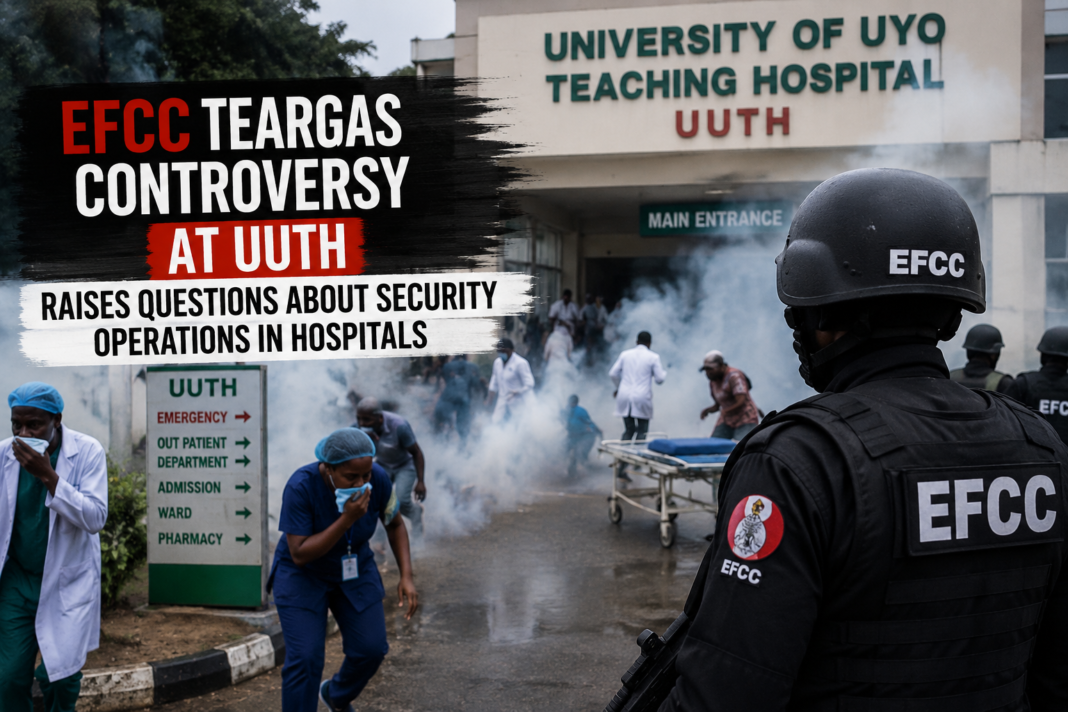

Tuesday, May 12 2026 remains an unforgettable day in the annals of Akwa Ibom state history. The events that unfolded at the University of Uyo Teaching Hospital (UUTH) on that fateful day have continued to generate outrage across Nigeria’s medical and civil society communities. What the Economic and Financial Crimes Commission (EFCC) described as a “routine visit” to the hospital quickly degenerated into a national controversy after operatives reportedly deployed teargas within the hospital premises, causing panic among patients, healthcare workers, and visitors.
For many Nigerians, the incident raised serious questions about operational conduct, respect for medical institutions, and the protection of vulnerable citizens during law enforcement activities.
According to eyewitness accounts, EFCC operatives arrived at the hospital premises during an investigation believed to be connected to certain administrative matters. While the anti-graft agency later insisted that the visit was lawful and routine, events soon spiralled out of control after security tensions reportedly erupted between operatives and individuals within the hospital environment.
The situation became chaotic when teargas canisters were allegedly fired within or around sections of the hospital. Patients, some already battling critical illnesses, were thrown into confusion. Relatives and healthcare workers scrambled for safety as panic spread across the medical facility.
There were reports that some patients who had respiratory-related ailments suffered severe complications due to exposure to the gas. Witnesses recounted scenes of confusion in wards where oxygen-dependent patients struggled to breathe amid the contamination of the air. Medical personnel reportedly battled to stabilise patients while simultaneously trying to calm frightened families.
In the aftermath of the incident, allegations emerged that some patients died following the disruption caused by the operation. Though investigations into the exact circumstances surrounding the deaths remain ongoing, the incident triggered widespread anger among healthcare professionals who argued that no law enforcement activity should compromise the sanctity of a medical facility.
Doctors at the institution subsequently embarked on strike action to protest what they described as an invasion of the hospital environment and an unacceptable endangerment of lives. The strike further disrupted medical services, compounding the suffering of patients who relied on the teaching hospital for treatment.
As public outrage intensified, the Akwa Ibom State Government intervened by convening meetings with all relevant stakeholders, including hospital management, medical associations, and security agencies. The intervention aimed to restore calm, address grievances, and prevent a complete breakdown of healthcare services at the institution.
Faced with mounting criticism, the EFCC bowed and later issued an apology over the incident. While the agency maintained that its presence at the hospital was legitimate, it acknowledged that the operation led to regrettable consequences and expressed concern over the disruption caused.
However, many observers believe the apology, though necessary, does not erase the serious concerns raised by the operation itself. Lives have been lost, and many have been made bereaved.
Across the globe, hospitals are regarded as protected spaces because they house the sick, the weak, and the vulnerable. Under international humanitarian principles, including provisions associated with the Geneva Conventions, medical facilities enjoy special protections and should never become theatres of aggressive security operations except under extremely limited circumstances. Even during armed conflicts, attacks or hostile actions within hospitals are heavily restricted because of the catastrophic risks posed to patients and medical personnel.
Critics argue that the deployment of teargas in or around a functioning hospital demonstrated a troubling lapse in operational judgment by the EFCC. Law enforcement agencies are expected to balance enforcement duties with public safety considerations, especially in sensitive environments such as hospitals, schools, and places of worship.
The UUTH incident has therefore become more than just a controversy involving one agency and one hospital. It has evolved into a broader conversation about professionalism, proportionality, and accountability in Nigeria’s security operations.
Many Nigerians are now demanding clearer operational protocols for security agencies conducting activities in sensitive public institutions. Experts insist that agencies must adopt conflict-de-escalation strategies and ensure that enforcement actions do not endanger innocent citizens.
The incident also serves as a reminder that the fight against corruption, no matter how important, must never come at the expense of human life and dignity. Security operations carried out without adequate caution can undermine public trust and inflict irreversible harm on the very citizens the government is meant to protect.
For the victims, healthcare workers, and families affected by the UUTH incident, the scars may linger long after the headlines fade. The challenge now is whether authorities will learn from the tragedy and implement reforms capable of preventing such operational failures in the future.
The controversy surrounding the University of Uyo Teaching Hospital incident is not the first time the EFCC has faced criticism over its modus operandi. Over the years, the agency has repeatedly come under public scrutiny for aggressive raids, late-night arrests, and the use of excessive force during operations. Several past incidents involving mistaken identity, harassment of innocent citizens, invasion of private residences, and heavy-handed treatment of suspects have sparked debates about professionalism and adherence to human rights standards.
In some cases, operatives were accused of storming hostels, hotels, and residential estates with armed force, creating panic among residents and bystanders. Human rights advocates and concerned citizens have consistently argued that while the war against anti-corruption is important, law enforcement agencies must operate within the bounds of civility, proportionality, and respect for public safety. The events at UUTH have therefore reinforced long-standing concerns about whether the EFCC’s operational culture adequately prioritizes caution and the protection of innocent lives during enforcement activities.


