

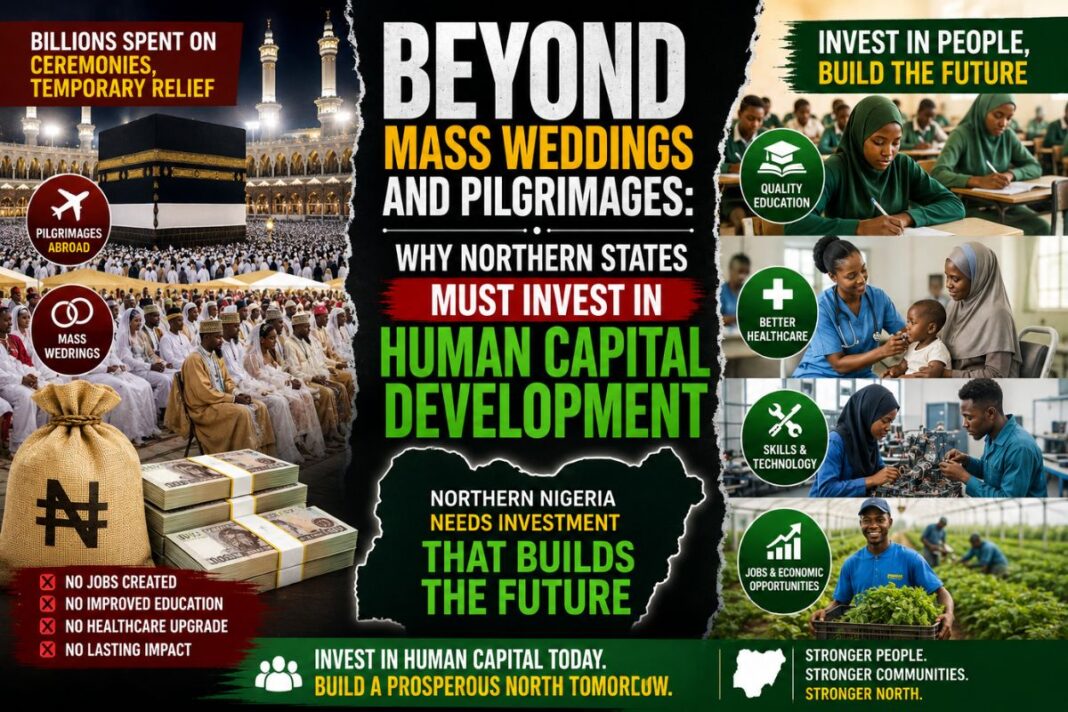

It is now a ritual for several state governments in Northern Nigeria spend billions of naira sponsoring citizens to perform pilgrimage to Mecca and Jerusalem. Many of the same states also organise mass weddings for hundreds or thousands of couples, often at government expense. The events are celebrated with fanfare. Politicians receive applause.
Religious leaders offer prayers. The beneficiaries express gratitude.
Yet, beyond the ceremonies and photographs, a difficult question remains: what happens after the wedding and after the pilgrimage? Does a sponsored trip to Mecca create jobs for unemployed youths? Does it improve literacy rates among children? Does it reduce maternal mortality? Does it equip young people with digital skills needed in the twenty-first century? Does it solve the challenge of millions of out-of-school children roaming the streets across Northern Nigeria?
The answer is obvious.
You may also like;
- Imole Shines On: Ademola Adeleke Wins Osun 2026 Governorship Election With 511,067 Votes to Beat APC’s Oyebamiji
- When the Mob Becomes Judge, Jury and Executioner
- Why Nigerians Naturally Turn to Prayer During Crisis and Why Action Still Matters
- FAAC Windfall and the Missing Development Dividend: What Are Nigerian Governors Doing With the Money?
While religion and culture remain important aspects of society, governments exist primarily to provide public goods, improve living standards and create opportunities for citizens. Unfortunately, many Northern states appear trapped in a cycle where symbolic religious and cultural programmes often receive more political attention than investments in human capital development.
You don’t need to go far to behold the glaring consequences across the region.
According to various reports by international development agencies, Northern Nigeria continues to record some of the country’s worst indices in education, healthcare, poverty, nutrition and gender development. Several states in the region consistently rank low on human development indicators. Millions of children remain out of school. Maternal and infant mortality rates remain alarming. Youth unemployment is widespread. In many communities, access to quality healthcare is still a luxury.
These realities should concern leaders far more than the number of pilgrims sponsored annually or the number of couples married under government-funded programmes. No society develops by prioritizing ceremonies over capacity building. The world’s most prosperous societies did not become successful because their governments financed religious pilgrimages. They became prosperous because they invested heavily in education, healthcare, science, technology, skills acquisition and economic productivity.
Countries such as Singapore, South Korea and Malaysia were once poorer than many developing nations today. Their leaders understood that human beings are the most valuable resources any nation possesses. They therefore invested aggressively in schools, technical education, healthcare systems and innovation.
Today, the results speak for themselves.
Northern Nigeria possesses one of Africa’s largest youth populations. This should be a tremendous advantage. Instead, it is gradually becoming a burden because millions of young people lack access to quality education, vocational training and employment opportunities.
Imagine if the billions spent annually on pilgrimages were partly redirected towards scholarships for indigent students. Imagine if those funds were invested in modern technical colleges, digital innovation hubs, agricultural training centres and entrepreneurship programmes. Imagine if every local government area had functional libraries, science laboratories and skills acquisition centres.
The long-term impact would be transformational. A young graduate trained in software development can create jobs for others. A skilled technician can contribute to industrial growth. A well-trained farmer can improve food security. A healthy and educated population attracts investment and stimulates economic activity.
The same cannot be said for a government-sponsored pilgrimage, no matter how spiritually rewarding it may be for participants. Similarly, mass weddings may offer temporary relief to some families, but they do not address the underlying economic conditions that make marriage difficult in the first place.
The challenge facing many young people is not merely the cost of wedding ceremonies. It is unemployment, poverty, and economic uncertainty. A young man with a stable income and decent living conditions is more likely to marry and sustain a family without government intervention.
Rather than spending hundreds of millions on wedding ceremonies, governments should focus on creating the economic environment that enables citizens to thrive independently.
This is not an argument against religion.
Religion remains a powerful force for moral guidance, social cohesion and community development. Northern Nigeria is deeply religious, and that reality deserves respect. However, governance and religion must not be confused.
The responsibility of government is not to compete with religious organisations. Mosques, churches and faith-based groups already perform spiritual functions. Government’s primary role is to build roads, provide education, ensure healthcare, create economic opportunities and guarantee security.
When governments spend excessive public resources on activities that religious institutions can organise independently, they risk neglecting their constitutional responsibilities. There is also the issue of sustainability. Year in, year out, states allocate fresh funds for pilgrimages and mass weddings. The programmes must be repeated because they do not create lasting solutions. In contrast, investments in education and healthcare generate benefits that last for generations.
A child educated today may become a doctor tomorrow. A doctor can save thousands of lives over a career spanning decades. A girl empowered through education is more likely to delay early marriage, raise healthier children and contribute meaningfully to the economy. A vocational centre established today can continue producing skilled workers for many years.
These are investments with enduring returns.
Northern leaders must also recognise the growing global competition for talent and innovation. The world is changing rapidly. Artificial intelligence, automation and digital technologies are reshaping economies. Nations that fail to invest in human capital risk being left behind.
The future will not be determined by the number of sponsored pilgrims a state sends abroad. It will be determined by the quality of its schools, universities, hospitals, research institutions and workforce.
Young people in Kano, Kaduna, Sokoto, Borno, Katsina, Bauchi, Jigawa, Zamfara, Kebbi and other Northern states deserve more than symbolic programmes. They deserve quality education, modern healthcare, reliable infrastructure and meaningful opportunities.
The region’s development challenges are too urgent to be addressed through cultural sentiment or religious populism. Poverty does not disappear because people embark on pilgrimage. Illiteracy is not cured through mass weddings. Insecurity cannot be defeated through ceremonial programmes.
What Northern Nigeria needs is a deliberate shift in priorities. Governors should measure success not by the number of couples married under government sponsorship or the number of pilgrims transported abroad, but by the number of children enrolled in school, the reduction in maternal deaths, the number of jobs created, the quality of healthcare services delivered and the improvement in living standards.
History will not remember leaders for sponsoring the largest pilgrimage contingent. It will remember those who transformed the lives of their people through visionary investments in human capital.
The North has enormous potential. It has abundant land, a youthful population, rich cultural heritage and strategic economic importance. However, unlocking that potential requires courageous leadership willing to move beyond short-term political applause and invest in long-term development.
The future prosperity of Northern Nigeria depends not on how much is spent on ceremonies, but on how much is invested in people. And there is no better time to begin than now.