

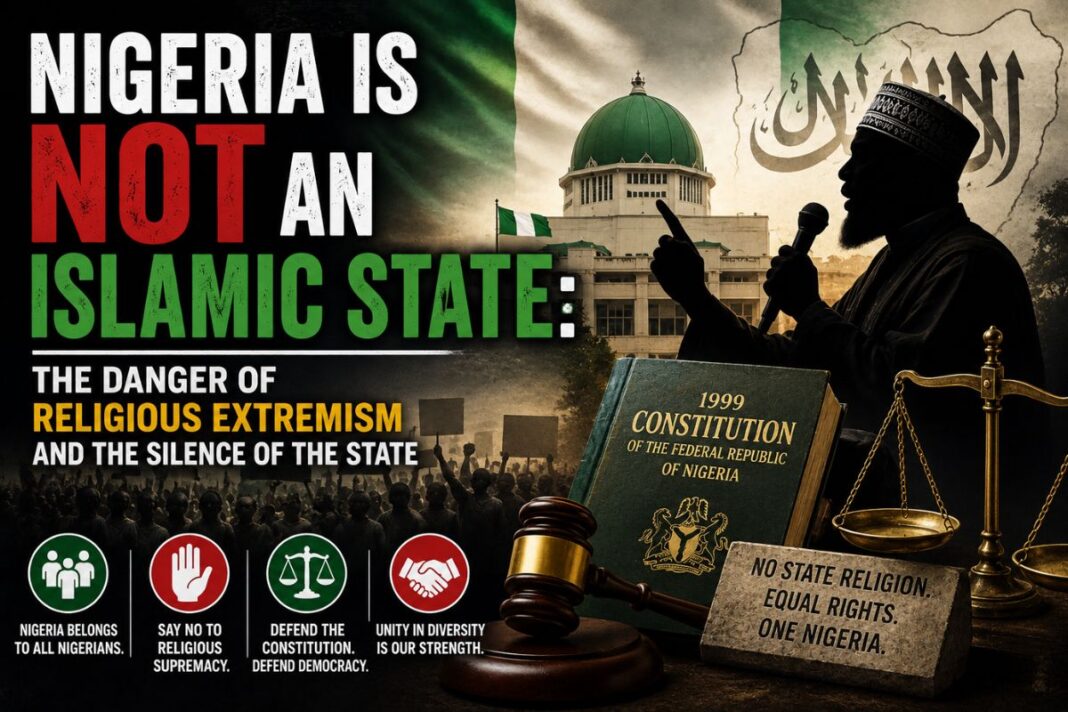

Nigeria is once again confronted with a familiar and troubling question: How should a democratic nation respond when influential religious leaders make statements that appear to challenge the constitutional foundations of the state?
The controversy surrounding reported comments by prominent Islamic cleric Sheikh Yahaya Jingir has reignited a debate that has simmered beneath the surface for decades. According to widely circulated reports and videos, the cleric defended the Muslim-Muslim presidential ticket and reportedly suggested that Nigeria is a Muslim country while urging support for similar political arrangements in future elections. The remarks have generated strong reactions from political leaders, religious organisations, and civil society groups, many of whom fear that such rhetoric deepens religious divisions in an already fragile nation.
At the heart of the controversy lies a fundamental constitutional fact: Nigeria is not an Islamic state. Neither is it a Christian state.
Nigeria is a secular constitutional republic governed by laws enacted under the Constitution of the Federal Republic of Nigeria. While the Constitution does not expressly use the word “secular,” its provisions make the intention unmistakably clear.
Section 10 of the 1999 Constitution states: “The Government of the Federation or of a State shall not adopt any religion as State Religion.”
Those seventeen words represent one of the most important safeguards in Nigeria’s democratic framework. They were deliberately inserted to protect the country’s religious diversity and prevent the domination of one faith over others.
Nigeria is home to millions of Muslims, millions of Christians, and adherents of traditional religions and other beliefs. The Constitution recognises them all as equal citizens under the law.
Section 38 further guarantees freedom of thought, conscience, and religion, including the freedom to change one’s religion or belief and the freedom to manifest and propagate it.
Section 42 prohibits discrimination on the grounds of religion, ethnicity, place of origin, sex, or political opinion.
Taken together, these provisions establish a simple principle: the Nigerian state belongs to all Nigerians, not to adherents of a particular faith.
Any suggestion that Nigeria is constitutionally an Islamic state is therefore inconsistent with the express provisions of the Constitution.
You may also like;
- When Nigeria’s Prisons Become Content Studios
- When the Mob Becomes Judge, Jury and Executioner
- Why Nigerians Naturally Turn to Prayer During Crisis and Why Action Still Matters
- The Man Who Never Cried — A Story About Men, Mental Health, and the Silence That Kills
This is why comments that appear to elevate one religion above others are not merely political statements. They strike at the foundation of national unity.
The danger becomes even greater when such statements are made by influential clerics with large followings.
Religious leaders wield enormous influence in Nigeria. In many communities, especially in Northern Nigeria, a cleric’s words carry more weight than those of politicians, academics, judges, or journalists. Consequently, public pronouncements by religious figures can shape political attitudes, electoral behavior, and interfaith relations.
When such influence is deployed responsibly, it promotes peace and social harmony. In the same vein, when it is deployed recklessly, it can inflame tensions and reinforce extremist narratives.
Nigeria has paid a terrible price for religious extremism. From the Maitatsine uprisings of the 1980s to the Boko Haram insurgency that has claimed tens of thousands of lives, the country has repeatedly witnessed the consequences of ideological radicalization.
The Boko Haram movement itself began with ideas that rejected aspects of the Nigerian state and constitutional order before eventually degenerating into one of Africa’s deadliest terrorist organisations.
History teaches a painful lesson: extremist ideas rarely become dangerous overnight. They gain legitimacy gradually when society fails to challenge them at their earliest stages.
This is where the role of the security agencies becomes relevant.
Critics have frequently accused successive governments and security agencies of applying double standards in dealing with religious extremism. Many Nigerians observe that individuals expressing controversial religious or separatist views are often treated differently depending on the identity of the speaker and the ideology involved.
Such perceptions, whether entirely accurate or not, undermine public confidence in state institutions. The duty of agencies such as the Department of State Services (DSS), the Nigeria Police Force, and other intelligence bodies is not to police religious belief. Every Nigerian has a constitutional right to hold and express religious opinions.
However, these agencies have a responsibility to monitor rhetorics that are capable of threatening national security, inciting hostility, or undermining constitutional order.
The state cannot afford to be indifferent when influential voices promote narratives that encourage citizens to view politics primarily through a religious lens.
Silence can be interpreted as approval. It is often seen as consent. Inaction can embolden extremists. Selective enforcement can deepen suspicion among different groups.
This concern is not limited to Sheikh Jingir alone.
Over the years, several public figures have made statements that many Nigerians interpreted as promoting religious supremacy or defending extremist elements.
Among the most controversial has been the role played by cleric Ahmad Gumi in engagements with armed bandits in northern Nigeria. His meetings with bandit leaders generated widespread criticism and sparked debates about whether the state was normalizing criminality by allowing such interactions to occur with minimal official scrutiny. While supporters argued that dialogue could help reduce violence, critics contended that the engagements risked legitimizing groups responsible for mass killings, kidnappings, and terror. The controversy highlighted broader concerns about the state’s inconsistent approach to security challenges.
Whether one agrees with Gumi’s methods or not, the larger issue remains the same: when radical or controversial narratives are not confronted decisively, they gain visibility, legitimacy, and influence.
Equally troubling is the perception that successive governments have sometimes exploited religious identities for political gain. Nigeria’s political history is repleted with examples of politicians who mobilise voters through ethnic and religious sentiments rather than competence, policy, and performance.
The result has been predictable. Instead of debating education, healthcare, economic growth, innovation, and security, public discourse often descends into arguments about whether a candidate is Christian or Muslim.
The Muslim-Muslim ticket debate is itself a reflection of this reality.
Supporters argue that competence should be the sole criterion for political office. Opponents argue that Nigeria’s delicate religious balance requires inclusiveness at the highest levels of government.
Both positions can be debated within democratic norms.
What cannot be justified is the suggestion that political power should permanently belong to one religious group or that citizens who disagree are somehow less entitled to participate in national life.
Democracy is built on equal citizenship. Religious supremacy is incompatible with that principle.
The implications of normalising such rhetoric are profound. First, it risks deepening mistrust between christians and muslims. It could encourage retaliatory extremism from other groups. Also, it weakens national identity by replacing citizenship with religious affiliation as the primary basis of political belonging. It also creates fertile ground for radical organisations seeking to recruit followers. And finally, it distracts the country from the urgent challenges confronting ordinary Nigerians.
At a time when millions struggle with poverty, unemployment, inflation, insecurity, and inadequate public services, Nigeria cannot afford to become trapped in endless religious polarization.
The Constitution already provides a framework for coexistence. What is required is faithful adherence to it.
Religious leaders have every right to participate in public debate, but that right carries responsibilities. They must promote peace, tolerance, and national unity rather than division and exclusion.
Security agencies must apply the law impartially and respond consistently to rhetoric capable of threatening social cohesion. Political leaders must stop exploiting religious sentiments for electoral advantage. And citizens must remain vigilant against attempts to redefine Nigeria along sectarian lines.
The future of Nigeria does not lie in Christian domination. Neither does it lie in Muslim domination. Rather, it lies in constitutional democracy, equal citizenship, and respect for diversity. The Constitution is clear. The law is clear. History is clear. Nigeria belongs to all Nigerians.
Anyone who seeks to elevate one religion above the others is not strengthening the country. They are weakening the fragile bonds that hold it together. And that is a risk the nation ignores at its own peril.